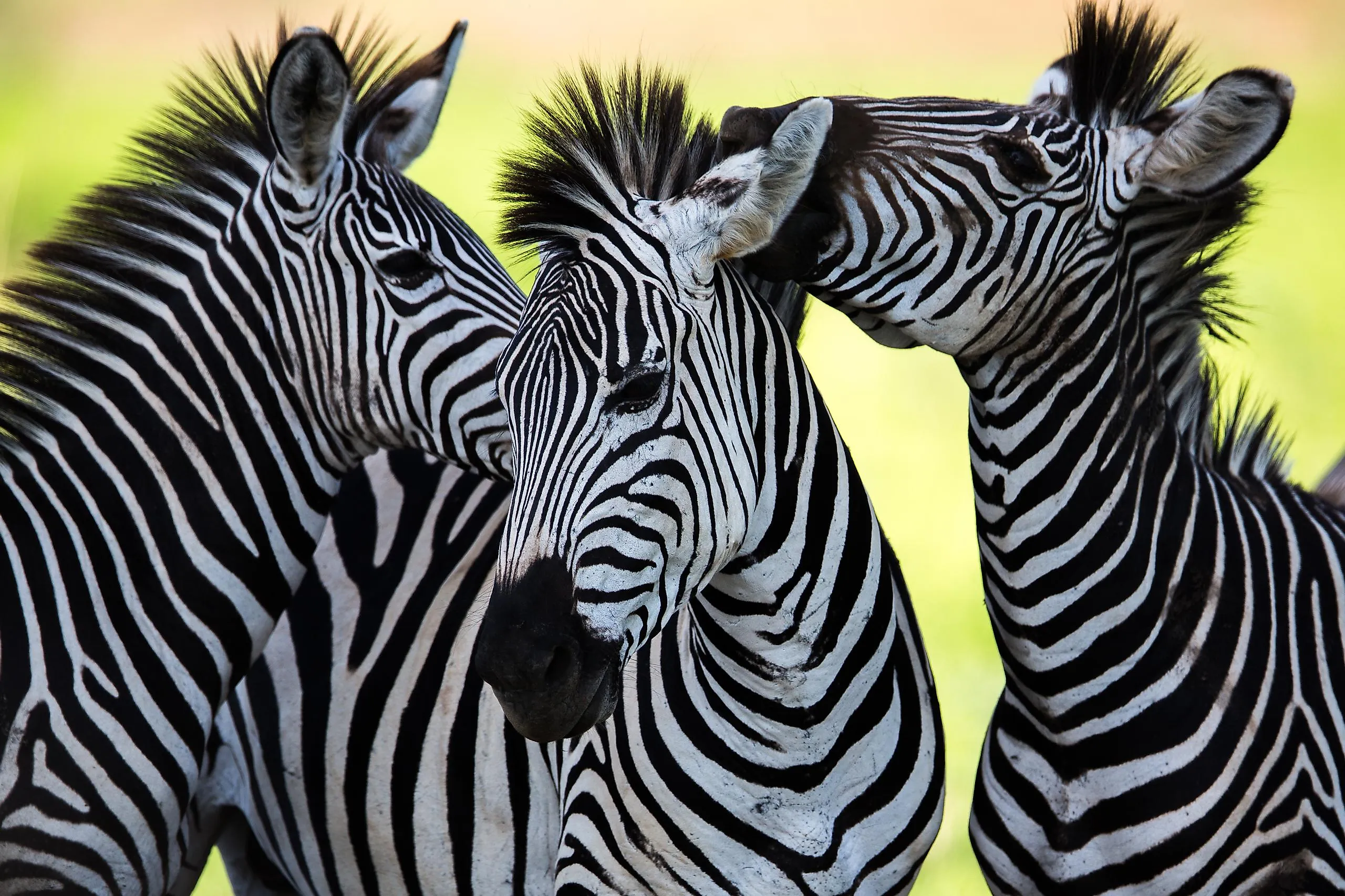
Zebra
One of the most striking mammals in the animal kingdom, zebras are black-and-white African herd animals closely related to the domestic horse. They are sociable animals who bond and travel together, wandering the African plains and savannas while fending off predators with their powerful kick. Fast and feisty, zebras are so much more than their iconic coloring. They can roam hundreds of miles together from one grazing ground to the next, form stable family units, and even chat amongst themselves, communicating with barks, snorts, and grunts. They are also ecosystem engineers, contributing to the health of their habitats for many other species. This makes them a priority for conservationists who have declared January 31 as International Zebra Day. Read on to discover the habits, habitats, and some fun facts about this engaging equine.
Classification, Species, and Subspecies

Zebras belong to the horse family Equidae and the genus Equus, making them close relatives of horses and donkeys. There are three living zebra species, all native to Africa: the plains zebra (Equus quagga), the Grevy’s zebra (Equus grevyi), and the mountain zebra (Equus zebra).
The plains zebra is the most widespread species. Several subspecies have been described, though scientists debate the exact number recognized today. Commonly cited forms include Crawshay’s zebra (E. quagga crawshayi), the half-maned zebra (E. quagga borensis), Grant’s zebra (E. quagga boehmi), Chapman’s zebra (E. quagga chapmani), and Burchell’s zebra (E. quagga burchellii). The quagga (E. quagga quagga), which once lived in South Africa and had reduced striping on its hindquarters, went extinct in the late 19th century.
The mountain zebra has two recognized subspecies: Hartmann’s mountain zebra (E. zebra hartmannae) and the Cape mountain zebra (E. zebra zebra). Grevy’s zebra (E. grevyi), the largest zebra species, is distinct enough that it is not divided into subspecies in modern classifications
Range and Habitat

Zebras are native to over 15 African countries, but while all three species of zebra are found on the African continent, they differ in their preferred habitats. The plains zebra is primarily found in the grasslands of eastern and southern Africa. Grevy’s zebras live in semi-arid environments in Kenya and Ethiopia. Mountain zebras, as their name suggests, prefer the dry upland regions of Namibia and South Africa.
Appearance

Zebras are instantly recognizable thanks to their eye-catching markings, which are unique to each animal. They can also help identify which species the animal belongs to. Plains zebras have wide stripes, set far apart, while a mountain zebra’s stripes are narrower and closely spaced on its head and shoulders but wider apart on the haunches. The Grevy’s zebra has the narrowest stripes of the three, and its belly is pure white.
The zebra’s stripes are formed from the pigment melanin, which determines the color of their fur. Hairs that contain melanin are black, while those that don’t are white. So is the zebra white with black markings or black with white markings? It's the latter, because the black pigment pattern is more pronounced and considered the primary color by biologists. No two zebras have exactly the same stripe pattern. Like fingerprints, a zebra’s markings can be used to identify individual animals.
Plains zebras and mountain zebras are around the same size, measuring up to 4.8 ft tall and weighing around 850 lbs. Males are slightly larger than females. The Grevy’s zebra is larger, growing up to 5.3ft tall and weighing up to 1,000 lbs.
Diet

Similar to horses, zebras are long-legged, sturdy, single-hoofed animals with strong teeth designed to crop and graze on grass. They have a dorsal stripe along their spine, a tasseled tail, and a thick mane. Zebras are herbivores, meaning they only eat plants. It may seem limited, but their diet is actually quite varied as they will eat almost any type of grass, as well as leaves, young trees, and shrubs. They are efficient and adaptable foragers who will travel hundreds of miles for food. They typically migrate during the dry season, when it becomes harder to find water and fresh grass.
Behavior and Reproduction

Zebras are highly sociable animals. They form small family groups known as ‘harems’ that generally consist of a male (the stallion), a few mares, and their young. Harems can sometimes join together to form a large herd, but they retain their own groups, much as different families come together in a community. The major advantage of being part of a large herd is protection from predators who might be tempted to pick off the vulnerable in a small group.
While zebras are considered very nomadic, Grevy’s zebras can be territorial, with the males marking their boundaries. This subspecies is also very independent. Neither males nor females form lasting bonds or stable family groups.
Zebras are surprisingly chatty. They communicate with each other using sounds and facial expressions. Plains zebras have at least six different calls and use these to signal a variety of emotions from happiness to warnings. Zebras will stick their ears upright when greeting each other, but flatten their ears against their heads when they sense danger. Members of harems will also groom one another to reinforce their bond.
Like nearly all mammals (with the platypus as a notable exception), zebras give birth to live young. Their gestation period is 12 to 13 months, and their foals are striped brown and white at birth, with the brown later darkening. Foals imprint on their mothers quickly, knowing their stripe pattern from birth, so they can stick closely to the mare. They are also up on their feet quickly, usually able to run within an hour of birth. Zebras generally live up to 20 years in the wild and up to 40 years in captivity.
Fun Facts About Zebras

- Built for speed, zebras use their long legs to sprint away from predators and can run up to 43 mph.
- Zebras know how to fight. They have a powerful kick they use to fend off lion attacks.
- A 2014 study from UC Davis showed that the zebra’s stripes confuse horseflies and tsetse flies, leading scientists to theorise that their markings are an evolutionary adaptation designed to prevent disease.
- The Grevy’s zebra is named for a former president of France who was gifted a zebra in 1882 by the king of Abyssinia
- The oldest known zebra in captivity is Sandy, a resident of Belfast Zoo in Northern Ireland who celebrated her 40th birthday in 2022.
A Crucial Species

Zebra populations are declining due to disease, predation, habitat loss, and poaching. Zebras are prey for hyenas, crocodiles, and lions, but they are also hunted by humans for their meat and coat. According to The IUCN Red List of Threatened Species, mountain zebras are classified as Vulnerable, the plains zebra is Near Threatened, and the Grevy’s zebra is Endangered.
Protecting zebras is important as these fascinating and resilient animals play a fundamental role in their ecosystems. Zebras are known as "pioneer grazers," meaning their feeding habits help maintain balance among plant species. By foraging on a wide variety of plantlife, zebras help keep invasive species in check. Another ecological benefit of healthy zebra populations is their role in the wider food chain. Herd mammals are important prey species. When their populations thrive, so do the carnivores in their environment.
Zebra Conservation

Zebra conservation efforts are ongoing, led by groups including the International Fund for Animal Welfare, the African Wildlife Foundation, and the Grevy’s Zebra Trust. Projects include establishing safe wildlife corridors where zebras can migrate as needed without fear of poaching or human encroachment. There have also been efforts to promote more sustainable livestock management, as wild zebras are often forced to compete with livestock for grazing grounds.
Conservation efforts are not limited to Africa, however. The Smithsonian Conservation Biology Institute recently welcomed a mountain zebra foal as part of its imperilled species breeding program. Hopefully, initiatives like these, combined with greater public awareness and education, will help reverse the decline in zebra populations and ensure the survival of this unique ungulate.