How The Ottoman Janissaries Became The World's Most Feared Soldiers
Once one of the most powerful empires in the world, the Ottoman Empire stretched from the western end of North Africa to the Balkans. Controlling such a huge swatch of territory wasn’t an accident but occurred over centuries of careful diplomacy and military might. At the tip of the Ottomans’ spear were the Janissaries, an elite unit of soldiers who helped establish Ottoman dominance throughout much of the Mediterranean and Middle East. Read on to find out why the Janissaries commanded so much fear and respect amongst their enemies until their eventual dissolution.
History

Likely founded by Sultan Murad I during the latter half of the 1300s, the Janissaries were formed to be both a personal army loyal to the sultan. Sources vary on where its members were drawn from, however. Some claim they were recruited from prisoners of war or Christian children under Ottoman rule taken as tribute to the state, known as the devşirme system. Regardless, the new recruits would convert to Islam and then undergo training in war tactics and statesmanship. Additionally, the Janissaries became the royal bodyguards of the sultan. Despite their lowly birthright, each Janissary was given a salary and given privileges over time, including upward social mobility and political involvement. However, Janissaries were sworn to celibacy at first, resulting in no children. For their loyalty, they were sometimes given gifts by the sultan himself. When not engaged in warfare, Janissaries were called on to fortify towns on the periphery of the empire and to also enforce the law in Istanbul, the imperial capital. Due to their growing influence, the Janissaries began exerting remarkable domestic power. After the reign of Bayezid II from 1418 to 1512, the Janissary corps routinely demanded that sultans supply extra payment to preserve their continued allegiance. When Osman II attempted to lower their salary, the Janissaries overthrew him, leading to his execution. By the late 17th century, corps had grown to approximately 67,000 in strength.
Battles

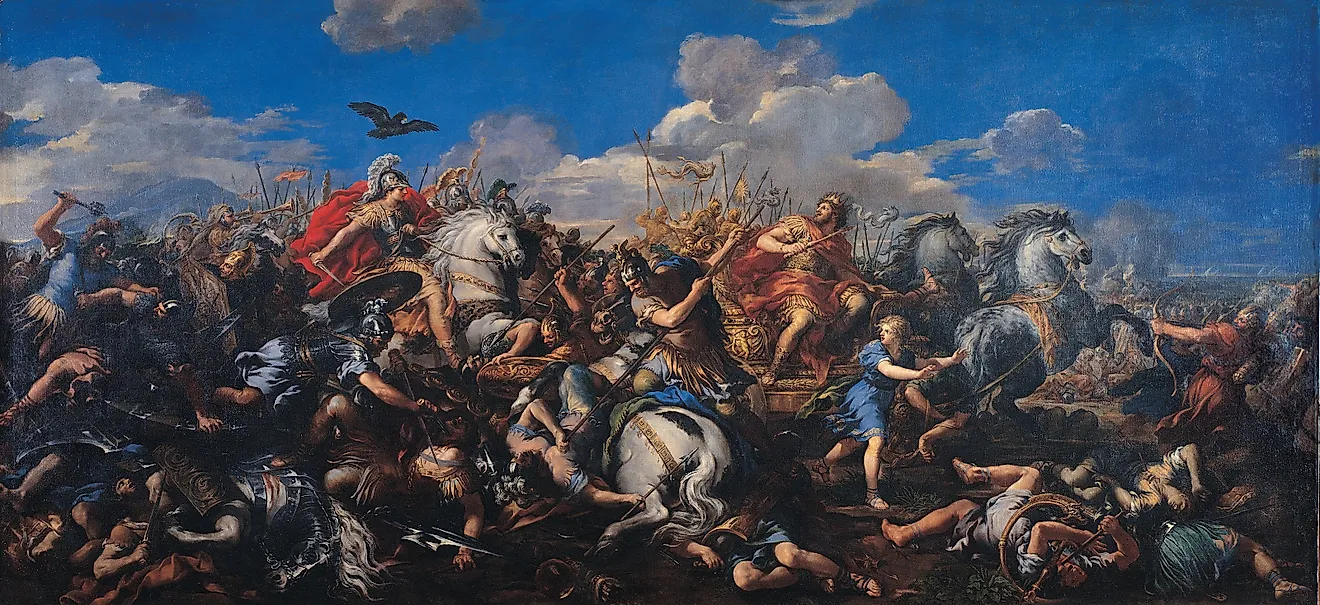
Consequently, the Janissary corps took part in some of the Ottoman Empire’s most vital battles. In 1444, as the empire expanded northward, it came into conflict with the Kingdom of Hungary. At the Battle of Varna, Janissaries aided in defeating Hungary and the Crusaders to establish hegemony over the Balkans. Nine years later, in 1453, the Janissaries arguably played their most pivotal role via the Fall of Constantinople. The capital of the Byzantine Empire, Constantinople, was defended by the imposing Theodosian Walls. Nonetheless, the Janissaries utilized their developed training to overcome the city’s defenses, thus causing the Byzantine Empire to crumble and Ottoman power within Europe to flourish in the process. Finally, the Battle of Mohács in 1526 against Hungary saw Janissary forces once again play a crucial part in Ottoman victory, which subsequently saw both the Kingdom of Hungary fall and the Ottoman Empire move unchecked into Central Europe, where it remained for over a century.
Training

Following their initiation and familiarity with Ottoman culture, boys were trained in soldierly activities, such as sharpshooting, with those demonstrating high proficiency becoming officers. Over the course of their military schooling, they would regularly pray, sleep, and eat together as well, developing a high level of esprit de corps. Furthermore, Janissaries were expected to refrain from growing beards or partaking in activities unrelated to combat. Occasionally, the sultan himself would visit the barracks where the Janissaries resided and interact with them on a personal level, sharing meals at times. These visits contributed to a fatherly dynamic between the sultan and his troops, cementing loyalty and personal endearment. When participating in actual fighting, Janissaries were taught to march to the rhythms of the mehter band, ensuring discipline among the chaotic battlefield.
Equipment

Mustafa Kemal Atatürk wearing the traditional Janissary uniform at a masquerade ball during his early years in the Ottoman army. Public Domain, https://commons.wikimedia.org/w/index.php?curid=1405709
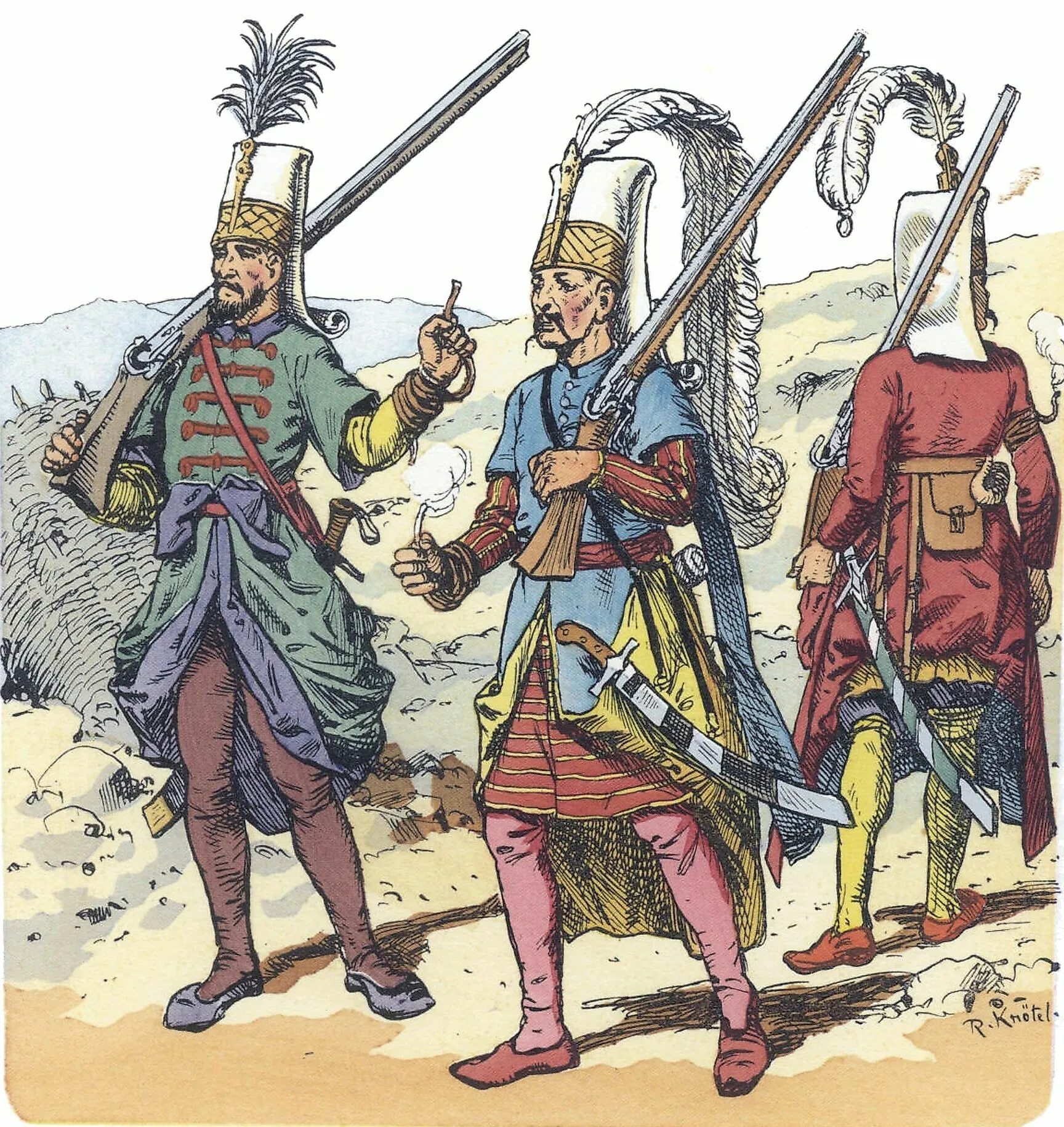
Each Janissary would carry a saber common to the period and also, as Janissaries were considered expert archers, bows and arrows. Beginning in the 15th century, firearms also accompanied Janissaries, one of the first infantry units to carry gunpowder weaponry, heavy trench guns among them. Later on, matchlock muskets became standard weaponry among the Janissary corps. A more peculiar practice was the carrying of a spoon on their hat, attributing the “brotherhood of the spoon” moniker to the Janissaries. In regard to clothing, the standard uniform incorporated loose-fitting trousers and a linen or cotton shirt whose length ended just above the knees. A sash was tied around the upper torso, which could act as a pocket, holding smaller items for everyday use. An outerwear overcoat was also worn. Lastly, the Janissary headgear was made out of tubular white felt, which adorned the head and had material running down the back and ending below the waist.
Decline

The Janissaries' ultimate downfall occurred in the early 19th century after a long series of events and institutional revisions. Janissary actions involving the removal of sultans worried future rulers that their position was perpetually precarious as long as the Janissaries were active. Moreover, systemic changes in the late 16th century permitted members of the elite unit to marry and bear children, who inherited Janissary positions. And rather than new recruits being formally trained, those with monetary means could buy themselves into corps, seriously harming combat capabilities. As Janissaries grew in wealth and stature, they emphasized personal affluence over military effectiveness, further damaging their battlefield prowess. As the armies of Europe’s major powers modernized organizationally, Ottoman leadership sought to emulate the European reforms but faced a harsh backlash from the more conservative-minded Janissaries, who viewed it as a threat to their position. Consequently, the Janissaries mutinied, and Sultan Mahmud II ordered the disbandment of the corps in 1826. Janissaries were, in the thousands, either killed, imprisoned, or exiled; their unit as a whole was totally destroyed.
Discipline and Corruption
Initially, a feared fighting force seldom rivaled, which protected the Ottoman sultan with their lives, the Janissaries slowly turned into a self-serving faction, ultimately destroyed by the very man they had sworn fealty to. Nevertheless, their legacy leaves a name synonymous with the once-mighty Ottoman Empire. Their legacy is remembered in Turkey to this day, and they mark a long and fascinating chapter in Western military history.