10 Examples Of Ancient Roman Architecture
- The original name of the Roman Colosseum was the Flavian Amphitheatre.
- The aqueduct at Pont du Gard carried 9 million gallons of water a day into the Roman city of Nemausus.
- There are three styles of columns used in Roman architecture: Doric, Ionic, and Corinthian.
Roman buildings were engineered to outlast the empire that raised them, and many have. The Romans wrote the manual, too. The architect Vitruvius laid out the entire craft in his ten-book treatise On Architecture, insisting that anything worth building had to deliver three things: firmitas, utilitas, and venustas, or strength, usefulness, and beauty. Nearly two thousand years on, the best Roman work still hits all three. Here are ten examples that simply refuse to fall down.
10. Triumphal Arches

A triumphal arch had one job: to make sure nobody forgot who won. Part sculpture and part propaganda, these freestanding monuments straddled the great Roman roads so that every traveler passed beneath a permanent record of the empire's conquests. The Roman commander Lucius Stertinius put up some of the earliest around 196 BCE to mark his victories in Spain, and as Rome expanded the arches multiplied and grew grander, until raising one became almost exclusively an imperial honor. The originals still standing in Rome, like the 69-foot Arch of Constantine and the lavish Arch of Septimius Severus, outclass every later imitation, including Berlin's Brandenburg Gate, whose bronze four-horse chariot lifts the idea straight from the Roman playbook, and the Arc de Triomphe in Paris.
9. Roman Baths

Bathing, for the Romans, was a civic event, and they built for it accordingly. The grand public baths fused domes, vaults, and arches with the era's best engineering: concrete, waterproof stucco, and the hypocaust, an underfloor system that drove hot air through hollow spaces beneath the floors and inside the walls, all hidden behind frescoes, marble, and mosaics. A complex was far more than a place to wash. It packed in cold and hot pools, steam rooms, exercise yards, and even libraries. The colossal Baths of Caracalla in Rome could handle roughly 1,600 bathers at a time, and you can still walk the ruins at Pompeii and in the English city that took its name from the habit, Bath.
8. Library of Celsus

The Library of Celsus is part bookhouse, part tomb. Finished around 117 AD in the great city of Ephesus, in what is now Turkey, it was raised by Gaius Julius Aquila as a monument to his father, Tiberius Julius Celsus Polemaeanus, a Roman senator and proconsul of Asia who lies buried in a crypt directly beneath the reading room. At its peak it held as many as 12,000 scrolls. Its two-story facade of paired columns and statues looks impossibly tall and wide, and that is by design: the architects gently curved the base and made the outer columns slightly smaller than the central ones, an optical trick that fools the eye into reading the building as larger than it is.
7. Maison Carrée

Almost no Roman temple came through the centuries intact. The Maison Carrée in Nimes, France, is one that did. Built around the turn of the first century AD and dedicated to Gaius and Lucius Caesar, the young grandsons and adopted heirs of the emperor Augustus, it owes its survival to almost never sitting empty. Across two thousand years it has served as a Christian church, a town hall, a storehouse, and even a stable, and today it is a museum. In 2023 it was named a UNESCO World Heritage Site. Roughly 85 feet long and 50 feet tall, its clean Corinthian portico became a template that architects copied for centuries, Thomas Jefferson among them when he designed the Virginia State Capitol.
6. Nimes Amphitheater

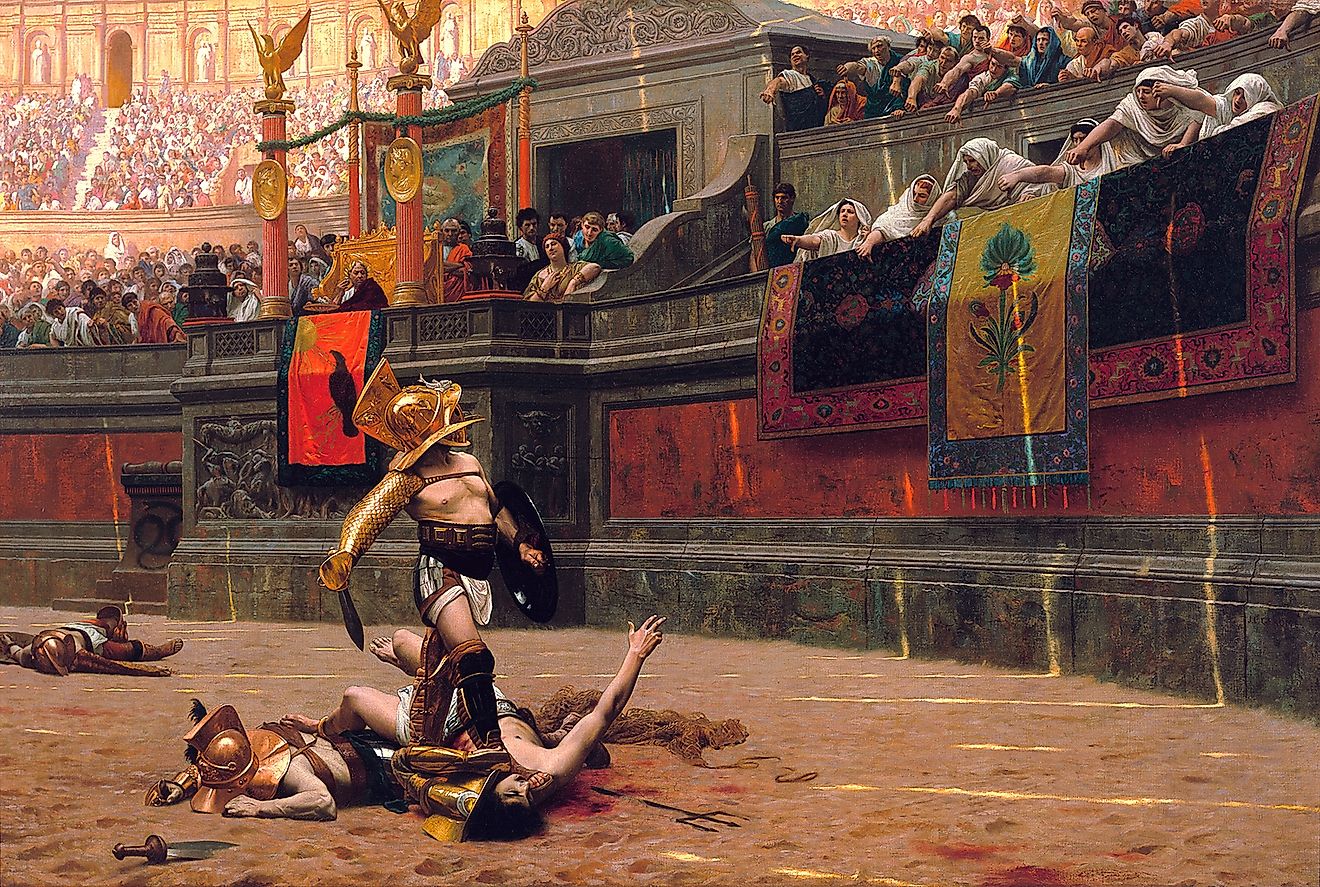
Nimes did not stop at one Roman masterpiece. A short walk from the Maison Carrée stands one of the best-preserved Roman amphitheaters anywhere. Raised near the end of the first century AD, when the city of Nemausus ranked among the wealthiest in Roman Gaul, the arena seated about 24,000 and announced that wealth in stone. It proved so durable that in the Middle Ages people simply moved in, packing houses and a small fortress inside the ring. The crowds came for gladiator duels and staged animal hunts, not the chariot races that belonged in the circus. Today they come for concerts, festivals, and bullfights.
5. Temples of Baalbek

At Baalbek, in modern Lebanon, the Romans went enormous. Begun in the first century BC and worked on for roughly two hundred years, the sanctuary holds three temples, dedicated to Bacchus, Venus, and Jupiter. The Temple of Jupiter was the giant of the group. Its 54 columns of imported granite once stood close to 70 feet tall, among the largest the Roman world ever raised, and six of them still stand today. Earthquakes, war, and centuries of stone-robbing have battered the complex, yet what survives is staggering. The ruins are a UNESCO World Heritage Site and remain an active archaeological dig.
4. Diocletian's Palace

When the emperor Diocletian did the nearly unheard-of and voluntarily stepped down in 305 AD, he retired to a palace so large it eventually became a city. Built on the Adriatic coast at what is now Split, Croatia, the compound runs more than 700 feet on a side behind walls reaching some 85 feet, with stylistic flourishes borrowed from across the empire. After Rome fell, locals took shelter inside those walls and never left. The old palace is now the living heart of Split's old town, its halls and cellars threaded with shops, cafes, and apartments, which makes it one of Croatia's most visited landmarks and a UNESCO World Heritage Site.
3. Pont du Gard

The Pont du Gard was never built to carry people. It carried water. It is the showpiece span of a roughly 31-mile aqueduct that delivered about 9 million gallons a day to the city of Nemausus, modern Nimes, on nothing but gravity and a famously gentle slope of around one foot of drop for every 3,000. Three tiers of arches rise nearly 160 feet above the river and stretch some 900 feet across the gorge, and the whole structure was fitted together from precisely cut limestone blocks without a drop of mortar. The aqueduct stopped delivering water by about the sixth century AD, but the bridge was far too useful to abandon and carried road traffic for centuries afterward.
2. Pantheon

Carve "Marcus Agrippa, son of Lucius, three times consul, built this" across your facade and you would expect Agrippa to get the credit. He does not, quite. Agrippa built the original Pantheon around 27 BC, but after fire destroyed it, the emperor Hadrian rebuilt it from the ground up around 113 to 125 AD and, in a rare show of imperial modesty, kept Agrippa's name on the porch. What Hadrian left still holds a record: the largest unreinforced concrete dome on Earth, a perfect hemisphere lit by a single open oculus at its crown. Step through the rectangular, column-fronted porch into the round hall and the proportions click into place, the height to the oculus exactly equal to the dome's diameter. Built to honor all the Roman gods, the Latin-inscribed monument has stood essentially complete for nearly nineteen centuries, helped along by its conversion into a church in 609 AD.
1. Colosseum

No Roman building is more recognizable. The emperor Vespasian broke ground around 70 AD, and his son Titus opened it in 80 AD with 100 straight days of games, a spectacle that reportedly featured some 2,000 gladiators and thousands of animals. The location was a deliberate message: Vespasian raised the arena on the drained lake of the despised emperor Nero's private palace, handing the public a playground where a tyrant had kept a pleasure garden. The freestanding travertine-and-concrete oval measures about 620 by 510 feet and climbs through four levels, the lower three ringed with arches framed by columns in ascending order, Doric, then Ionic, then Corinthian. Beneath the long-vanished wooden floor lay the hypogeum, a two-level warren of tunnels, cells, and lifts that fed animals and fighters up into the arena. It held tens of thousands, perhaps 50,000 or more, and it remains the headline draw among Italy's tourist attractions. If you want the backstory, there are plenty of reasons the Colosseum was built.
Built to Last
Vitruvius asked for strength, usefulness, and beauty, and the proof is that you can still walk through most of this list. Some of these buildings became churches, some became whole towns, one became a museum and another a bullring, but they kept working long after the empire that raised them was gone. That is the real Roman trick: not just building something magnificent, but building it to still be standing once everyone has forgotten how it was done.