Getting to Know One of Ontario’s Prettiest and Most Historic Towns
Known as "The Prettiest Town in Canada," Goderich, Ontario, sets high expectations for first-time visitors. So as I rolled off the Bluewater Highway and into its Roman-inspired, octagonal town square, my anticipation peaked... and then temporarily tanked (to no fault of the town). For you see, 2026 is the summer of construction in Southwestern Ontario. Last week, my photo and article-seeking mission failed in Paris (i.e., the historic river town, not the French capital), which was completely gutted due to planned water main replacements. Now, I found the northern ring of Goderich's Courthouse Square undergoing a similar upheaval. Disappointed but not deterred, I worked my way over to Cait's Cafe for a restrategizing session by the windowsill.
"It's okay," I thought. Goderich still has the oldest lighthouse on the Canadian shore of Lake Huron. It still has cloud-piercing churches. It still has the Huron Historic Gaol (i.e., jail) and partner Huron County Museum. It still has over a quarter of its footprint dedicated to parkland and trails. It still has the dizzying Menesetung Bridge. It still has three beaches connected by a 1.5-kilometer boardwalk. It still has countless 19th and early 20th-century estates lining Lighthouse Street. All of its 140 boutiques are still open for business. And after this temporary facelift is finished, Goderich will be better than ever. In hindsight, if it weren't for the downtown construction, I might have missed some of these peripheral attractions. But now I know how beautiful and uniquely historic Goderich really is. Let me show you.
Downtown
This is what "The Square" usually looks like:
And this is what life on the south side of downtown Goderich still entails:

Not too shabby, right? My first impression of Goderich was merely colored by my arrival on the north side of this enigmatic main street (or rather, loop), which was designed by co-founder John Galt in the early 1800s, one of the few Roman-style radial street plans in North America. No wonder it needs a little maintenance.
Sidewalk detours and dismantled roads aside, downtown Goderich still maintains a bright and bold character. The stalwart courthouse at its core is complemented by the massive mural outside The Den (coffee, juice & yoga), the sidewalk features from Elizabeth's Art Gallery, the spritely presence (inside and out) of SurfSup Skate Cafe, the storied facades of The Livery Theatre and Bedford Hotel, and the green interior of Courthouse Park, upon which the weekend markets sprawl.
Waterfront

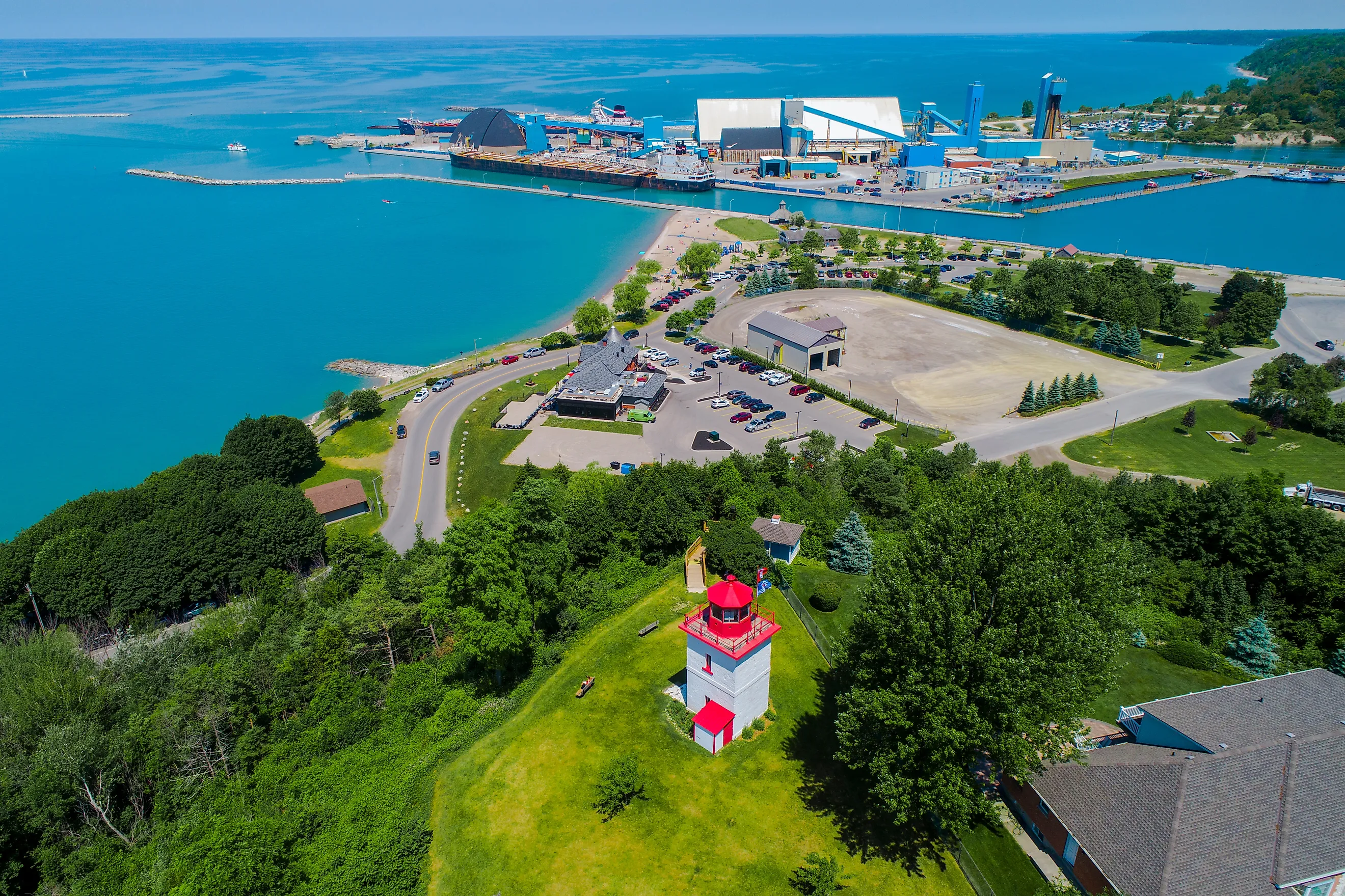
A stately yet creative downtown is one thing, but pair that with bluffs overlooking a clear Great Lake, and you've got yourself a nation-leading combo. Goderich's waterfront is still home to the first lighthouse constructed on the Canadian shore of Lake Huron. Along with being a panoramic hilltop dotted with old cannons, lookout benches, and, in my case, a sweet neighborhood girl selling lemonade, Lighthouse Park provides staircase access to St. Christopher's Beach. From there, you can stroll down to Rotary Cove Beach, or head north along the boardwalk to the always-popular Main Beach.

I worried at first that Main Beach would be soured by the adjacent salt mine and ship-lined harbor, but those industrial elements never detracted from the views or the vibes. It helped to learn what I was actually lounging above: the largest underground salt mine in the world, a buried salt city that runs beneath Lake Huron across roughly the footprint of Goderich itself, about as deep as the CN Tower is tall. Suddenly the harbor was not an eyesore but the only deepwater port on this side of the lake, and the whole sightline felt richer for it. This is not the asphalt plant in Port Stanley, which offends both the eyes and the nose. Goderich has leaned into its assets instead. The go-to spots for fish 'n' chips on the waterfront are The Old Saltie and Beach Street Station, the latter enshrining yet another of the town's early industries, the railway. And each September, the Salt & Harvest Festival sets up in plain view of the Maitland River's blue processing plant.
Historical Sites

Though the Goderich Lighthouse is the most significant historical site in town, the Huron Historic Gaol and accompanying Huron County Museum are much more interactive spaces for history buffs to explore. The former is a county jail turned National Historic Site. Open every day to summertime visitors, this three-story stone octagon is a great place to escape the heat and peer deep into Canada's penal annals. Built in 1841, the Huron Gaol was praised for its humanitarian design, but despite that progressive blueprint, daily life within its walls was brutal. Reportedly, three men were hanged, and many others were jailed for such trivialities as "profane language," "telling fortunes," and "milking a cow." With that said, as I toured the cell blocks and open-air courtyard (guarded by 18-foot walls), I was surprised by how (relatively) accommodating this prison was.

A combo ticket includes full access to the Huron County Museum, located just around the corner. With sections exploring the cabins and lifestyles of early pioneers, agricultural development, military history, cartography (more exciting than it sounds), and Victorian households, an hour's investigation will leave you with a satisfying overview of what the past 200 years have held not only for Goderich, but Ontario as a whole. Also, given that the 1,800-foot-deep salt mine is off limits to non-personnel, the audio-visual exhibit at the Huron County Museum is the best way to see that labyrinth of electrolytes.

While taking a formal tour of these major historical sites is fulfilling, one of the joys of walking around Goderich is that you constantly come upon beautifully maintained structures from the mid-19th century. Some, such as Lighthouse Street's Lancaster House and Wellesley House, are formally recognized, while others simply exist as time-capsule residences. A similar sense of historical awe occurs along North Street, where the steeples of 19th- and turn-of-the-20th-century churches pierce the sky.
Parks and Trails

Anyone who has read my various "strolling" articles knows that I'm a fan of seeing small towns on foot. So it was with great enthusiasm that I discovered Goderich's extensive trail system. The Goderich to Auburn Rail Trail (GART), Guelph to Goderich Rail Trail (G2G), Tiger Dunlop Trail, Sifto Loop Trail, Millennium Trail, Waterfront Boardwalk, and all of the little parks, wooden staircases, and connector paths that bridge Goderich's attractions are destinations unto themselves.
The Menesetung Bridge, in particular, demands attention. Built in 1907 as a Canadian Pacific Rail crossing and adapted for pedestrians in the early 1990s, this 230-meter (750-foot) marvel stands roughly 18 meters (60 feet) above the Maitland River. From up there, you can see the salt facility at the mouth of the river, golf carts rolling up the fairways of The Maitland, raptors overlapping with prop planes above, beavers swimming down below, and Carolinian forests all around.
Good Goderich!

Co-founder William "Tiger" Dunlop may have been biased when he declared his newly acquired region "the most beautiful country in Canada." And the Queen may or may not have snowballed on the sentiment with her own "prettiest town in Canada" proclamation, though no reigning monarch has actually set foot here. Nonetheless, the promise flatly stated on Goderich's welcome signs is substantiated through natural beauty, architectural prowess, meaningful history, and character-rich commercialization. Ontario's side of Lake Huron has a ton of must-see towns sprinkled along its shoreline. There is Lambton Shores to the south, Bayfield just down the coast, and Tobermory way up at the tip of the peninsula. But after touring Goderich this fine sunny Tuesday, I might have to shuffle the podium yet again.