7 Overlooked Towns In England Worth Visiting
The seven places below rarely turn up on first-time England itineraries, and those first-timers are missing out. All of them easily fill a full day's worth of discovery, and several considerably longer. Robin Hood's Bay ran one of the busiest smuggling operations on England's northeast coast through the 1700s, and the tunnel network beneath the village is still there. Alderley Edge has a face carved into its sandstone with a rhyming inscription cut below it. Castle Ashby has an arboretum laid out in the 1860s around what is thought to be the largest weeping beech in the United Kingdom. Beyond England's typical tourist destinations, these hidden gems await.
Windermere

Windermere sits in the Lake District National Park, the only English national park to hold UNESCO World Heritage status, which it was awarded in 2017. The lake it is named for is England's largest natural lake, 17 kilometres (10.5 miles) long and 67 metres (219 feet) at its deepest. Windermere Lake Cruises sails the water every day of the year except Christmas Day, running steamers and launches the length of the water. The evening sunset sailing runs only in summer and is worth booking ahead.
Orrest Head, the low fell above the town, is roughly a 30-minute climb and opens onto the fells and rolling farmland below. Down on the lakeshore, Windermere Jetty Museum holds more than 200 years of Windermere boat-building, from Victorian steam launches to record-breaking speedboats. Part of the appeal is that the collection is not static. The boatyard restores vessels in view of visitors, and a working dock holds others afloat rather than up on blocks.
West Lulworth

West Lulworth, in the county of Dorset, sits on one of the most heavily studied stretches of coastline in Britain. Lulworth Cove shows why. It is an almost perfectly circular natural cove, cut where the sea breached a wall of Portland limestone and then scoured out the softer rock behind it, exposing beds laid down between roughly 150 million and 60 million years ago. About a 40-minute walk along the cliff path brings you to Durdle Door, the limestone arch that turns up on more Dorset postcards than anything else on the coast.
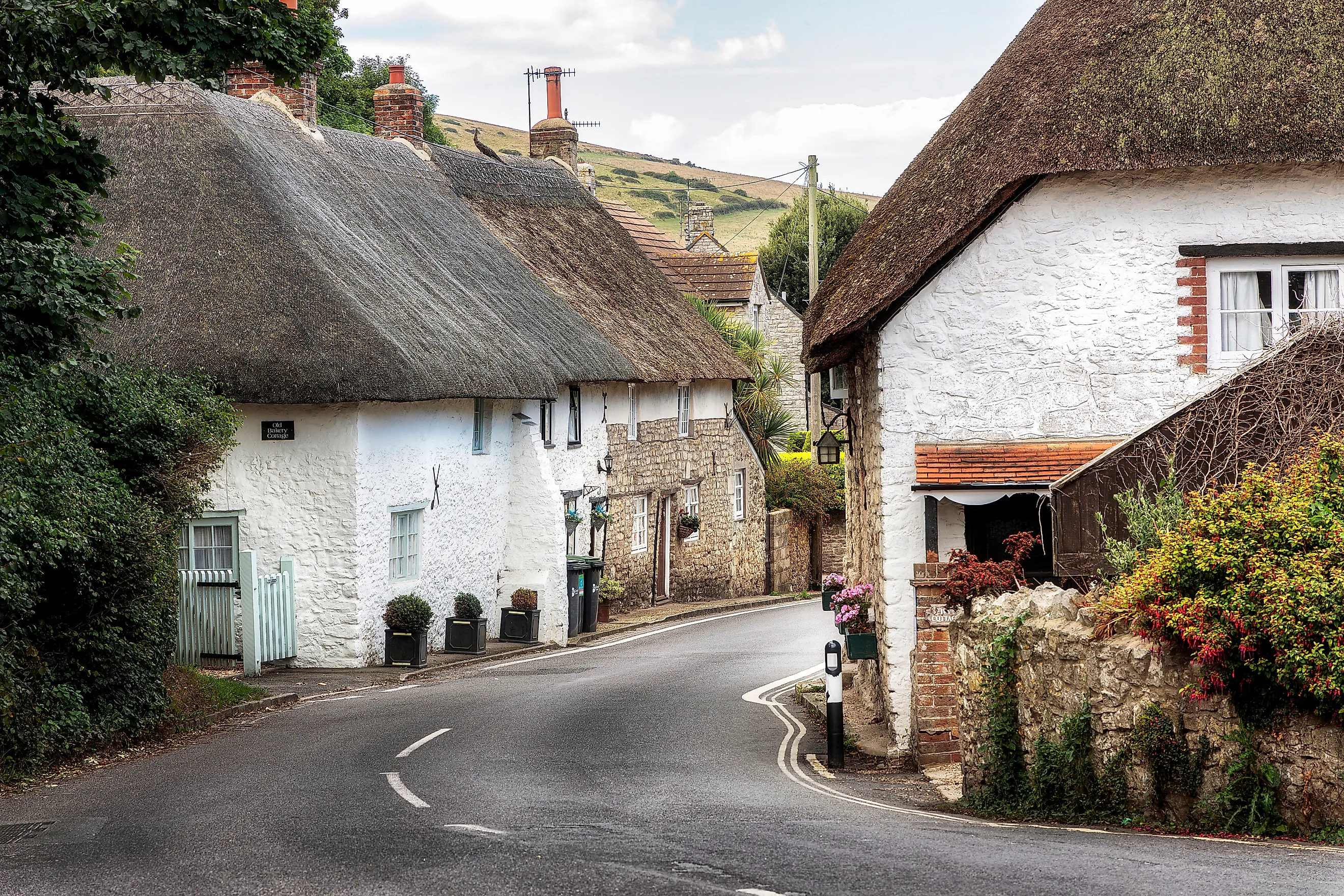
The village has a historical side to match. Holy Trinity Church was built in 1869 and 1870 in Early Geometrical Gothic, replacing a small Norman church that had fallen into disrepair. The graveyard of that older church survives further along the village street. Nearby, you will pass thatched cottages, some of them 300 to 400 years old. When hunger strikes, there is The Dolls House. The jade-green cottage is Grade II listed and once housed Lulworth fishermen. It is run now by the Lulworth Estate and serves Dorset cream tea alongside fudge made on the premises.
Robin Hood's Bay

Robin Hood's Bay is a fishing village on the North Yorkshire coast. In the 1700s, it was one of the busiest smuggling spots anywhere on the north-east coast, moving contraband through a warren of underground tunnels and connected cellars. The old street plan survives more or less intact, which is why the lanes are so narrow and so steep. The beach below is a mix of sand and rock, and the exposed rocky platforms are good ground for loose fossils, including Jurassic material weathered out of the shale and limestone.
After that, head for the chippy. Fish Box does battered fish and fat chips with mushy peas, and it sits near the top of Bay Bank, which is useful given the climb. Finish with a pint at the Laurel Inn, a tiny Grade II listed pub in an early 18th-century cottage with a cast-iron range and an open fire. It has no kitchen, so bringing your own supper in is not only allowed but expected.
Morecambe

Morecambe is a resort town in Lancashire, and one of England's best-loved comedians was born there in 1926. John Eric Bartholomew took the town's name for the stage and became Eric Morecambe, and his statue stands on the promenade. The boxer Tyson Fury has also made his home in the town. The promenade itself is the main event, a long seafront walk with the Cumbrian fells across the bay and the Tern Project's bird sculptures and poem path set along it. The Festival Market sits just behind it. Around 100 stalls and shops fill the covered hall, with a couple of cafes among them, and it trades on Tuesday, Thursday, Saturday, and Sunday.
The Morecambe Winter Gardens is the town's grandest survivor. It opened as the Victoria Pavilion in 1897, closed to the public in 1977, and was saved from demolition by local campaigners in 1985. The Grade II* listed theatre is now run by a volunteer trust and is still being restored, so it opens for tours and events on selected dates rather than daily. Check ahead, then go behind the scenes and hear what the building used to be.
Alderley Edge

Alderley Edge in Cheshire has a folklore tradition that has outlasted most of the county's. At the Wizard's Well, a face is carved into the sandstone above an inscription that reads "Drink of this and take thy fill, for the water falls by the Wizard's will." The carving is reputed to be a 19th-century work by Robert Garner, great-great-grandfather of the novelist Alan Garner, who built "The Weirdstone of Brisingamen" (1960) around these woods. The Edge itself is a short walk from the well, a wooded sandstone escarpment riddled with old copper workings and worth an afternoon. The Merlin, an upmarket gastropub on Wilmslow Road, is where to head afterward. It is at its best on a Sunday, when the roast arrives with a Yorkshire pudding and proper roast potatoes.
Barton-le-Clay

There has been a watermill at Barton-le-Clay since at least 1086. That is the year the Domesday Book was completed at the order of William the Conqueror, and it records a mill on the site. The mill is described by its present owners as among the oldest overshot mill sites in the country. What stands there now is the Olde Watermill Shopping Village. More than 20 independent shops fill the restored mill buildings and the yard around them, alongside an antiques centre and a coffee shop. Among the tenants is Handmade Local, a craft shop stocking makers from Hertfordshire, Bedfordshire and Buckinghamshire. It is open every day except Tuesday.
Once the shopping is done, Barton Hills National Nature Reserve is a short walk away, a chalk grassland and beechwood site at the northern end of the Chilterns where wildflowers and butterflies come out in summer and hares are a common sight. To finish, The Royal Oak on the High Street is a 19th-century village pub with real ale and a couple of open fires, and it puts on live music most weeks.
Castle Ashby

Castle Ashby Gardens is the reason to come. The arboretum dates to the 1860s and holds what is thought to be the largest weeping beech in the United Kingdom, alongside an orangery and a run of formal gardens. The estate tearoom opens Thursday through Monday and serves cakes alongside hot and cold food. Note that a parking charge applies even if the tearoom is all you have come for.
A little over a 10-minute walk away, the Rural Shopping Yard fills a set of converted farm buildings with independent traders. The Eggshell Gallery deals in collectables and antique clocks, with a rotating stock of musical boxes. Limeblue is a gift boutique, and The Deli runs a cheese counter with an eatery beside it. The village also has a quieter wartime layer. It held a vehicle depot during the Second World War, and by the time volunteers surveyed Britain's 20th-century military sites for the Defence of Britain Project between 1995 and 2001, nothing of the depot was left standing.
Seven Towns, Seven Very Different Days
These towns are made for the curious traveler and those looking to get off the beaten path. Beyond England's big-name landmarks, towns like Morecambe and Windermere invite organic exploration and discovery, from Lulworth Cove on the English Channel to Cumbria's beautiful Lake District. Each with its own unique character and charm, these seven sweet spots are sure to delight.