Nottingham Has Europe’s Largest Cave Network, Step Inside
Nottingham recorded its 1,000th cave in May 2026, confirming that the largest network of man-made caves in Europe lies beneath this historic destination. I spent two days exploring the city, visiting as many of the accessible portions of its underground world as possible. Along the way, I took in a castle tunnel used for a royal coup, a centuries-old pub carved into a cliff, and a medieval tannery. And, of course, the legendary Robin Hood makes an appearance.
One Thousand Caves and Counting

The discovery of Nottingham's 1,000th cave was announced by the city in May 2026. The figure had stood at 924 just a year earlier, but a combination of research using historical documents and maps, as well as discoveries made by property developers, added a bumper crop of "new" caves.
Interestingly, Nottingham has no natural caves. Instead, generations of residents cut these chambers by hand, depending upon their needs. And judging by the sheer volume of caves, their needs for storage cellars, workshops, homes, burial places, tanning pits, and even air raid shelters were staggering.
Written evidence of their existence is plentiful and even predates the caves that survive in Nottingham today. Asser, the Welsh Bishop of Sherborne, described the settlement in his Life of King Alfred in 893 as Tigguo Cobauc, which literally translates as "place of caves." That a ninth-century writer thought these holes in the ground were noteworthy says a lot about their importance.
The Sandstone That Made It Possible

Nottingham stands on a rock type known as the Nottingham Castle Sandstone Formation, part of the Sherwood Sandstone Group, which takes its name from Sherwood Forest to the north. The same formation makes up Castle Rock, the cliff the castle occupies, and it runs directly beneath the city.
Where this sandstone came from is perhaps the most fascinating part of the story. According to the British Geological Survey, it was deposited by an enormous river that flowed from what is now northern France 250 million years ago, during the Triassic period. Several thousand feet wide, the river crossed a hot, semi-arid landscape, enabling the sediment it carried to build up in inland basins across what would eventually become the English Midlands.
The rock has high porosity, and the calcite cement that originally bound the sand grains together has leached out beneath the outcrops, leaving only a weak clay cement in its place. The formation is also notably free of significant joints and major bedding planes. The result is a rock soft enough to cut with simple hand tools yet strong enough to stand as an unsupported roof once cut, so a chamber dug here stays up without props, arches, or masonry.
Nottingham Castle

While most of Nottingham's 1,000 caves aren't open to the public, there are several that can be explored safely, all of them handily located within a 15-minute walk of one another. First on my list was Nottingham Castle.
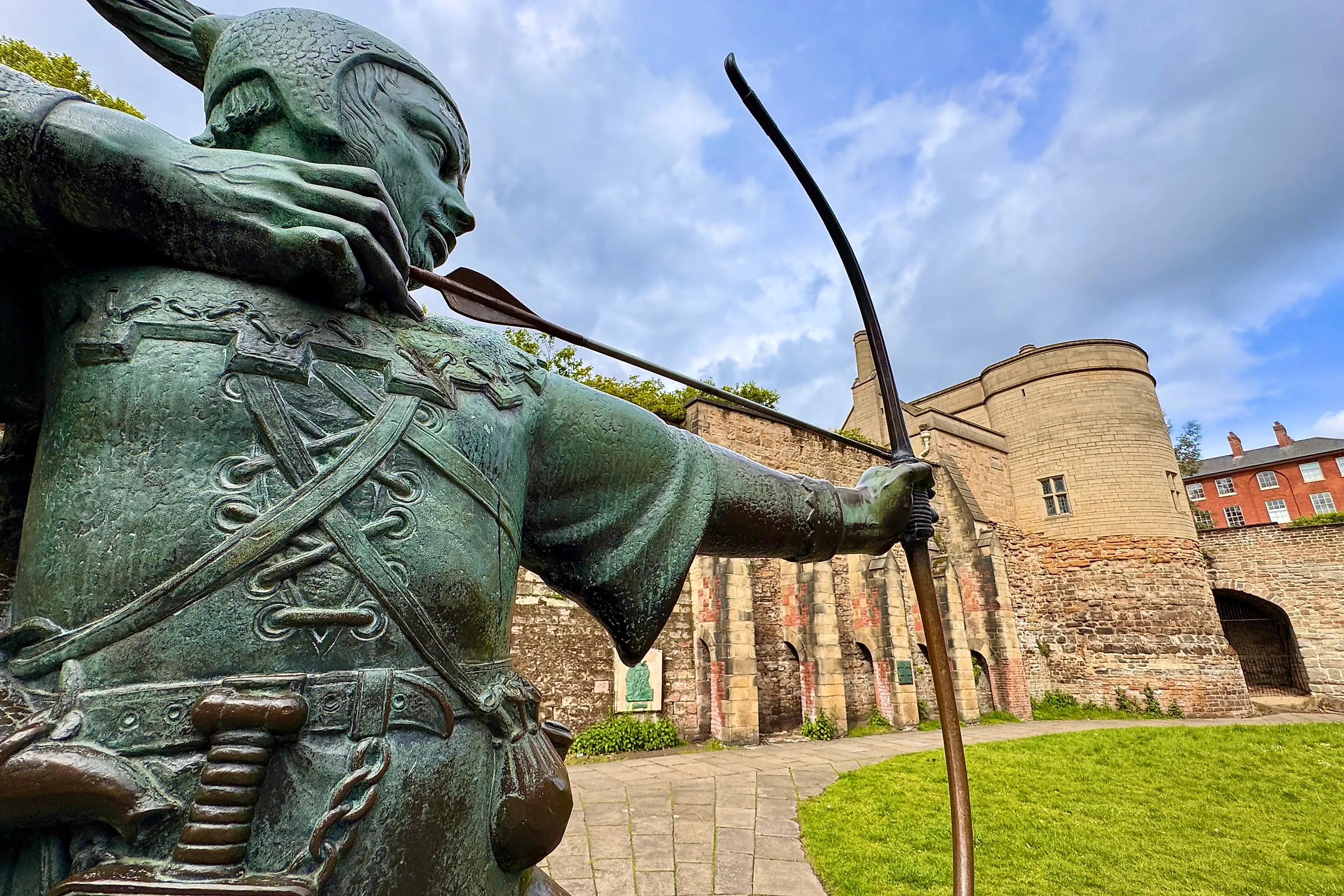
Founded in 1068 by William the Conqueror, this must-see historic attraction features the castle grounds, a museum, as well as art exhibits. Outside the gatehouse, in what was once the outer bailey moat, stands the Robin Hood statue, unveiled in 1952 and the city's ultimate selfie spot.
Highlights inside Nottingham Castle include Robin Hood Adventures, an attraction which uses storytelling screens and digital archery to tell the ballads of the legendary folk hero, and the Rebellion Gallery, which covers Nottingham's long record of civil unrest. The terrace outside boasts the best views of the city.
The Castle Caves

The castle's cave tour, though, is the main event. After a brief video introduction about the history of the unique rock formation on which the castle stands, we made our way down a steep, uneven, but manageable set of stairs hewn out of the rock. Strangest of all was the sandy texture of the ground we walked on. It felt more like walking on a beach than down a set of centuries-old steps.
The most important feature you'll encounter on the way down is Mortimer's Hole. This man-made tunnel of 127 steps runs from the castle terrace down through the sandstone of Castle Rock to Brewhouse Yard, depositing you just steps away from the city's most famous pub and that famous Robin Hood statue.
Along the way, you'll hear the story of how the tunnel got its name. In October 1330, the powerful nobleman Roger Mortimer summoned Parliament to Nottingham and stayed at the castle. He had deposed Edward II three years earlier and ruled England in all but name, alongside Queen Isabella of France, the mother of Edward III and his partner since 1326. Thinking himself secure behind the castle walls, Mortimer had not accounted for the caves beneath them.
On the night of 19 October, Edward III, then 17, entered the castle through a passage in the rock with Sir William Montagu and a group of loyal knights, and seized Mortimer in his chamber. Mortimer was taken to the Tower of London and executed. Isabella was sent to Castle Rising in Norfolk, and Edward ruled in his own right from that night on.
The Pub Built Around Caves

While you've got the option to revisit the castle, I said farewell to our guide and walked across Brewhouse Yard to the next stop on my Nottingham cave adventure, Ye Olde Trip to Jerusalem. Said to have been around since 1189, it's named for the local legend that claims Richard the Lionheart and his knights rested here before heading out on the Third Crusade.
The pub's setting is nothing short of remarkable. Built into large conical caves cut into the face of Castle Rock, it's quite unlike any other watering hole you'll ever come across. Grab yourself a menu, order a pint and some lunch, then have a wander while you're waiting for your meal to arrive, and note that pub tours are also available.

Highlights include the Rock Lounge, once the malting room of the old brewhouse. Here you'll see the 60-foot-tall chimney shaft through Castle Rock, which also served as a hoist for delivering ale directly to the castle above. Look out for the glass display case over the bar containing a model ship. Dubbed the Cursed Galleon, tradition has it that anyone who cleans it dies shortly afterward, which no doubt accounts for the decades of dust and cobwebs on it.
A short passageway from the Rock Lounge leads to the Museum Room. This interesting chamber features an antique chair which, if a woman sits in it, will apparently improve her chances of conceiving. Beneath these rooms are more cave cellars, created as purpose-built beer stores, one of which was later used as a cockfighting pit.
The Robin Hood Town Tour

I made use of my lunchtime pub break to meet up with Robin Hood himself. Looking every inch the part, Ade Andrews' popular Robin Hood Town Tours last for two and a half hours and are super fun and super informative. Andrews is both an actor and a historian, so the experience is something of a performance as he spices things up with medieval verse and the occasional toot on his hunting horn.
Our route through the city took in St. Mary's Church in the Lace Market, the oldest and largest medieval church in Nottingham. Completed on the site of an older church in 1474, the Robin Hood connection here is from old traditional ballads that tell how the outlaw was captured by the notorious Sheriff of Nottingham while at confession, only to be rescued by Little John.
The image that will forever stick with me, though, was the impact Andrews' version of Robin Hood had on those we passed along our route. As we walked the streets of Nottingham, he was stopped repeatedly by people asking for photographs and a chat. And it wasn't only tourists doing the asking. Locals wanted photos, too. And to his credit, Andrews remained in character the whole time.
The City of Caves

Guided to the entrance to the City of Caves by Robin Hood himself, I was ready for my third Nottingham cave experience. Located on Garner's Hill, this must-visit underground attraction protects the largest publicly accessible section of the city's cave network.
I took the guided tour, which revealed even more about how these caves were once used. The most shocking revelation was about the tanneries that were built here in medieval times. I was introduced to two caves cut into the cliff face that once housed the only known underground tannery in Britain, in use from 1500 to 1640.
The oldest, Pillar Cave, dates from 1250, was blocked by a rockfall by 1400, then cleared and brought into the tannery in 1500 with circular pits sunk to hold barrels. A second cave was fitted with rectangular clay-lined vats used for the skins of smaller animals such as sheep and goats.

As my guide emphasized, it was a dirty and smelly business to be in. Hides arrived with blood, hair, flesh, and dung still on them, and the preparation stages relied on lime, stale urine, and animal excrement to loosen the hair and soften the skins. All of which was done in the cramped conditions and open pits you see on the tour.
Other City of Caves highlights included a Victorian-era slum dwelling, a pub cellar, and a Second World War air raid shelter with its wartime fittings still intact.
How To Explore Nottingham's Underground City
Two days is enough to see the accessible caves properly, though advance planning is required as the tours are popular and book up. Here is what else you need to know.
- Nottingham Castle: The cave tour is an add-on requiring a "Castle and Grounds" ticket. Tours leave the courtyard and finish at Brewhouse Yard, and you should request the Mortimer's Hole tour specifically. Visit the castle's website for details.
- City of Caves: Bring headphones for the audio guide, and shoes with good grip. The site is cashless, with no toilets, and isn't suitable for wheelchairs, prams, or those with limited mobility. Details are on the National Justice Museum website.
- Ye Olde Trip to Jerusalem: The Rock Lounge and Museum Room are open to anyone dining or drinking at the pub, and lunchtimes are generally quieter than evenings.
- Robin Hood Town Tour: For the chance to hang out with a better-than-Hollywood version of Robin Hood, book a tour through Ade Andrews' official website.
- Where to Stay and Eat: I stayed at the first-rate Lace Market Hotel on High Pavement, a two-minute walk from City of Caves. For a superb dinner in an elegant old heritage building, book a table at the Cosy Club on Victoria Street.
- Things To Do: For ideas and inspiration about these and other fun things to see and do in Nottingham, check out the official Visit Nottinghamshire website.