9 Overlooked Towns In Northern Ireland Worth Visiting
The small towns strung along Northern Ireland's coastlines and river valleys stay relatively quiet even in the high season, which is much of the appeal for travelers who take the initiative to wander past the typical tourist destinations. What the more curious visitors discover are unique adventures and attractions, like a 12th-century keep with free admission, a whiskey licence dating to 1608, an oak wood of a kind now rare across the region, and villages built to a plan by architects with unusual ideas. Dundrum guards a Norman castle above a tidal bay, and Belleek has been firing porcelain on the Fermanagh border since the 1850s. These nine overlooked towns in Northern Ireland are worth adding to any travel itinerary.
Dundrum

This coastal village in County Down, Northern Ireland, rests on Dundrum Bay, where the green slopes of the Mourne Mountains run down to the water. For the full scope of the scenery, check out the views from Dundrum Castle, an Anglo-Norman castle built by John de Courcy in 1177 to guard the land routes from Drogheda via Greencastle to Downpatrick. Entry to the castle is free, and the upper levels give the best vantage in the village.
Murlough National Nature Reserve spans the other side of the bay road. Home to hundreds of bird and insect species, the reserve also features a four-mile golden-sand beach and a 6,000-year-old dune system with walking paths throughout. For an authentically Irish experience, head to The Dundrum Inn on Main Street, a family-run establishment that has been part of village life since 1834. It remains a community hub, known for its welcoming atmosphere and its local character.
Bushmills

Along the north Antrim coast, Bushmills is home to the whiskey that carries its name. The Old Bushmills Distillery boasts a district licence granted in 1608 and bills itself as the oldest licensed whiskey distillery in the world, and its tours include the copper stills and the maturation warehouses. For your stay, book a room at the Bushmills Inn, a 4-star inn and restaurant with origins as a coaching inn, and a practical base for reaching the Giant's Causeway, a few miles up the coast. Head to the edge of town for a tour of Dunluce Castle, perched on cliffs above the sea. There is evidence of settlement on the headland from the first millennium, though the ruins standing today mainly date to the 16th and 17th centuries, when the MacDonnells held it.
Downpatrick

On the Lecale peninsula in County Down, about 21 miles south of Belfast, sits a little town with a large history. Downpatrick is where the story of St. Patrick begins, by tradition, with his landing on Strangford Lough and the start of his mission in Ireland. The 82-mile waymarked route connecting Armagh to Downpatrick, Saint Patrick's Way: The Pilgrim Walk, follows that thread across two counties. The journey culminates at Down Cathedral, traditionally held to be the burial place of Ireland's patron saint, with the story told in more detail at the neighboring St. Patrick Centre. To explore the town's heritage beyond the saint, take a ride on the Downpatrick and County Down Railway, a preserved line running through the countryside, and look through its museum and carriage collection. End the day with a pint at Turley's Bar on Scotch Street, a family-run pub with live entertainment most weekends.
Moy

In County Tyrone, about five miles southeast of Dungannon, the village of Moy recorded a population of 1,941 at the 2021 census. Its name comes from the Irish an Maigh, meaning "the plain." Moy sits on the west bank of the River Blackwater, with Charlemont on the east bank in County Armagh, the two joined by Charlemont Bridge. The village square is the center of things, and the cafes around it do a steady trade. Stop in at The Moy Larder for coffee and homemade baked goods, or at Jimmy's Cafe a few doors along for a traditional cooked breakfast.
Walkers can spend a few hours along the Blackwater before heading out to The Argory, two miles from the village. Built in the 1820s for Walter MacGeough Bond and designed by the Dublin architects Arthur and John Williamson, the house exists because of a stipulation in his father's will requiring him to build away from the family estate. Step inside the Neo-classical interior for a sense of the family and their tastes. Outside, the grounds hold a rose garden with a sundial, an adventure playground, and the Courtyard Cafe.
Castlewellan

Castlewellan sits between the Mourne Mountains and Slieve Croob in County Down, about 11 miles southwest of Downpatrick. Its layout is the unusual part, with one broad main street opening into two squares, both planted with chestnut trees, laid out under the Annesley family, the Anglo-Irish landowners who shaped the town. Zebedees on Main Street serves a fish supper. Hillyard House, further along Main Street, has 20 rooms, a restaurant, and a bar, and stands almost at the gates of the forest park. Savage's Bar, also on Main Street, hosts live music on weekends.
Castlewellan Forest Park is the reason most people stop. Set between mountains and sea, it wraps around Castlewellan Lake and takes in the Scottish Baronial Castlewellan Castle, built in 1856. The park holds the Peace Maze, a hedge maze planted with community help in the early 2000s, along with lake walks, the walled Annesley Garden and its arboretum, roughly 27 kilometers of mountain bike trails, and an activity center for children.
Belleek

Belleek is the most westerly village in Northern Ireland, sitting on the River Erne in County Fermanagh right against the Donegal border. Its name has meant porcelain since 1857, so any trip here starts at the Belleek Pottery Visitor Centre, where the tour runs through the workshops, the museum holds early parian ware, and the tea room looks out over the Erne as it runs west toward Ballyshannon and the sea. A self-guided heritage walk takes in the village's older buildings, the last remains of the railway bridge, and stretches of original cobbled paving. Belleek Marina, just off Main Street, gives another view of the water.
The village runs on small independent businesses, several of them second- and third-generation. Gilmartin's Craft Shop, five minutes on foot from the pottery, has sold Irish-made jewellery and artisan gifts since Kevin and Veronica Gilmartin opened it in 1979, and their daughter now runs it. Miss B's Clothing stocks ladies' and children's wear on the same street. The Lemon Tree is a family-run coffee house whose ground-floor washrooms occupy what were once cells in the village jail, and it has become the standard meeting point for breakfast or a mid-afternoon coffee.
Cushendun

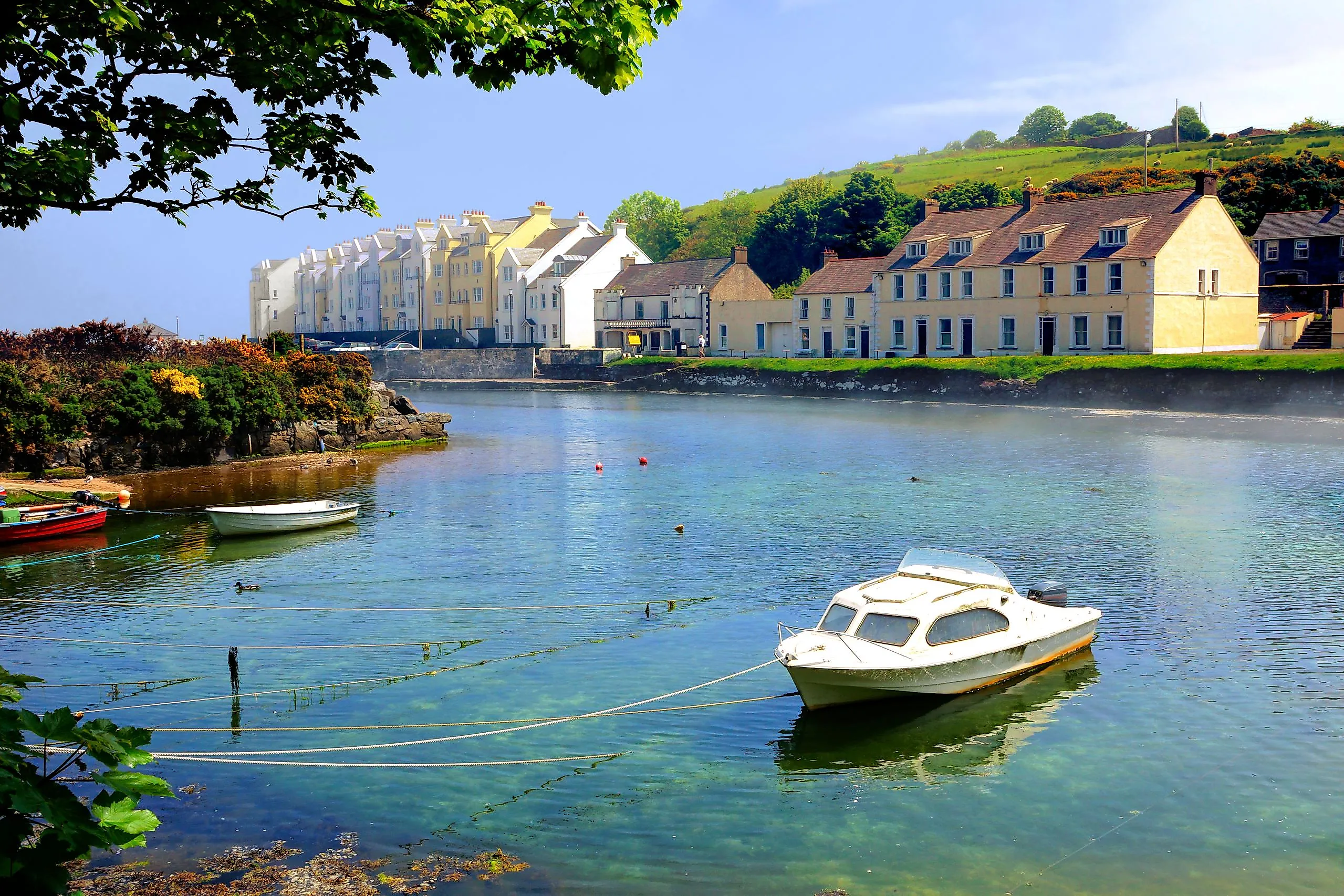
Cushendun looks like it was dropped in from Cornwall, and more or less it was. Ronald McNeill, Baron Cushendun, commissioned Clough Williams-Ellis to build the village in the 1910s and 1920s in memory of his Cornish-born wife, which is why this corner of County Antrim has whitewashed cottages under mansard roofs. The sea caves just south of the village later drew a different kind of attention as a filming location for Game of Thrones.
Walk the village to see the neo-Georgian Glenmona House, rebuilt by Williams-Ellis after a fire in 1922, and stop by The Old Church Centre, restored as a venue for live music, the Cushendun Community Cinema, quarterly craft fairs, and The Big Arts Weekend festival. The ruins of a 14th-century castle stand nearby on a site that was in use as far back as the Mesolithic. The village also showcases a sculpture of Johann the Goat, a local animal that became a mascot and a fixture in other people's holiday photographs.
Rostrevor

Back in the Mourne Mountains in County Down, on the shore of Carlingford Lough, Rostrevor sits at the foot of Slieve Martin. Rostrevor Oakwood National Nature Reserve is the overlooked excursion here, with a view down the lough toward the Cooley Peninsula on the far side. Woodlands like this are rare in Northern Ireland now. Its mature oak covers around 41 acres, mixed through with ash, hazel, holly, and wild cherry, and the ground beneath carries wild garlic and bluebells.
Neighbouring Kilbroney Park has forest trails for anyone who wants an easier walk. While here, take The Narnia Trail, a half-mile path with interactive displays and carved figures of Aslan and the White Witch. The Mourne landscape around Rostrevor is widely credited locally with feeding C.S. Lewis's imagination. The Fairy Glen walk follows a river through woodland said to be inhabited by fairies, and it makes a shorter, gentler counterpart.
Omagh

Omagh is the market town at the center of County Tyrone, and its independent shops and cafes carry the day here. Omagh Craft Collective, a volunteer-run community interest company in the town center, sells work by crafters from Omagh and the surrounding countryside, with a program that helps under-18s run their own craft businesses. The coffee is worth comparing across town. Riverfront Coffee House sits near the bottom of Market Street and Rōe Coffee Bar at Old Market Place, while The Strule Cafe occupies the Strule Arts Centre and looks out over the river it takes its name from.
Open country begins minutes from the town center. Gortin Lakes, north of Omagh, offers a short, easy walk around Oak Lough and Gortin Lake with the Sperrin Mountains rising on every side. The Ulster American Folk Park, on the road toward Newtownstewart, is an open-air museum tracing the passage of Irish emigrants to America in the 18th and 19th centuries, with reconstructed buildings on both sides of a full-scale emigrant ship.
Don't Overlook These Towns
These towns are small enough that several can be reached in a single day, but each holds up better as a destination than as a stop. Explore the market town of Omagh, Rostrevor's Oakwood National Nature Reserve, the coastal village of Dundrum, or historic Downpatrick, far from the crowds and deep in the heart of Northern Ireland.