6 Overlooked Towns In The UK Worth Visiting
Some of Britain's oldest stones and boldest buildings sit in towns most travelers never think to stop in. Aylesford quietly holds a burial tomb older than Stonehenge. Wells sits on the first cathedral England ever built in the Gothic style. The reward for looking past the obvious is that kind of history with the crowds subtracted. These six towns across all four UK countries make the extra effort worth it.
Aylesford, England

Aylesford holds some of the oldest human traces in England, with Neolithic activity stretching back thousands of years. The clearest sign stands on a hillside just north of the village at Kit's Coty House. This chambered burial tomb dates to roughly 4000 BCE, which makes it far older than Stonehenge. Three massive upright sarsens still carry a single capstone, and English Heritage keeps the site free and open. Archaeologists read it as a communal grave built by some of Britain's earliest farmers.
The town's medieval chapter shows up at The Friars, a Carmelite priory founded in 1242. Monks returned here in 1949 after a four-century absence, and the grounds now draw pilgrims to the open-air shrine and the pilgrims' hall. Visitors walk the cloisters, the pottery, and the gardens that run down toward the River Medway. Maidstone sits a short drive east for anyone who wants a larger base nearby.
Chichester, England

Just outside Chichester lies the largest known Roman residence anywhere north of the Alps. Fishbourne Roman Palace went up around 75 CE, only three decades after Rome invaded Britain. Its footprint runs larger than Buckingham Palace, and it holds the finest in-place mosaic collection in the country. The Cupid on a Dolphin mosaic anchors the north wing, where visitors walk above floors laid nearly two thousand years ago. A reconstructed formal garden traces the original Roman planting beds outside.
Back in the city center, Chichester runs a serious arts calendar for a town its size. The Pallant House Gallery holds one of Britain's best collections of modern British art, with work by Peter Blake and Graham Sutherland. The Chichester Festival Theatre has premiered plays that later moved to London's West End. Families break up a day of culture at Priory Park, which spreads green lawns and a playground beside a surviving medieval friary.
Wells, England

Wells is the smallest city in England, and its cathedral is the reason to come. Builders broke ground around 1175 and made it the first English cathedral raised entirely in the Gothic style. The west front carries roughly three hundred surviving medieval statues, the largest such gallery left in Europe. Inside, the scissor arches solve a structural crisis with a pair of inverted stone curves that still look impossible. It began as a Catholic cathedral and became Church of England after Henry VIII broke with Rome.
The Bishop's Palace stands right next door behind a moat, and it has housed the Bishops of Bath and Wells for eight centuries. Swans on the moat learned generations ago to ring a bell by the gatehouse for food. The town market fills the square below the cathedral twice a week with local growers and craft stalls. Traders here sell Somerset cheese, garden produce, and street food a few steps from the cathedral green.
Kidwelly, Wales

Wales draws fewer visitors than its neighbors, and Kidwelly shows what those travelers skip. The Normans founded Kidwelly Castle here around 1106, though most of the stone towers and curtain walls went up in the 13th and 14th centuries. Its concentric rings of defense and river-facing gatehouse made it one of the strongest fortresses in south Wales. Film fans recognize the exterior from the opening scene of Monty Python and the Holy Grail. Cadw runs the ruins today and stages costumed events through the warmer months.
Kidwelly Quay sits below the castle where the Gwendraeth Fach River meets salt marsh and mudflats. Wading birds feed across the estuary, and the flat paths make for an easy walk after climbing the castle towers. The old industrial quay once shipped coal and tinplate out to sea before the trade faded. A café in town serves breakfast and strong tea to walkers heading out for the morning.
Oban, Scotland

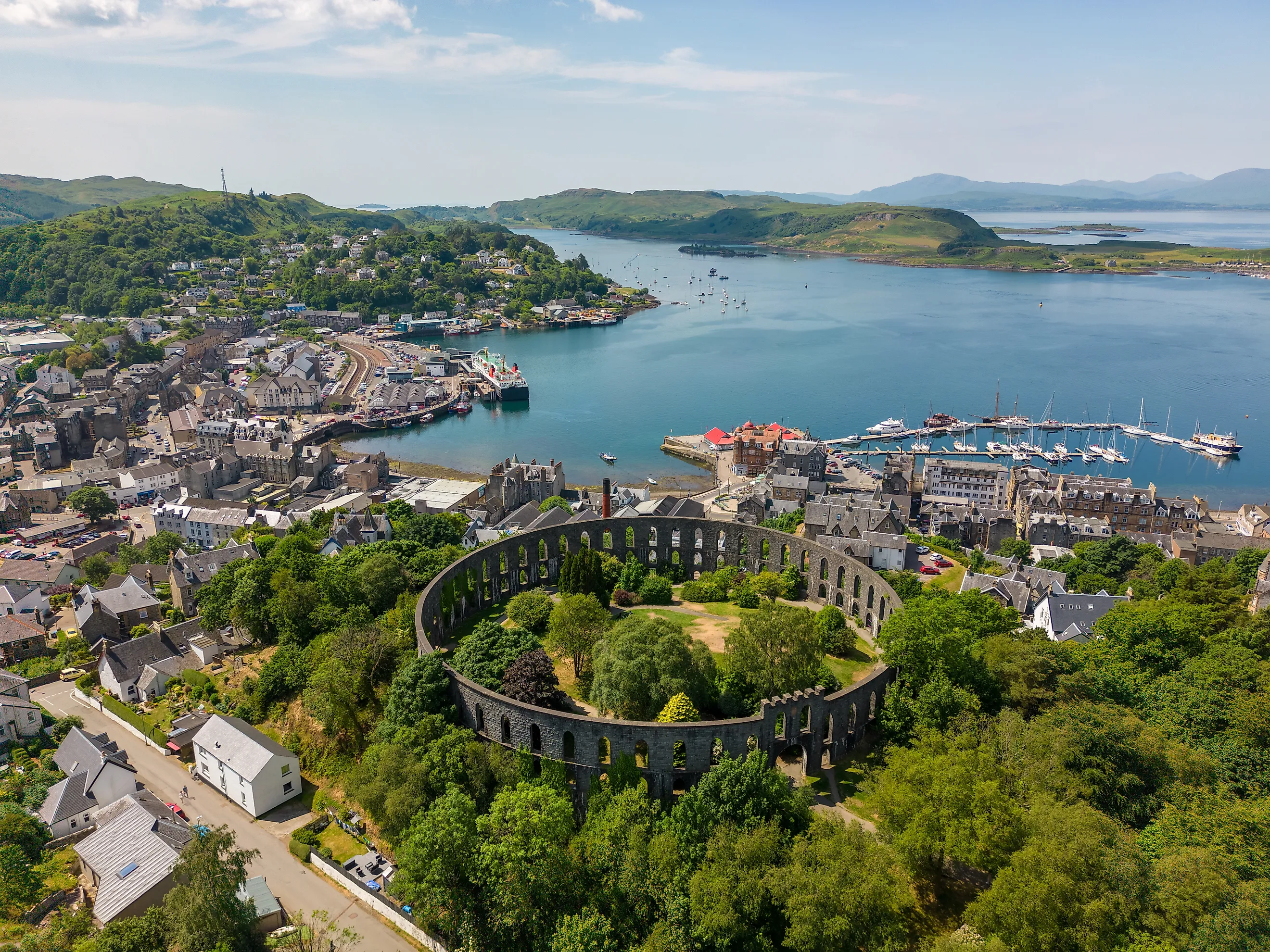
The whisky came first in Oban, and the town grew up around it. John and Hugh Stevenson built the Oban Distillery in 1794, years before the surrounding harbor became a town. It ranks among Scotland's oldest and smallest distilleries, wedged between the sea and a steep cliff on the main street. Guided tours end with a tasting of the maritime West Highland single malt the place is known for. The distillery sits barely two hundred steps from the water that shapes its flavor.
Above the north end of town stand the ruins of Dunollie Castle, the ancestral seat of Clan MacDougall. The neighboring 1745 House holds the clan museum, where the collection lays out centuries of Highland family history. Down at the shore, Ganavan Sands gives Oban a proper beach a short walk from the harbor. The Oban Chocolate Company turns out handmade chocolate near the waterfront for anyone who prefers a sweeter souvenir.
Rostrevor, Northern Ireland

C.S. Lewis spent childhood holidays around Rostrevor and later called this stretch above Carlingford Lough his idea of Narnia. Kilbroney Park spreads ninety-seven acres of woodland and lawn below Slieve Martin in the Northern Ireland hills. A themed Narnia Trail runs through the trees with carved figures of Aslan, Mr. Tumnus, and the White Witch. Harder walkers climb to the Cloughmore Stone, a fifty-ton glacial boulder that local legend credits to the giant Finn McCool. The park also holds some of Ireland's best mountain-bike descents.
The Fairy Glen threads a shaded path along a stream just outside the village, easy enough for an afternoon stroll. Rostrevor's short main street keeps a handful of cafés, pubs, and craft shops within a couple of blocks. A local bistro serves seafood and Irish classics for travelers settling in after a day on the trails. The village faces the lough with the Cooley Mountains rising across the water in the Republic.
Planning A Route Through The Overlooked UK
These six towns split cleanly by interest rather than by geography. Aylesford and Chichester reward anyone chasing deep history, from Neolithic tombs to Roman mosaics. Wells and Kidwelly turn on a single monumental building apiece, a Gothic cathedral and a Norman castle. Oban and Rostrevor lean outdoors, with a working distillery on one coast and Narnia's woodland on another. Pick the thread that fits the trip, and any of these towns rewards the detour off the usual UK circuit.