I am Canadian and I Love Michigan
Back in the day, Molson put out a cheeky commercial in which an average Joe takes to the stage and goes on an "It's pronounced Zed, not Zee…A toque is a hat…I am Canadian!" rant. This impassioned speech was designed to sell more beer, but also to play off the friendly rivalry, in hockey and otherwise, that Canada has always had with the United States. Well, 25 years on, following all the tariffs and "51st state" talk, that rivalry has become quite a bit more serious. These days, Canadians are vehemently boycotting booze and other U.S. goods, and in many cases, flat out refusing to cross the border for the next four years.
While I understand the frustrations, I think it's silly to throw the baby out with the bathwater. In fact, being the contrarian that I am, I've been steadily ramping up my visits to our southern neighbour. And yes, it's spelt with a U dang it! That's the sentiment I'm here to champion today. Less than an hour away from the vast majority of Canadians, hundreds of millions of our neighbours are still the same friendly and ideologically diverse people that they've always been. Not to mention, the United States is one of the most beautiful countries on the planet! Living in southwestern Ontario, I've developed a special affinity for Michigan.
Michigan is America in a nutshell. For starters, it's a swing state, so the full spectrum of politics is on display. You'll see Trump 2028 flags in some parts, and more pride flags than you can shake a bible at in others. Michigan has mega-highways and scenic byways, big cities and quaint towns, Great Lake beaches, infinite shorelines, unsuspected mountains, island enclaves, and Bigfoot-harboring forests. I am Canadian, and I love Michigan. Let me show you why.
Two Stories From St. Joe

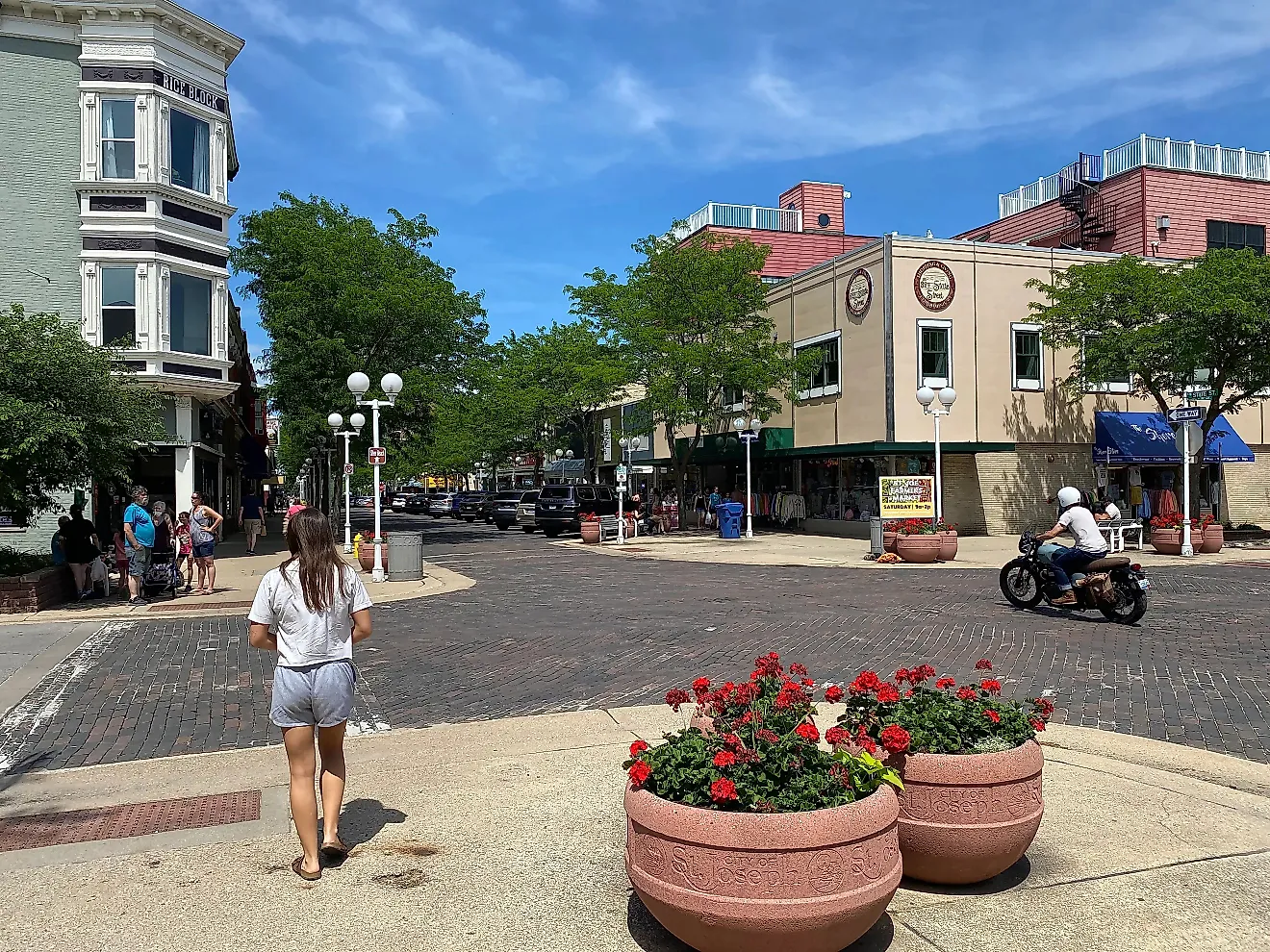
Michigan's multitudinous nature is well encapsulated by St. Joseph. One of the best beach towns on the Lower Peninsula, it is great for families, winos, antique hunters, and just about any other niche demographic. My first time through this Lake Michigan getaway was during my grubby van-life days. Having frolicked around Warren Dunes State Park, one of Michigan's 103 State Parks, by day, but uninterested in shelling out for a campsite that night, I took I-94 north to the aptly-named Lookout Park on a scenic bluff above the lake. To my delight, an authentic Mexican food truck had set up shop in this same narrow parking lot, giving me the opportunity to simultaneously satisfy my appetite and practice my Spanish. Whilst munching my burrito and watching the sun set, curious locals came by to check out my humble camper van. After a safe and restful sleep, I already awoke with a positive impression of St. Joe, and that was before I saw how cool the rest of the town turned out to be.
My next time through St. Joe was during a short road trip with my mum. As such, this visit surrendered the bohemian M.O. in favor of a classier approach. We experienced the Lake Michigan Shore Wine Trail, sampled some fudge, perused the Antiques on the Bluff market, and walked past the anglers and kite-fliers of St. Joe's iconic, two-lighthouse pier. Throughout town we noted scores of jovial families, couples young and old, and America 250 patriotism out the wazoo.
Saugatuck

The next morning, my mum and I rolled into the tranquil village of Saugatuck. This historic river community boasts the last remaining chain ferry in the country, which makes for a quirky shortcut to the beach. Saugatuck is also part of the Art Coast of Michigan, owing to its artistic heritage and on-going scene fueled by galleries, murals, music, and the Ox-Bow School of Arts. Additionally, as a creative workaround for COVID restrictions, Saugatuck pioneered the concept of the Social District, providing to-go drinks from participating establishments that can be enjoyed in public areas, while shopping, and while queuing at other popular restaurants. This legacy continues today, and has been adopted by several other Michigan communities, including St. Joe.
Finally, Saugatuck is overtly LGBTQ+ friendly, as evidenced by its ubiquitous embrace of Pride Month. While I've never noticed a Michigan community to be overtly unfriendly to any particular group, if you identify as queer, or wish to mark blue dots on your swing-state map, then Saugatuck is certainly for you.
Blue-Collared Copper Country

Whereas big cities and touristic towns tend to lean left, rural, blue-collared communities favor the right. It's not as if the Upper Peninsula is a perpetual Trump rally. Rather, it is populated by salt of the earth people grounded in nature and the economic bounty it provides. Or provided, part of the political crux. Nowhere is the "good old days" of 19th-century America more palpable than in the Keweenaw Peninsula's Copper County.
Michigan's Copper Rush kicked off the first industrial mining operations in the United States, preceding even California's Gold Rush. Stately towns such as Calumet and Houghton sprouted all around the mines. Their red-brick structures, and many mining sites, above and below ground, are now enshrined as part of the Keweenaw National Historical Park and are visited by the Copper Country Trail National Byway.
Following the Copper Bust, some of these communities pivoted to timber, whereas others simply fizzled out. Further reinvention has occurred in the form of historical tourism and outdoor recreation but these pillars pale in comparison to the industry juggernauts of yesteryear. Case in point, Copper Harbor, even with Fort Wilkins Historic State Park, ferry access to Isle Royale National Park, adjacent old-growth white pine tracts, and exceptional mountain biking, hiking, and skiing trails all around, has a permanent population barely in excess of 100 people. For us visitors, this means wilderness isolation that is rare in the lower 48 and a refreshing lack of pretense.
Mackinac Island

Another part of Michigan that seamlessly blends nature and history is Mackinac Island. This timeless rock bridges the gap between the Upper and Lower Peninsula, as well as Lake Michigan and Lake Huron. Having ferried over from St. Ignace or Mackinaw City, you will find a Victorian village where horse-drawn carriages and cruiser bikes have replaced cars. The first few blocks are built up with historical inns, museums populated by period actors, world-famous fudge shops, and everyday tourist amenities. At the east end of town, Fort Mackinac beckons history buffs to its hilltop, where regular tours and musket firings take place, once again thanks to skilled, period-appropriate staff. The remainder of the island belongs to the trails, trees, limestone arches and sea caves of Mackinac Island State Park.
National Lakeshores
Michigan is blessed with two out of the United States' three national lakeshores. The first encapsulates Lake Superior's dynamic beauty, whereas the second highlights Lake Michigan's massive sand dunes.
Pictured Rocks

Pictured Rocks National Lakeshore spans 42 miles of Lake Superior's southern shoreline between Munising and Grand Marais. The colourful, mineral-stained cliffs after which the lakeshore takes its name constitute its western third. These "Pictured Rocks" can be seen by boat, or in part via cliff-top trail viewpoints. But for a truly intimate, fully immersive experience, get yourself in a kayak. I joined the 5-hour Ultimate Tour put on by Pictured Rocks Kayaking. That might sound like a lot, but it was actually just 3 hours of light paddling, plus an hour of boat transit at the bookends. Along with the upwards of 200-foot sandstone cliffs, we visited several sea stacks, caves, and arches, and spotted such avian wonders as the peregrine falcon and bald eagle.
Sleeping Bear Dunes

Michigan is home to the largest collection of freshwater sand dunes in the world. Nowhere is this better represented than Sleeping Bear Dunes National Lakeshore. Jumping on the Benzie Manistee Pure Michigan Byway at its southern terminus, motorists get to experience the entirety of this 65-mile, vertically-sandy shoreline. Highlights include the Dune Climb, which is easily accessible from the parking lot and teases burning legs with multiple false plateaus, the 450-foot namesake dune, and the historic villages of Empire and Glen Haven. M-22 then detours onto the Leelanau Peninsula, with its wineries and maritime charm, before ending in the spritely districts of Traverse City.
Scenic Byways
Michigan hosts 23 Pure Michigan Byways, three of which are National Scenic Byways. But that isn't the extent of the state's scenic drives. Some routes bear no official designations, but are perhaps all the more appealing for it. We've already covered the Copper Country Trail on US-41, the Benzie-Manistee on M-22, and visited a few stops along the West Michigan Pike Historic Byway on US-31, so let's highlight three additional drives, one state, one federal, and one free agent
Sunrise Coast

Stretching 200 miles between the anonymous city of Standish and the extravagant Mackinaw City, the Sunrise Coast Pure Michigan Byway on US-23 hugs Lake Huron's western shoreline. Its east-facing orientation offers excellent sunrise-watching opportunities for you early birds. Especially if you rally around the many piers and lighthouses that speckle the waterfront. With that said, the Sunrise Coast's swimming beaches, state parks, and maritime museums ensure stimulating pit-stops throughout the whole day.
River Road

After watching the sunrise in Oscoda, consider side-tripping off the Sunrise Coast in favour of the River Road National Scenic Byway. This 22-mile one-way inland detour parallels the Au Sable River, delving ever deeper into Huron National Forest in the process. Scenic and/or historical turnouts crop up every few miles, making for a dynamic experience. Some stops present panoramic viewpoints, others interpretive monuments, and others still lengthy wooden staircases down to the river's edge or multi-use trails through the jack pines.
Thumbcoast

Spanning Harsens Island up to the buzzing beach town of Caseville, the Thumbcoast hits a lot of beats in just 140 miles. So-called because of the geographical nub it follows in the southeast corner of the Lower Peninsula, this is not an official scenic byway of any kind, but it is one heck of a scenic drive nonetheless. The first part, on M-29, follows the west bank of the St. Clair River, before reaching the overlooked towns of southern Lake Huron on M-25. The best part was the side-trip paddle out to Turnip Rock from Port Austin, but I also enjoyed the quirky harbors and various museums en route.
Cultural Quirks

Michigan, like the rest of America, was founded by immigrants and shaped by their pursuits of happiness. The fruits of religious freedom and artistic expression can be found state-wide, but leap out in certain enclaves. For instance, Dutch Calvinists founded Holland, Michigan in 1847, bringing with them windmills, clogs, and the long-standing Tulip Festival. Likewise, Frankenmuth was established by pious farmers of a former German kingdom, inspiring the Bavarian architecture, attire, and novelties seen today in its commercial core.
Religious expression was paramount in Michigan's early days, but Michigan has also fostered creative expression over the centuries. We already stopped at Saugatuck, aka "The Art Coast of Michigan," but Charlevoix adds its own unique brushstroke in the form of "mushroom houses." The 28 earthy residences throughout the city's Earl Young Local Historic District were constructed by the titular architect between the 1930s-50s and feel like something plucked out of a Tolkien novel.
I Love Michigan

Canada claims to accept all religions, nationalities, and points of views. Well, what an opportunity the next few years are to demonstrate our open-minded values. Republican or Democrat, Woke or MAGA, it's foolish to cut people off because they check the wrong box, wear the wrong colours, or live south of a certain latitude. Let's start intermingling again. Let's shake hands and share a pint with Americans from all walks of life, perhaps starting with Michigan. After all, with its mile-long beaches, four-season festivities, epic road trips, and storied towns, Michigan always shines a convivial light. I'm proud to be Canadian, and I'm happy to have Michiganders as my neighbours.