9 Overlooked Towns In Scotland Worth Visiting
Palm trees grow along the harbor at Plockton, thanks to a warm Atlantic current. Booksellers filled Wigtown's main street and turned it into Scotland's National Book Town. Every New Year's Eve, locals in Stonehaven swing flaming balls on wires through the streets. At St Monans, a 14th-century church stands on a rock above the waves. Film crews used Culross for Outlander because its 17th-century streets survived almost untouched.
Plockton

On the shores of Loch Carron is the town of Plockton, a working fishing village that looks like a film set. The Gulf Stream warms the water of this sheltered bay enough for "palm trees", which are actually New Zealand cabbage palms, to survive beside the traditional Highland cottages. Plockton Harbour is a small working harbor with lobster boats, creels, and seals that sit out on the rocks. A short walk from the harbor is Plockton Coral Beach, a small beach with calcified seaweed that looks like coral, unique to this part of the coast.
Calm waters in the sheltered bay make this one of the best places on the west coast for sea kayaking and boat trips, with trips to the seal colonies and nearby islands. This village has no through traffic, so visitors are either here for the quiet harbor, the pastel cottages on the hillside, or its proximity to the Isle of Skye. The village sits 15 minutes by road from Kyle of Lochalsh, the mainland gateway to the Isle of Skye via the Skye Bridge.
Wigtown

Wigtown is Scotland's National Book Town, a designation earned in 1998 when a group of residents and booksellers decided to rebuild the town's economy around second-hand books. It worked: the town is claimed to now have more bookshops per capita than almost anywhere in Britain, and the annual Wigtown Book Festival brings in authors and readers from across the country. The 10-day literary festival takes place in September/October and features author talks, debates, and live music, transforming a quiet village into a bustling cultural hub.
The Bookshop is billed as Scotland's largest second-hand bookshop, with around 100,000 books housed in a three-story townhouse. The shop also runs a popular Random Book Club, whose subscribers receive a surprise book by post each month. For those more interested in whisky, the Bladnoch Distillery is Scotland's southernmost whisky distillery, located on the outskirts of town, producing single malt and offering tours.
Dunkeld

A historic cathedral town where the River Tay meets the Highlands, Dunkeld has been a place of worship since a Celtic monastery was established around the year 570. The oldest religious site in the village still standing is the Dunkeld Cathedral. This partially ruined medieval cathedral was founded in 1260 on the banks of the River Tay. The nave is a roofless ruin, but the choir is still used for worship. The cathedral, at the end of Cathedral Street and its restored 17th-century streetscape, is one of the most photographed settings in Perthshire.
Across the 1809 Thomas Telford's Bridge, near the town of Birnam, is the Hermitage. This National Trust for Scotland property has towering Douglas firs, the Black Linn Falls on the River Braan, and Ossian's Cave, all reachable by a short, easy walk through the woodland. There was an ancient oak forest in the area as well, and it inspired Shakespeare's Macbeth. The 500-600-year-old Birnam Oak is the sole surviving tree associated with the historic Birnam Wood, and is just a few steps from the River Tay.
Culross

Outlander and other period productions have used Culross as a filming location, and a quick walk through town shows why. The village is billed as Scotland's most complete surviving 17th-century burgh, a time capsule of crow-stepped gables, red pantiled roofs, and cobbled streets that slope down to a small harbor on the Firth of Forth. The town is full of carved stones and inscribed lintels above doorways, many dating to the 17th and 18th centuries, marking the trades and families that once lived there.
Culross Palace sits on the west side of town. Built between 1597 and 1611 by Sir George Bruce, a local coal mine owner who made his fortune exporting salt and coal, the structure is an ochre-colored 17th-century house with painted ceilings, period furnishings, and a reconstructed kitchen garden open to visitors every day. North of town is the Culross Abbey, ruins of a Cistercian monastery founded in the 13th century. The ruins are worth exploring, especially with a legend of a secret tunnel and a piper who disappeared inside it.
Inveraray

Inveraray is widely regarded as Scotland's first planned town, laid out in 1745 by the 3rd Duke of Argyll with straight, wide streets and dignified Georgian homes. Sitting at the head of Loch Fyne, Scotland's longest sea loch, the town is also the ancestral seat of Clan Campbell, one of Scotland's most powerful families. Inveraray Castle is a neo-Gothic castle, the ancestral home of the Duke of Argyll and Clan Campbell, and remains a family home. The Armoury Hall has the highest ceiling in Scotland, at 21 meters.
On the hill above the castle stands Dun na Cuaiche, an 18th-century watchtower at about 248 meters, reached by a steep woodland walk of roughly 1.5 miles. From the top there are wide views of the castle, town, and Loch Fyne. Between the loch and the center of town is Inveraray Jail, a historic 19th-century prison and courthouse. Today it is a living museum, with costumed guides, original cells, and an escape room in the Debtor's Prison. The combination of clan history, planned architecture, and loch-side setting makes Inveraray a unique town.
Melrose

In the Tweed Valley, in a region of abbeys, rolling hills, and textile history, is the village of Melrose. The town has a long history: Romans built a fort here, Cistercian monks founded an abbey in 1136, and Walter Scott lived nearby at Abbotsford. Melrose Abbey is considered one of the finest examples of medieval architecture in Scotland. A casket discovered in 1996 at the abbey is believed to contain the heart of Robert the Bruce, reburied under a memorial stone in 1998. Down the street is the Trimontium Museum, a 5-star museum dedicated to the Roman fort that once stood nearby.
Today, Melrose is a small but lively town with independent shops, gardens, and a strong cultural calendar. The Borders Book Festival is an annual festival held in June. Set in the grounds of Harmony Garden, the festival draws authors and readers to the small village. Melrose was also the birthplace of rugby sevens in 1883, a fast-paced variant of rugby union, and the Melrose Sevens tournament is still played annually at The Greenyards, celebrating the sport's historic roots.
St Monans

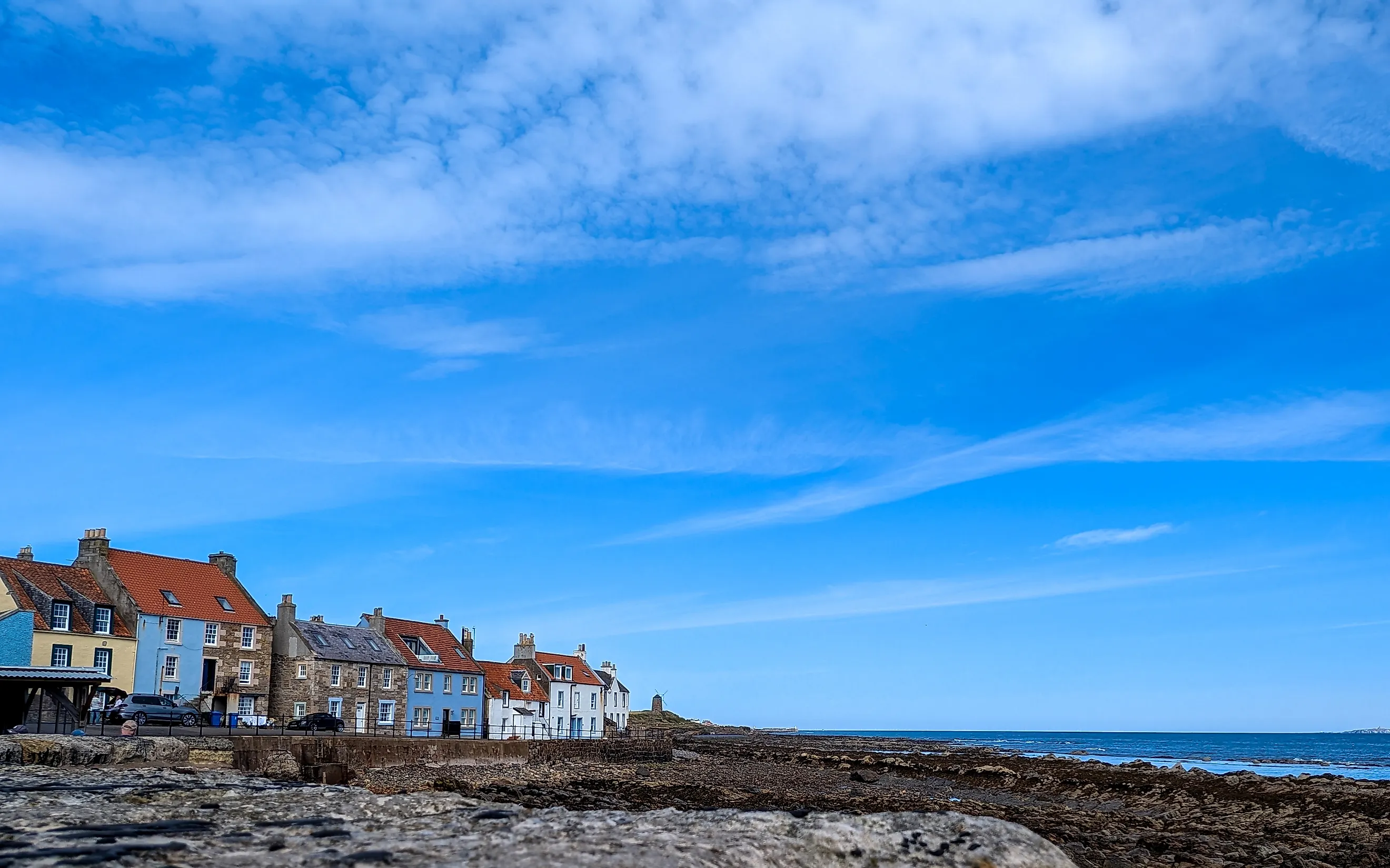
St Monans is a working fishing village that has not been gentrified into a tourist postcard. The harbor is still active, the cottages are still lived in, and the 14th-century St Monans Auld Kirk sits on a rock directly above the sea, with waves visible from the churchyard. St Monans Harbour is the heart of the village, with creels, lobster boats, and the classic view back to pantiled cottages on the hillside. Sitting on the Fife coast, St Monans is part of a string of historic fishing villages, including Anstruther and Pittenweem.
Follow the Fife Coastal Path to the east, and walkers will pass the St Monans Tidal Pool before reaching the St Monans Windmill and Salt Pans. This restored 18th-century windmill once powered a salt-panning industry. Display boards explain the process of boiling seawater to extract salt, a major industry when coal and sea met the right coastline. Follow the Fife Coastal Path to the west, past the Auld Kirk, and visitors will discover Newark Castle. The ruined 16th-century manor is now only a photogenic shell of its former glory on the cliff edge.
Cullen

A former royal burgh with a wide sandy beach, Cullen sits on the North Sea about 90 kilometers east of Inverness. The Cullen Viaducts, a dramatic series of Victorian railway viaducts completed in 1886, divide the town into two parts and are now part of a coastal walking and cycling path. Through the viaduct arches, walkers get some of the best views of the town and Cullen Bay. On the bay is Cullen Beach, a sandy beach with a distinctive set of offshore rocks known as the Three Kings. A few miles east along the coast at Portknockie is Bow Fiddle Rock, a sea arch shaped like the tip of a fiddle bow.
The two divisions of the town are the upper town and the Seatown, a tight cluster of 17th-century cottages by the harbor. Seatown has a claim to culinary fame: the Cullen Skink originated here. This traditional smoked haddock, potato, and onion soup is available at cafes and restaurants throughout the village. Rockpool Cafe, a small corner cafe a block from the viaducts and right on the town square, is a popular place to order Cullen Skink.
Stonehaven

Another working harbor town, Stonehaven, is best known as the home of the Stonehaven Fireballs Ceremony. An annual Hogmanay tradition held on New Year's Eve, locals swing flaming balls on wire and parade through town, creating one of Scotland's most distinctive and dramatic New Year celebrations. The ceremony concludes when participants hurl any remaining fireballs into Stonehaven Harbour to cast away the old year's troubles. During the rest of the year, the harbor is active with fishing boats and full of seafood restaurants, ice cream shops, and the Stonehaven Tolbooth Museum. This small museum is in the oldest surviving building in Stonehaven, a 16th-century tolbooth that once served as a courthouse and prison, and now houses local history exhibits.
Hikers can walk south from the harbor on the Stonehaven-Dunnottar coastal path, which heads towards the Dunnottar Cliffs. The path descends past these cliffs above Castle Haven and continues down to Dunnottar Castle. The ruined castle sits on a cliff-top promontory and is surrounded on three sides by the North Sea. The castle played a role in the Scottish Wars of Independence and the Scottish Reformation. The castle is most famously known as the place where a tiny garrison successfully hid the Honours of Scotland (the Scottish crown jewels) from Oliver Cromwell's invading army in the 17th century.
Overlooked Towns Worth a Look
These nine towns might be overlooked by international travelers who are only visiting Edinburgh, Glasgow, or even Inverness. But a short detour can prove that Scotland's best experiences are not always in the cities or well-known Highland villages. They can be found in a cathedral town where the River Tay meets the Highlands, a planned Georgian town where a clan castle still functions as a family home, or a harbor village known for a smoked-haddock soup. Not every road leads to international fame, but that is what makes these villages worth visiting.