9 Overlooked Towns In Ireland Worth Visiting
Most trips to Ireland run along the same well-worn line through Dublin, Galway, and the Ring of Kerry, and the coach parks fill accordingly. The trouble is that the country's real character was never concentrated in those few stops. It lives in the smaller places that the itineraries skip, where a pub session is played for the regulars rather than the tour groups and a twelfth-century tower stands without a ticket queue beneath it. The nine towns here are the ones that reward leaving the main road. Each offers something worth the detour, and none asks you to share it with a crowd.
Westport, County Mayo

Westport sits a few miles inland from Clew Bay on Ireland's western coast, and it does not look like its neighbors. The town was laid out to a planned Georgian design in the eighteenth century, with tree-lined malls following the Carrowbeg River and a formal octagon at its center. That architecture carries into the Westport Town Hall Theatre, which programs plays, comedy nights, and concerts through the year. Westport has collected tidy-town and quality-of-life awards for decades, yet it stays off most visitors' routes into Ireland.
The Great Western Greenway begins in Westport and runs 42 kilometers along a former railway line toward Achill Island, open to walkers and cyclists with the bay on one side and the Nephin hills on the other. Back in town, Matt Molloy's draws the evening crowd. The pub belongs to the flute player of The Chieftains, and its back room hosts traditional sessions most nights over a pint of Guinness.
Ballyvaughan, County Clare

Just 361 people lived in Ballyvaughan at the 2022 census, but the village punches well above that number as a base for the northern Burren. The limestone country here breaks into terraces and bare pavement, and the Wild Atlantic Way threads right through the middle of it. A short drive from the harbor, the Aillwee Burren Experience runs guided tours of a cave system carved into the hills, followed by a birds-of-prey flying display outside. For the coast itself, the lookout points along Ballyvaughan Bay open onto Galway Bay and the hills of Connemara beyond.
The village eats well for its size. Mr. Kebab turns out kebabs and pizzas near the water, and O'Loclainn's has poured whiskey and beer from a small, low-ceilinged bar on the corner for generations. It holds one of the largest whiskey collections of any pub in the west.
Doolin, County Clare

Doolin sits about 23 kilometers southwest of Ballyvaughan, and its reputation rests almost entirely on music. Traditional players have gathered in its pubs for decades, and the village is widely regarded as one of the homes of Irish folk in the country. Gus O'Connor's Pub runs sessions every night alongside plates of beef-and-Guinness stew and fish and chips. McGann's, a few doors along, keeps its own music schedule and kitchen going.
The land around Doolin matches the music. The Cliffs of Moher rise a few kilometers south, and the coastal path from the village walks the clifftop for roughly eight kilometers to the main viewing platform. Boats also leave Doolin pier for the Aran Islands and for the base of the cliffs, where the rock wall stands more than 200 meters above the Atlantic.
Dingle, County Kerry

Dingle is the only town on the peninsula that shares its name, out at the southwestern edge of County Kerry. It lies inside a Gaeltacht, one of the districts where Irish is still spoken as a daily language, and shopfronts and road signs carry the older names. West of town stands the Gallarus Oratory, a drystone chapel built without mortar and shaped like an upturned boat, which scholars date to somewhere between the seventh and ninth centuries. It has kept its interior dry for more than a thousand years.
The town works as hard on the present as on the past. Dingle Oceanworld sits on the harbor with sharks, rays, and a penguin colony among its tanks. A short walk away, the Dingle Distillery runs tours of its stills and pours tastings of the whiskey and gin it makes on site.
Kinsale, County Cork

Kinsale stands at the mouth of the Bandon River in County Cork, with a fort on each bank of the harbor. Charles Fort, built in the 1670s and 1680s under Charles II, is a star-shaped bastion fortress and one of the largest military installations in Ireland. Across the harbor sit the ruins of James Fort, the older of the pair, begun in 1602 and now reduced to low walls and outlines you can trace on foot. For the wider story, the Kinsale Museum lays out the town's long life as a fortified port.
Kinsale also earns a place on the winter calendar. Around the end of January, the town fills with Beatles tribute acts, scholars, and fans for the Kinsale Beatles Festival, a weekend of live music, talks, and panels devoted to the band.
Cobh, County Cork

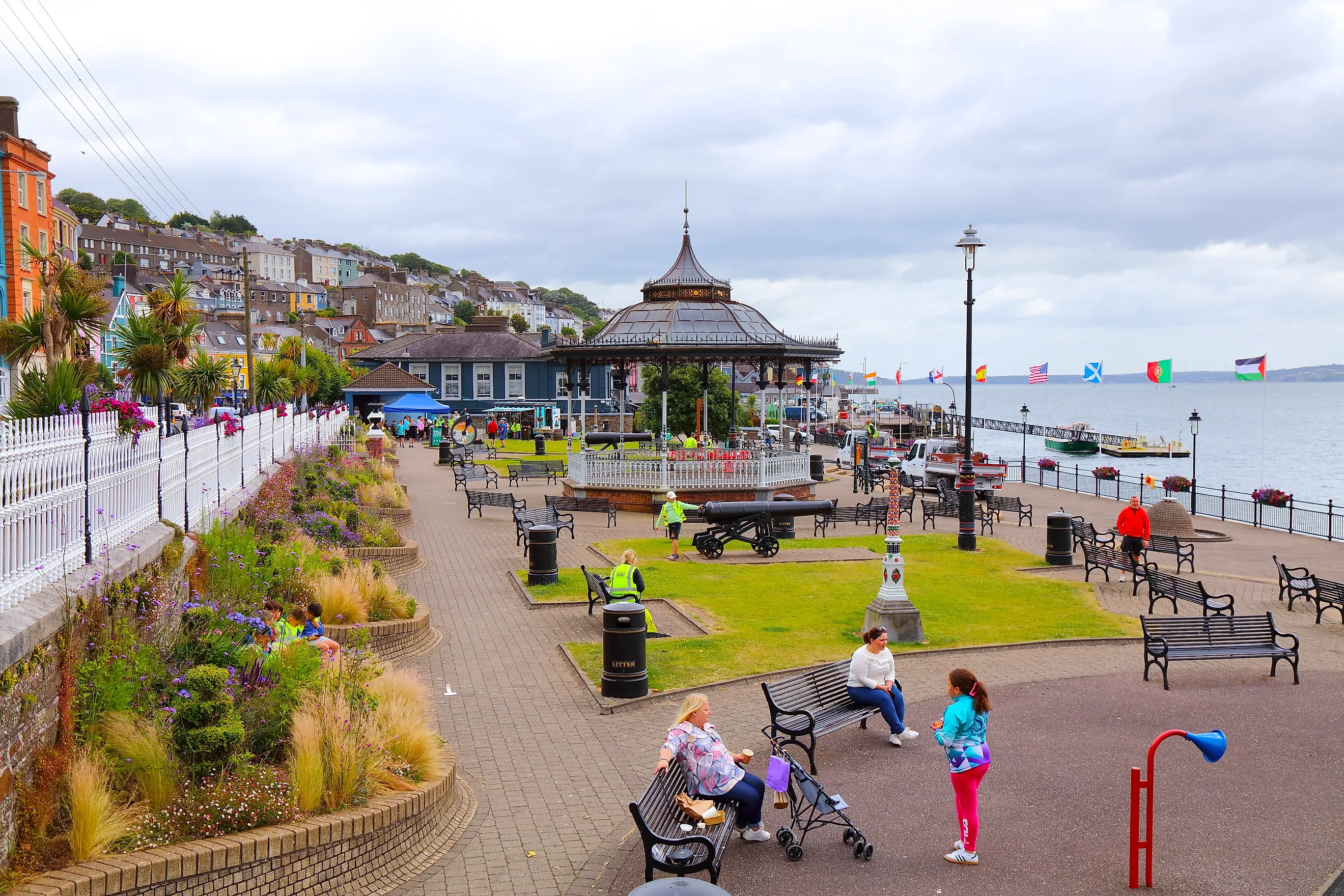
Cobh climbs the hillside of Great Island in Cork Harbour, its terraces of tall houses rising toward St. Colman's Cathedral. The town, known as Queenstown until 1922, carries two of the Atlantic's darkest stories. It was the final port of call for the Titanic on April 11, 1912, and 123 passengers boarded there before the crossing. The Titanic Experience Cobh occupies the old White Star Line ticket office where those passengers stepped aboard the tenders. Three years later, when a German U-boat sank the Lusitania off the Old Head of Kinsale, the survivors and many of the dead were brought here, the nearest large port. The Lusitania Peace Memorial in Casement Square marks the loss.
The Cobh Heritage Centre, set in a Victorian railway building on the waterfront, widens the lens to emigration. Some 2.5 million people left Ireland through this harbor, among them Annie Moore, the first immigrant processed at Ellis Island, whose statue stands on the quay.
Ardmore, County Waterford

Fewer than 500 people live in Ardmore, a seaside village about 15 kilometers from Youghal on the Waterford coast. Its history reaches back to the fifth century, when Saint Declan is said to have founded a monastery here, possibly before Patrick's mission. The 30-meter round tower that survives on the site dates to the twelfth century and is counted among the last of its kind built in Ireland, still standing in remarkable condition. From the monastery the Ardmore Cliff Walk loops about four kilometers around the headland, an easy hour above the bay.
The village also holds a Michelin star. House, the restaurant at the clifftop Cliff House Hotel, has kept its star every year since 2010, cooking Waterford produce and seafood in a glass-walled room that faces the water. A table there books well ahead.
Lismore, County Waterford

Inland from Ardmore, Lismore gathers around a castle above the River Blackwater. The castle traces its origins to the medieval period and remains a private residence of the Devonshire family. Visitors cannot enter the house, but the seven-acre walled gardens open to the public, along with a contemporary art gallery, with the castle rising behind them. Nearby, the Lismore Heritage Centre runs guided walks that cover the town's ecclesiastical past and its architecture.
Lismore keeps a full arts calendar too. The Blackwater Valley Opera Festival stages productions with leading singers each summer, several of them inside the castle grounds. In June, the Immrama Festival brings travel writers to town to read from and discuss their work, a fitting subject in a place people have long passed through.
Dalkey, County Dublin

Dalkey lies at the southern end of Dublin Bay, about half an hour from the city center by DART along the Irish Sea. The village grew up as a medieval port, and Dalkey Castle, a fortified merchant's town house from the fourteenth century, tells that story with costumed guides and a living-history program. From the castle it is a short walk to Dillon's Park and the harbor at Coliemore, which looks across a narrow channel to Dalkey Island and its Martello tower.
The village keeps close ties to Dublin without the bustle. Finnegan's, a pub on the main street, has long been a local fixture and serves seafood to a steady crowd. Each June the Dalkey Book Festival takes over halls, churches, and pubs across the village for four days of readings and conversation, drawing writers who share the literary tradition Dublin is known for.
Planning A Route Through Ireland's Quieter Towns
The nine towns split neatly by region, which makes them easy to string together. Westport, Ballyvaughan, and Doolin trace the western seaboard along the Wild Atlantic Way, while Dingle sits farther south on the Kerry coast. Kinsale, Cobh, Ardmore, and Lismore cluster across Cork and Waterford within an easy drive of one another, and Dalkey rounds off a trip near Dublin. A traveler with a week and a rental car can reach most of them without doubling back, and each stop trades the coach-tour crowds for music, history, or a quiet stretch of coast.