How Many State Parks Are Open Year-Round?
There is no single, clean answer to that question, and any article claiming otherwise is guessing. Unlike the National Park Service, which tracks all 63 national parks under one federal system, state parks are run by fifty separate state agencies, each with its own fiscal year, staffing budget, and definition of "open." A park can be open for day use but close its campground in December. It can stay open every day of the year but shut its only restroom building for the season. Because of that, no national database tracks year-round operation the way NPS.gov tracks visitation.
What can be said with confidence is why most state parks scale back in the off-season, and which parks buck that pattern entirely by building an amenity specifically designed to keep people coming through the gate in January as well as July. The eight parks below, one from each of eight states with especially strong park systems, do exactly that. Each stays open and functional year-round because of one specific feature, whether a heated cabin, an underground visitor center, a working ski lift, or a lodge suite with a furnace. None of them are guessing about their own hours. All of the details below come directly from each state's parks agency.
Why Most State Parks Close Down Part of the Year
Three forces drive seasonal closures more than anything else. The first is money. State park budgets are tied to state legislatures, and many agencies simply cannot justify paying rangers, plowing roads, and running water systems in a park that would see a handful of visitors a week in February. The second is physical access. Mountain parks in Utah, New York, and Michigan sit at elevations where snow makes roads impassable without heavy equipment, and pipes that are not drained before winter will burst. The third is staffing. Many state parks rely heavily on seasonal employees and volunteers who are simply not available, or not needed, once summer ends.
None of that means the parks themselves disappear. Most state park land remains legally open to the public year-round for hiking, even when the campground gate is locked and the visitor center is dark. The difference between "open" and "fully staffed and serviced" is where most of the confusion about this topic comes from.
Anza-Borrego Desert State Park, California

At 650,000 acres, Anza-Borrego Desert State Park is California's largest state park and the third-largest in the country. It stays open, and busy, every day of the year because its climate does the opposite of what most seasonal parks face. Winter is the peak season, not the dead one. Desert heat that can exceed 100°F (38°C) in summer keeps crowds thin, while October through May brings mild days and the park's famous wildflower blooms.
The park's Anza-Borrego Visitor Center is the clearest sign that this was built for year-round use. It is constructed almost entirely underground, set beneath a desert garden west of Borrego Springs, specifically to stay cool without heavy air conditioning. Inside, exhibits cover the park's paleontology and geology, including fossils from an extinct bird with a 16-foot (4.9-meter) wingspan. Outside, more than 500 miles (805 kilometers) of roads, many open to both vehicles and mountain bikes, wind through badlands, palm oases, and slot canyons in the California desert. A day-use fee of $10 per vehicle applies Friday through Sunday and holidays.
Caddo Lake State Park, Texas

Nine cabins at Caddo Lake State Park were built in the 1930s by the Civilian Conservation Corps, using pine, oak, and hickory harvested from the surrounding forest, with several featuring native ironstone fireplaces. They remain the park's overnight draw today, rentable in every season thanks to East Texas's mild winters, which rarely dip cold enough to threaten pipes the way a Rocky Mountain park would.
The park sits on Big Cypress Bayou and Caddo Lake, the only natural lake of any size in Texas, where bald cypress trees draped in Spanish moss create a maze of sloughs and channels. Paddlers can explore Saw Mill Pond by canoe or kayak, and anglers fish for any of the more than 70 species recorded in the lake. Alligators live in the park, and visitors are advised to review posted safety guidance before setting out on the water. A short network of trails leads to a historic CCC-built pavilion, and interpretive programs run on a seasonal schedule. Unlike parks that fully shutter facilities in winter, Caddo Lake's biggest closure is a single day. The cabins and group hall close only on Christmas Day.
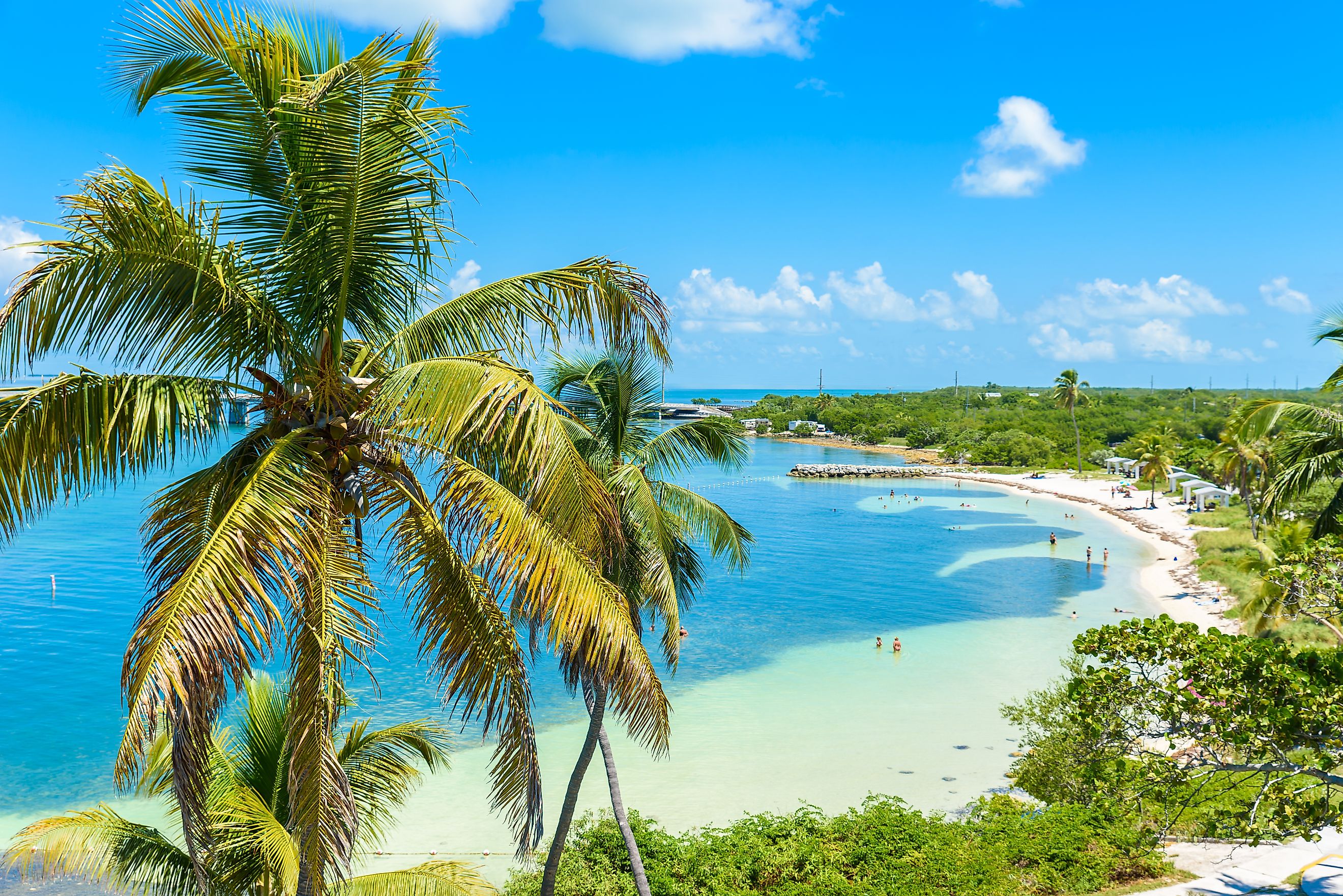
Bahia Honda State Park, Florida

Few state parks anywhere have a stronger claim to true year-round appeal than Bahia Honda State Park, a 524-acre island park in the Florida Keys between Marathon and Key West. Three duplex cabins, six units in total, sit on stilts overlooking the water, each with central air conditioning and heat, a full kitchen, and its own wood deck. Reservations open 11 months in advance and fill quickly regardless of season, a sign that this park was never designed around a summer-only calendar.
The park's beaches, Sandspur, Calusa, and Loggerhead, are regularly ranked among the best in the country, and the surrounding reef draws snorkelers to view the underwater habitat just offshore. A marina, boat ramps, and a concession renting kayaks and snorkel gear round out the amenities. Because the road to the cabins passes beneath the historic Bahia Honda Bridge, vehicles must be under 6 feet 8 inches (2 meters) tall to reach them. The park does note that day-use areas can reach capacity and temporarily close, most often between December and March, when its year-round popularity peaks rather than fades, an inversion of the pattern seen at most Florida parks further north.
Porcupine Mountains Wilderness State Park, Michigan

Michigan's largest state park, at nearly 60,000 acres along the Lake Superior shoreline in the Upper Peninsula, does not simply tolerate winter, it operates a ski hill built for it. Porcupine Mountains Wilderness State Park, known locally as "the Porkies," runs its own downhill ski area with a chairlift, a rope tow, and 15 runs dropping about 560 vertical feet, alongside more than 20 miles of groomed cross-country ski trails connected to warming shelters.
Overnight guests can choose from 19 rustic log cabins and several yurts scattered through the old-growth forest, heated by wood stoves or propane furnaces, with a handful available for booking in every season. The park's other headline features, Lake of the Clouds and the Presque Isle River corridor, draw hikers across more than 90 miles of trails in warmer months. In Michigan's case, the amenity that keeps the park alive in January is not a workaround for winter, it is the entire reason many visitors come.
Allegany State Park, New York

New York's largest state park, at 65,000 acres in the Enchanted Mountains near the Pennsylvania border, calls itself a four-season destination, and its lodging backs that up. Allegany State Park maintains more than 300 cabins and cottages across its two developed areas, Red House and Quaker, and a substantial share of them are specifically "winterized," meaning they are insulated and heated for cold-weather rental rather than closed after Labor Day.
That infrastructure supports the park's other winter draw, the Art Roscoe Cross Country Ski Area, which offers more than 35 miles of groomed trails considered among the best in the Northeast, plus 90 miles of groomed snowmobile trails elsewhere in the park. In warmer months, the same trail network shifts to hiking, mountain biking, and horseback riding, while two lakes, Red House and Quaker, offer swimming beaches and non-motorized boating. Rock formations known as Thunder Rocks and the Bear Caves are popular day-use stops. Some campsites remain seasonal, but New York's largest state park is explicit that it is open to visitors year-round.
Wasatch Mountain State Park, Utah

Wasatch Mountain State Park, in Utah's Heber Valley, runs two entirely different identities depending on the season, and both are fully built out rather than improvised. In summer, visitors book tee times on one of four 18-hole golf courses across the park's Wasatch Mountain and Soldier Hollow complexes. In winter, those same grounds convert to nearly 70 miles of groomed snowmobile trails, with warming stations at the golf clubhouse and visitor center.
The park's clearest year-round anchor is Soldier Hollow, the cross-country skiing and biathlon venue built for the 2002 Winter Olympics. It now operates in every season, offering lift-served snow tubing, Nordic skiing, and snowshoeing in winter and mountain biking and biathlon-style shooting events in summer. Cabin rentals at the park remain available straight through the winter months, and the historic Tate Barn and Huber Grove farmstead add a cultural stop to a visit. Located roughly 50 miles southeast of Salt Lake City, the park sits close enough to the capital to draw day-trippers in every season Utah's tourism calendar covers.
Mount Spokane State Park, Washington

Most state parks that host winter sports lease out a hill and call it a bonus feature. Mount Spokane State Park does something rarer. A full lift-served ski resort operates entirely within its boundaries. Mt. Spokane Ski and Snowboard Park covers roughly 1,700 skiable acres across 52 runs, served by six chairlifts and a surface lift, making it one of the larger ski operations located inside any state park in the country.
The mountain's history explains why. Spokane's ski club began developing runs on Mount Spokane in the 1930s, and the first double chairlift in the world was installed there in 1946. The area was formally reclassified from a recreation area to a full state park in 1974. Beyond the downhill terrain, the park grooms nearly 37 miles of Nordic ski trails, with warming huts stocked with wood stoves along the route, plus 16 miles of trails set aside for snowmobiling. Summer visitors trade skis for roughly 100 miles of hiking trails and 80 miles shared by mountain bikers and equestrians, reaching a 5,883-foot (1,793-meter) summit with views into Idaho and Washington's Selkirk Mountains.
Itasca State Park, Minnesota

Established in 1891, Itasca State Park is Minnesota's oldest state park, and it is best known as the source of the Mississippi River, where visitors can walk across the water on a line of stepping stones near where the river begins its 2,300-mile journey to the Gulf. Much of the park's overnight lodging, including the log cabins built in the 1930s near Douglas Lodge, closes for the season between early October and Memorial Day weekend.
The exception, and the reason Itasca counts as a year-round destination, is the Four-Season Suites, a set of two-room units near Douglas Lodge with kitchenettes, central heat, and air conditioning, priced lower in winter than in summer. The nearby Jacob V. Brower Visitor Center and the Wilderness Sanctuary, a 2,000-acre National Natural Landmark within the park, remain accessible for winter hiking and snowshoeing. Visitors planning a cold-weather trip to this stretch of northern Minnesota should book the Four-Season Suites specifically, since most of the park's other historic cabins simply are not available outside the warmer months.
Plan Around the Amenity, Not the Season
The parks above share one trait that separates them from the seasonal rule. Each built something, a cabin with a furnace, a visitor center dug into a hillside, a full ski hill, that gives people a reason to visit when the calendar says they shouldn't. That is a more useful way to plan a winter or shoulder-season trip than searching for a definitive list of "year-round" parks, since even the parks above have exceptions worth checking before booking. Confirming current hours directly with the relevant state parks agency remains the safest step before any visit, since fees, reservation windows, and facility closures can vary each year.