The Snake Infested State Parks In The Appalachians
The Appalachian Mountains are prime snake country, and two venomous species in particular, the timber rattlesnake and the copperhead, love precisely what the range offers: sunny rock outcrops to bask on, boulder fields and crevices to den in, and forests packed with mice to eat. A handful of state parks strung along the range are especially snaky. Here are the Appalachian state parks where you are most likely to meet a serpent, and how to share the trail with it safely.
Cheaha State Park, Alabama

At the far southern tip of the Appalachians, Cheaha State Park crowns the highest point in all of Alabama and sits inside the sprawling Talladega National Forest, which is well known for its venomous snakes. Both timber rattlesnakes and copperheads patrol the rocky slopes and sun-warmed overlooks here, right where hikers tend to pause for the view. The reassuring part is that both species would far rather quietly slip away than tangle with a person.
Hanging Rock State Park, North Carolina

Perched in the rugged Sauratown Mountains, Hanging Rock ranks among North Carolina's snakiest state parks. It is one of the relatively few places in the state where the copperhead and the timber rattlesnake share the very same slopes. Researchers who tracked the park's rattlesnakes documented multiple winter dens set into rock crevices, and found that the snakes fan out across the mountain in summer, which is exactly when hikers are out in force too. Both venomous species are present, alongside a whole cast of harmless ones.
Cumberland Mountain State Park, Tennessee

Up on Tennessee's Cumberland Plateau, Cumberland Mountain State Park is classic copperhead territory, with timber rattlesnakes in the mix as well. Tennessee is home to four venomous snakes, and two of them turn up here among the forested trails and rocky creek banks. Copperheads in particular are dangerously easy to walk right past, since their coppery, hourglass-banded bodies melt almost perfectly into a trail carpeted with fallen autumn leaves.
Grayson Highlands State Park, Virginia

Famous for the wild ponies that roam its high, open balds, Grayson Highlands sits among the loftiest terrain in Virginia, where the Appalachian Trail crosses rocky, sun-soaked ridgelines. That high, rocky, exposed habitat is textbook timber rattlesnake country. Most hikers come for the ponies and the panoramic views, but the same boulder-strewn slopes that make the scenery so dramatic also make ideal basking ledges and denning spots for rattlers, so it pays to watch where you step.
Hickory Run State Park, Pennsylvania
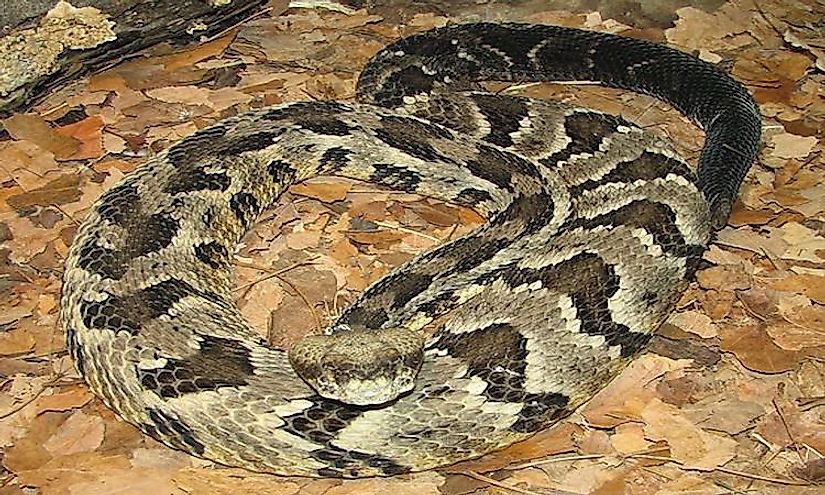
Pennsylvania holds one of the largest remaining timber rattlesnake populations in the eastern US, and Hickory Run, in the Pocono region, is a prime example of why. The park's thick forests, clear streams, and especially its enormous Boulder Field, a vast glacial jumble of angular rocks, create perfect reptile habitat. Timber rattlesnakes and eastern copperheads both occupy the rocky ridges and talus slopes, basking wherever the forest opens out onto bare, sun-warmed stone.
Harriman State Park, New York

At the northern reaches of the range, in New York's Hudson Highlands, Harriman State Park is one of the most important timber rattlesnake strongholds anywhere in the region, with copperheads sharing the same rocky ridges. The Appalachian Trail threads directly through the park's maze of ridges and valleys, which conceal numerous snake dens. It is living proof that Appalachian snake country runs all the way from Alabama to the very doorstep of New York City. Wherever you hike these parks, though, the rules are simple and genuinely reassuring: snakes are not out to get you. Both the timber rattlesnake and the copperhead are shy, superbly camouflaged ambush hunters that strike people only when stepped on or grabbed. Watch where you put your feet and hands around rocks and logs, keep dogs leashed, never try to handle or kill a snake, and give any you spot a wide berth. Do that, and these snake-rich parks are as safe as they are beautiful, while the snakes, which are protected and keep the rodent population in check, will be only too happy to avoid you right back.