The Oldest Carousels In the United States
Before they're ready to tackle the roller coasters and thrill rides that dominate most theme parks, kids get their first taste of an amusement park aboard the gentlest of rides: carousels. A staple of fairs since the late 1800s, they continue to be the first proper ride most people experience growing up.
In Oak Bluffs, Massachusetts, and Watch Hill, Rhode Island, generations have been handing that memory down on the same wooden horses since the 1880s. Ranked here by the build year given in each carousel's National Historic Landmark or National Register nomination, the oldest of these rides are still going strong, whether you call them merry-go-rounds or carousels.
1. Flying Horses Carousel, Oak Bluffs, Massachusetts and Flying Horse Carousel, Watch Hill, Rhode Island (Tie)

The Flying Horses Carousel was built by Charles W.F. Dare for Coney Island in 1876, and ties for first place as the oldest operating platform carousel in the country, with a second carousel attributed to the same maker in Rhode Island. Consisting of 20 stationary horses and four chariots attached to a rotating floor, it moved to Oak Bluffs on Martha's Vineyard in 1884, and since 1889 it has been located at the foot of Circuit Avenue.
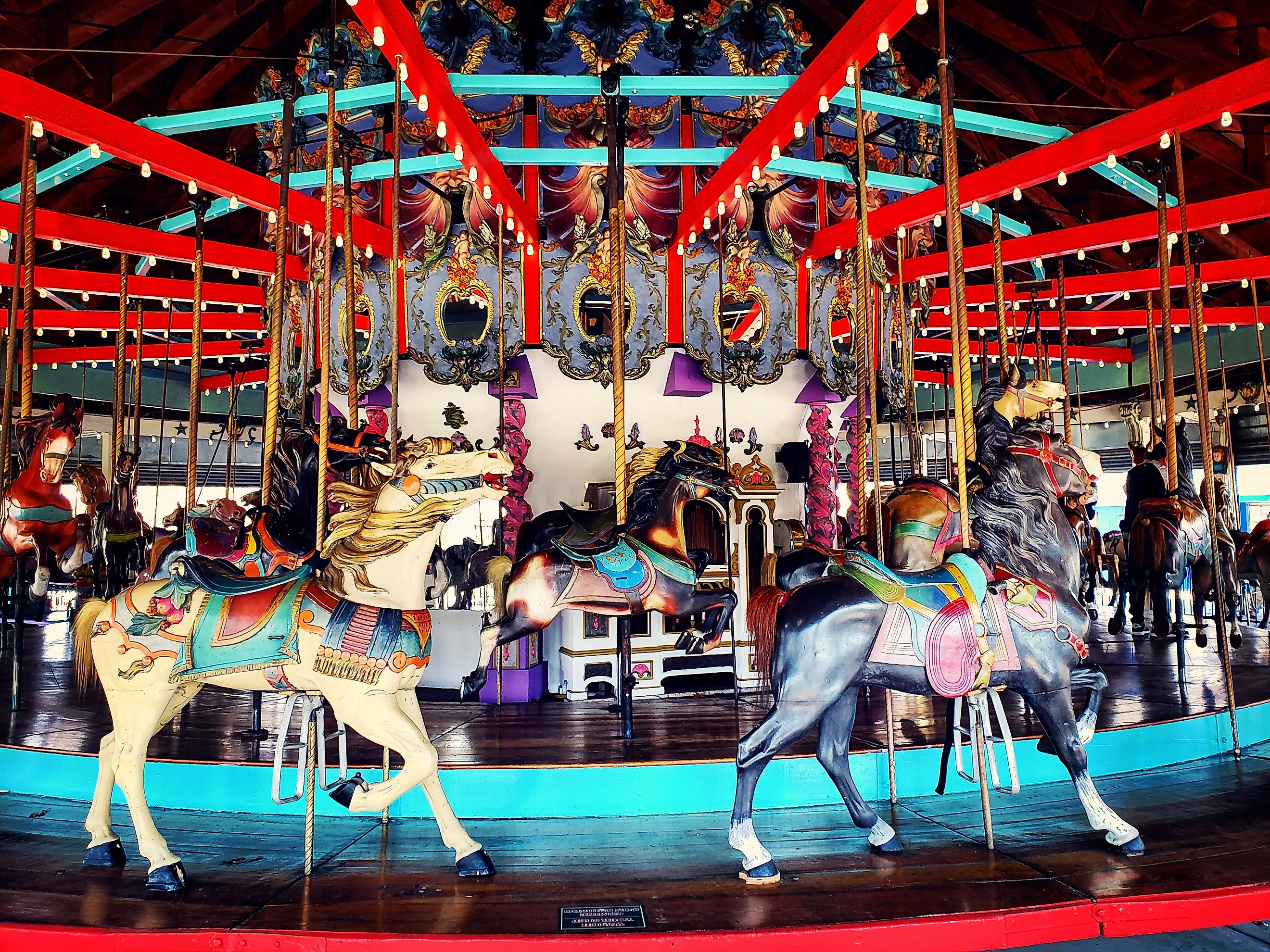
Each of its elegant hand-carved horses features real horsehair and glass eyes, while riders on the outside horses can make a game out of their ride. Two chutes, one inside the platform and one outside, dispense steel rings that riders grab as they pass, and a single brass ring is loaded at the bottom of each stack; whoever pulls it wins a free ride. Now owned by the Vineyard Preservation Trust, the carousel celebrated its 150th birthday in summer 2026.

Watch Hill's Flying Horse Carousel was built in 1876 and is also attributed to the makers of the Oak Bluffs ride. The carousel horses at this charming beach village at the southwestern tip of Westerly hang from chains rather than standing on a floor, and they swing outward as the ride picks up speed, hence the name. Its horses are more plainly carved than those at Oak Bluffs, leading many experts to suggest it's the older of the two. A traveling carnival left it behind in 1883 and never came back for it.
The ride was horse-powered until water took over in 1897, and each of its 20 horses began life as a spring rocking horse, a discovery made by Gary Anderson, the Connecticut artist who has refurbished them since 1993. The hurricane of 1938 buried the horses in the dunes and destroyed three chariots that were never replaced. Only the outside riders here get a shot at the brass ring.
2. Crescent Park Looff Carousel, Riverside, Rhode Island and Looff Carousel at Slater Park, Pawtucket, Rhode Island (Tie)
Danish-born carver Charles I.D. Looff is credited with Coney Island's first carousel, also in 1876. That ride burned in the 1911 Dreamland fire, but by then, Looff had moved his business to Crescent Park, an amusement park on Narragansett Bay in the Riverside section of East Providence. It was here in 1895 that he built this machine as his showroom. The park is long gone, and the Crescent Park Looff Carousel is the only ride left from it, still in the building Looff designed for it.
Fifty feet across with 62 hand-carved figures and four chariots, it's decorated with beveled mirrors, glass jewels, and colored pressed-glass windows. The Rhode Island General Assembly named it the State Jewel of American Folk Art in 1985, and the National Park Service made it a National Historic Landmark in 1987. The city runs it on weekends from late May, $2 a ride, and free for children under three. The brass ring arm is still in use.

The year 1895 also saw Looff build a smaller stationary machine for Lee Funland in Troy, New York. It was moved to Slater Memorial Park in Pawtucket in 1910, where it has run ever since in a 12-sided Looff-style building. The city calls it the oldest Looff "stander" carousel in the world, with its animals fixed rather than jumping. Looff made up for the lack of motion with speed, and the platform still turns at nine miles per hour.
The ride features 44 horses, three dogs, a lion, a camel, a giraffe, and two chariots, with a band organ built in 1909. The ride closed in 1967, the city put it up for sale in 1971, and residents raised the money to restore it, reopening it in 1979. The National Carousel Association named it Historic Carousel of the Year in 2018, and a ride that cost a nickel in 1910 costs a dollar today.
3. Highland Park Dentzel Carousel, Meridian, Mississippi
Gustav Dentzel, the Philadelphia cabinetmaker who founded the Dentzel carousel firm, built the Highland Park Dentzel Carousel in 1896. It went on show at the 1904 Louisiana Purchase Exposition, the St. Louis World's Fair, and Meridian bought it in 1909 for $2,000. The city even built a custom home for it in Highland Park from a Dentzel blueprint, the only such building still standing with its Dentzel carousel inside.
The carousel is 30 feet across with two rows of 20 standing horses, eight other animals including a lion, tiger, two giraffes, two goats, and two deer, along with two chariots. It's the only two-row stationary Dentzel menagerie left anywhere, and three tiers of original oil paintings circle the center.
4. Cass County Dentzel Carousel, Logansport, Indiana

Robison Park, a trolley park north of Fort Wayne, opened this stationary Dentzel menagerie carousel in 1902. When the park closed in 1919, Fort Wayne resident Frank Franz bought the ride and shipped it 60 miles southwest to Logansport. Four more private owners followed before money was raised by the local Jaycees, a civic club for young adults, in 1972 to keep it in town.
The ride's 43 Dentzel animals include horses, reindeer, goats, giraffes, a lion, and a tiger, and the ring arm drops 70 silver rings and one brass ring per ride. Here, the brass ring earns a free-ride token that never expires.
A full restoration at The Carousel Works in Mansfield, Ohio, in 1993 brought back the original colors, and the carousel now runs from Memorial Day weekend to Labor Day inside the McHale Community Complex in Riverside Park, at just a dollar a ride.
5. Forest Park Carousel, Queens, New York

Daniel Carl Muller, a Dentzel-trained carver, opened D.C. Muller and Brother in Philadelphia in 1903, and his Forest Park Carousel is one of only two survivors from his business. Built that year for Lakeview Park in Dracut, Massachusetts, it was sold off after the park burned in the 1950s. It was bought in 1972 to replace a Dentzel carousel in Forest Park that had burned in 1966.
The ride has 52 figures, as well as its original band organ, and the outside row of military-style horses is Muller's signature work. It stopped running in the 1980s, fell into disrepair, and reopened in May 2012 under NY Carousel, which has built a small amusement village around it. The city's Landmarks Preservation Commission made it a New York City landmark in June 2013.
Reach For The Ring
The National Carousel Association puts the number of golden age wooden carousels still operating in North America at 150, out of the 2,000 to 3,000 built between the 1880s and the 1930s, and the ones we've included above are the oldest of them.
Rides still cost only a buck or two, and ring arms still swing out at some, offering a few lucky folks a free ride or two. And if a child in your group has never been on one, there's no better place to start than on a horse a great-grandparent might have ridden.