The Oldest Castles In America
By definition, a castle is a fortified residence built for a ruler or noble, generally in the medieval era, combining domestic quarters with military defenses. America's oldest buildings come well after the Middle Ages, but many are still called "castles" for a variety of reasons. Some were forts designed to protect harbors, while others were private homes whose fancy architecture or deep-seated local history earned them the name. Dating from the colonial period through the early nineteenth century, these structures document changing approaches to defense, wealth, and domestic design. Better yet, their surviving walls, furnishings, and additions are mostly open for you to see and explore today, revealing how their various uses changed across successive generations.
Bacon's Castle - Surry County, Virginia - 1665

Built in 1665 for merchant and planter Arthur Allen, Bacon's Castle in Surry County is the oldest surviving brick dwelling in the United States. Despite its name, the building was constructed as more of a residence rather than a fortified castle, although its solid brick exterior was impressively hardy for its time and location. Its High Jacobean design includes clustered brick chimneys and curved gables, features rarely preserved in American houses from this period.
The name comes from Bacon's Rebellion in 1676, when Nathaniel Bacon's supporters occupied the property for approximately four months, although Bacon himself never lived there. Today, Preservation Virginia operates the house as a museum, with guided tours exploring its architecture, successive owners, and the lives of the enslaved people who worked on the estate.
The grounds include a reconstructed seventeenth-century English formal garden, an 1830 dwelling formerly for enslaved people, a period-accurate smokehouse, and a barn dating to around 1700, all showcasing how the property functioned as a working Southern plantation as well as an upscale home.
Castillo de San Marcos - St. Augustine, Florida - 1672-1695
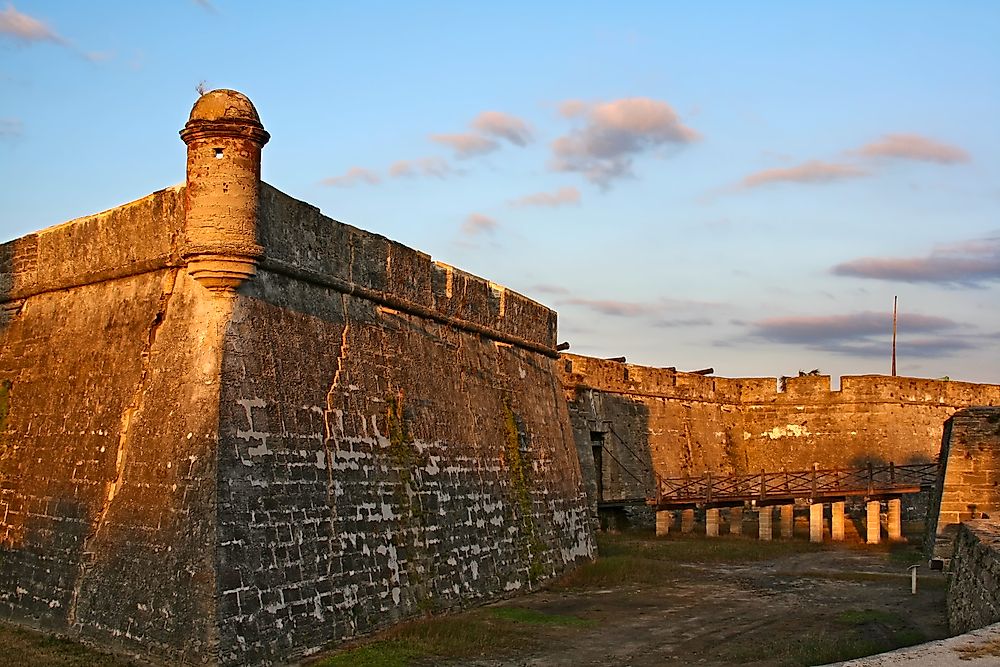
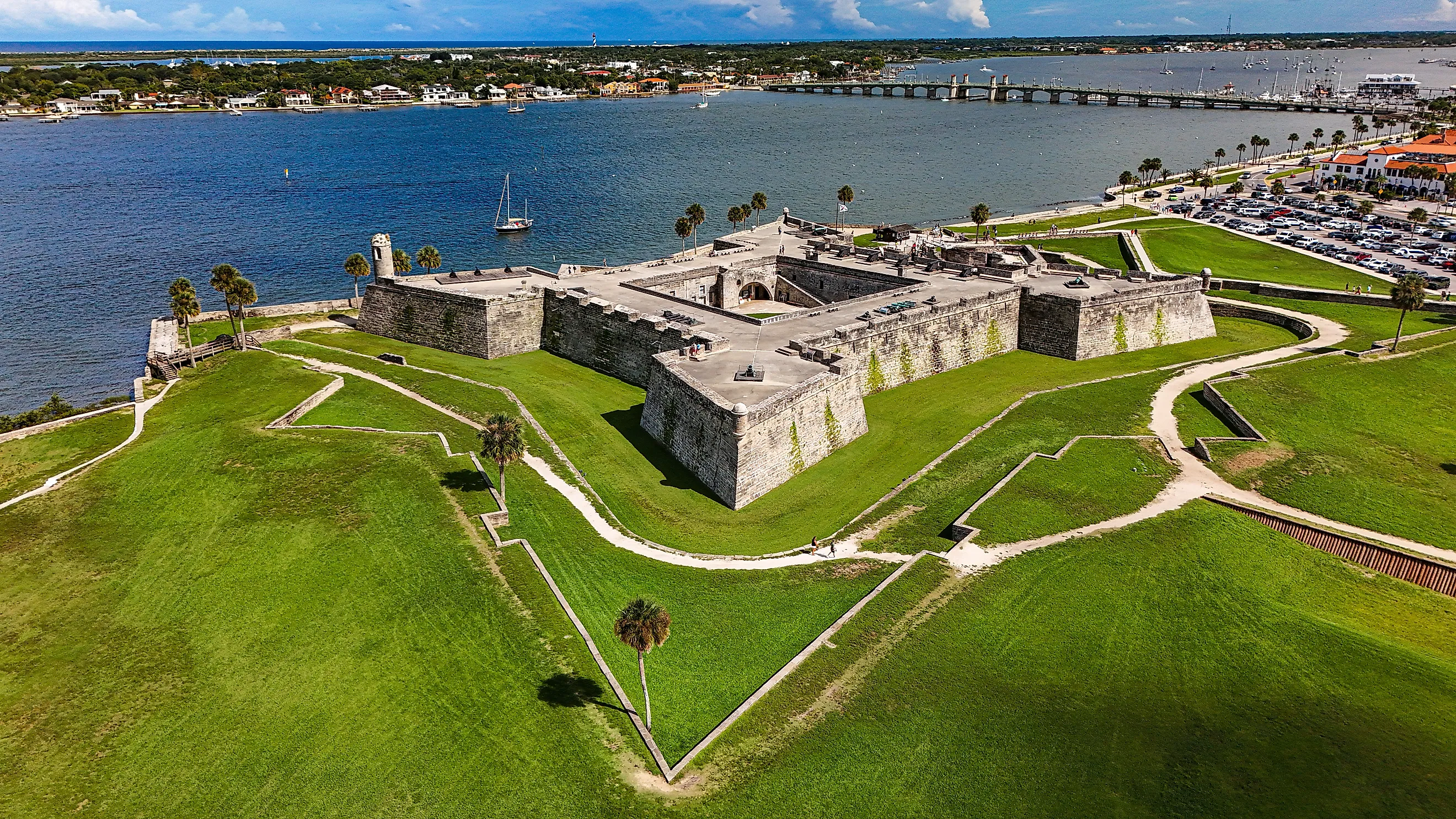
Spanish authorities began building Castillo de San Marcos in 1672 to defend St. Augustine after repeated attacks exposed the weaknesses of its original wooden forts. Fully completed in 1695, it is widely considered the oldest surviving fortification in the continental United States.
Its walls consist of coquina, a porous limestone formed from shell fragments and quarried on nearby Anastasia Island. This material actually proved excellent at absorbing cannon fire without shattering, contributing to the fortress's survival through several British sieges. Its four bastions also allowed defenders to fire along the outer walls, while a surrounding moat further hindered approaching troops.
During an attack in 1702, townspeople sheltered inside as English forces burned the rest of St. Augustine. The fort never fell in battle, although later on, treaties transferred it between Spanish and British control, then, of course, to the Americans after the Revolutionary War.
Preserved as Castillo de San Marcos National Monument, modern sightseers can explore rooms surrounding the courtyard and climb to the gun deck overlooking Matanzas Bay, where cannons once guarded the waterfront approaches.
Nemacolin Castle - Brownsville, Pennsylvania - 1789

Nemacolin Castle (also known as Bowman's Castle) started as a home built by merchant Jacob Bowman in 1789, presiding over the Monongahela River in Brownsville. Successive generations enlarged the property as the family's business interests prospered, eventually transforming it into the mansion still standing today. Some of its most notable surviving elements include a chimney from the original log house and portions of stone additions dating to between 1805 and 1822.
The castle-like appearance developed much later. Around 1859, two brick towers introduced contrasting architectural styles, with a Gothic Revival tower facing the river and an Italianate tower overlooking a nearby neighborhood. Although its towers suggest military architecture, the building, again, served strictly as a family residence.
The family called the house Nemacolin Towers after the Delaware guide associated with the area's early travel routes. Now operated by the Brownsville Historical Society, the museum offers guided tours examining the Bowman family and the house's development from a frontier home into an elaborate nineteenth-century mansion.
Castle Tucker - Wiscasset, Maine - 1807

Castle Tucker has stood adjacent to the Sheepscot River since 1807, when Judge Silas Lee commissioned the brick mansion during Wiscasset's years as a prosperous shipping port. Captain Richard H. Tucker Jr. purchased it in 1858 and moved in with his wife, Mollie, and their infant daughter. The family reshaped the house with an Italianate entrance and a towering enclosed piazza facing the water, added in 1859. However, financial difficulties later prompted the family to take summer boarders, adding another chapter to the mansion's history.
Historic New England acquired the property in 1997, and tours now examine its preserved rooms and the family's letters, possessions, and experiences, showing how a household built on trade adapted as its circumstances changed. Inside, the strongest connection to its past comes from the meticulously maintained furnishings accumulated by three generations of Tuckers. For example, the parlor retains its walnut Rococo Revival furniture set with original upholstery, while the kitchen contains an Empire Crawford stove from 1905.
Castle Williams - Governors Island, New York - 1807-1811

Completed in 1811, Castle Williams guarded New York Harbor with tiers of cannon positions enclosed within a circular red sandstone fort. Construction began in 1807 under Lieutenant Colonel Jonathan Williams, the Army's chief engineer, whose name the structure carries. Its protected gun chambers, called casemates, helped establish an imposing example for later American coastal defenses to use.
Together with Fort Jay, Castle Clinton, and other harbor fortifications, it prepared New York for a British naval attack from the ocean that never came during the War of 1812. Its most consequential service instead involved imprisonment. During the Civil War, Confederate enlisted men were confined here, and the Union Army subsequently developed the building into a military prison, adding heating, plumbing, and eventually electricity.
Preserved within Governors Island National Monument, its thick walls and central courtyard are a major historic attraction for those finding themselves in and around the Big Apple. The entrance still bears inscriptions marking the construction dates, including the spelling "Compleated 1811."
Explore America's Rich History at These Longstanding Landmarks
These fascinating buildings survived because successive generations found reasons to keep using them. Gun chambers became prison cells, family homes took in boarders, and furnishings remained long after their owners died, making for excellent museum pieces. Visiting them will not only teach you about their original construction dates and who exactly made them, but they also show how generations of Americans adapted substantial pieces of infrastructure to changing needs, leaving behind physical evidence of military service, family ambition, and the preservation process in the meantime.