The Most Mysterious Signals Ever Detected From Space
A single flash from deep space can outshine the Sun's output across several days. Astronomers call these millisecond flashes fast radio bursts. Some crossed billions of light-years to hit radio dishes on Earth. One 72-second burst arrived in 1977 and vanished before anyone could confirm it. Another radio source blinks every 18 minutes like a lighthouse turning three times an hour. A pulse this regular once earned the nickname "Little Green Men." Each of these signals still puzzles the scientists chasing its source.
A Signal That Shouldn't Exist

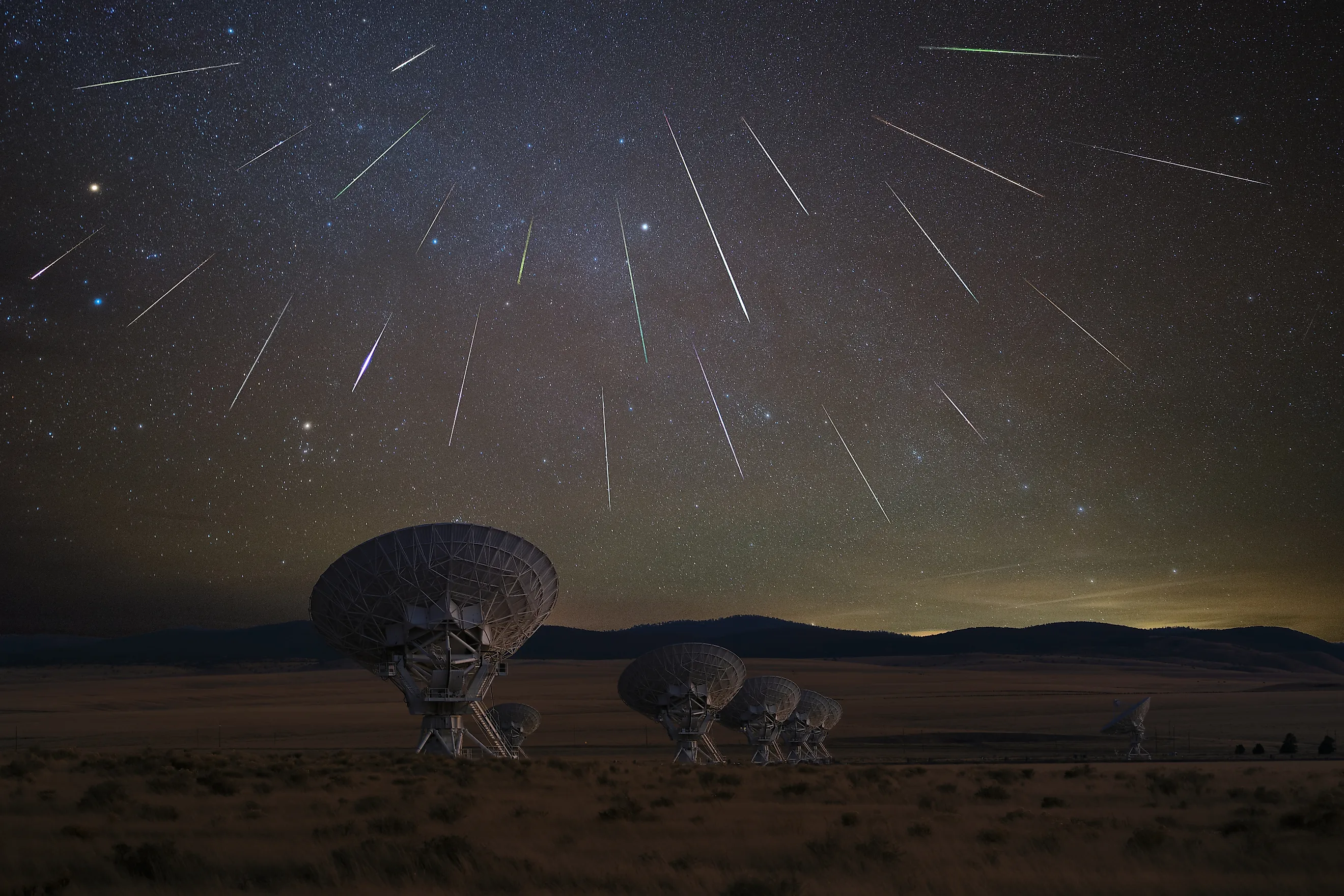
In 1977, a radio telescope in Ohio detected a signal so unusual that astronomer Jerry Ehman circled it on a printout and wrote a single word beside it: "Wow!" The burst lasted just 72 seconds, then disappeared into silence.
Few astronomical observations have generated as much long-term debate. The Wow! Signal was far stronger than the surrounding background noise and arrived near a frequency often considered useful for interstellar communication. Hydrogen, the most common element in the universe, naturally emits radio waves around that frequency. While not a smoking gun, it piqued astronomers' interest.
The strangest part is what happened afterward: nothing. Astronomers have searched the same region of sky for decades, but the signal has never returned. Natural radio emissions, unknown astronomical sources, and interference from objects closer to Earth have all been proposed as explanations. None has settled the question. The Wow! Signal remains mysterious because it was strong, brief, oddly placed, and gone before anyone could point a second telescope at it.
Bursts That Outshine The Sun

Fast radio bursts make the Wow! Signal look slow. These bursts can last only a few milliseconds, yet in that sliver of time they can release as much energy as the Sun produces over several days. A human would not see them as a flash in the night sky. They arrive as blasts of radio energy, picked up by giant dishes and computers listening for patterns in the cosmic static.
The first major example, now known as the Lorimer Burst, was identified in 2007 after astronomers searched old telescope data. It appeared to come from far outside the Milky Way, meaning the signal had crossed an enormous stretch of space before reaching Earth. Since then, hundreds of fast radio bursts have been found, proving they are not rare accidents or equipment glitches.
Some now appear linked to magnetars, which are neutron stars with magnetic fields so intense they make Earth's magnetic field seem almost nonexistent. A magnetar is the crushed core of a dead star, packing more mass than the Sun into a sphere about the size of a city. Still, magnetars may not explain every burst. Some fast radio bursts repeat, while others don't. Some come from violent star-forming regions, and others appear in quieter cosmic neighborhoods. The result is a mystery with more than one suspect.
The Repeating Burst That Would Not Stay Quiet

Most fast radio bursts were first detected as one-time flashes. FRB 121102 changed that. Instead of vanishing forever, this signal repeated, allowing astronomers to track it back to a small galaxy billions of light-years away.
That deepened the mystery. A one-time burst could be explained by a single catastrophic event, such as an explosion or collision. A repeating burst needs something that can survive after each flash and fire again. That points toward extreme objects such as magnetars, but the environment around FRB 121102 appears unusually active, with a persistent radio source nearby. It is as if the burst is coming from a cosmic storm zone rather than an empty patch of space.
Each new pulse gave scientists another chance to measure how the signal had been stretched, scattered, and twisted during its long trip to Earth. Somewhere in a distant galaxy, an object keeps shouting across space, resting, then shouting again.
The Radio Lighthouse That Blinks Every 18 Minutes

Most pulsars flash quickly, like cosmic beacons spinning several times a second. In 2022, researchers announced something far stranger: a radio source that repeated about every 18 minutes. That speed is slow enough to feel almost broken by neutron-star standards, like a lighthouse that turns only three times an hour.
The object, known as GLEAM-X J162759.5−523504.3, was found in archival data from a radio telescope in Western Australia. When active, it became one of the brightest radio sources in the sky for short periods, then faded again. The signal did not fit neatly with ordinary pulsars, which usually rotate much faster, and it did not behave like a simple flare from a normal star.
Researchers have suggested several possible explanations. It could be an unusual neutron star, a highly magnetized white dwarf, or a member of a still poorly understood class of objects. None of those answers is fully satisfying yet. The mystery is not just that the signal repeats, but that it repeats at a pace current models struggle to explain.
The "Little Green Men" Signal

One of the most famous mysterious space signals turned out not to be alien at all, but its first appearance was so strange that scientists gave it an unforgettable nickname. In 1967, Jocelyn Bell Burnell detected a radio pulse repeating with astonishing regularity. The signal was so precise that researchers jokingly labeled it LGM-1, short for "Little Green Men."
The real source was a pulsar, a rapidly spinning neutron star. These objects are the leftovers of massive stars that exploded. A neutron star can squeeze more mass than the Sun into a sphere roughly the size of a city. A teaspoon of its material would weigh billions of tons on Earth. As it spins, beams of radio waves sweep across space. If one beam crosses Earth, astronomers detect a pulse, like a lighthouse beam passing over a dark coast.
Today, pulsars are well understood compared with the Wow! Signal or fast radio bursts. But LGM-1 still belongs in this story because it shows how astronomy often works. A signal that first looks impossible can later reveal an extreme natural object no one had fully imagined before.
Signals That Map The Invisible Space Between Galaxies

Some mysterious signals reveal more because of what they pass through. Fast radio bursts can travel billions of light-years before reaching Earth. During that journey, their radio waves pass through gas, dust, and plasma spread between galaxies.
That invisible material slightly delays and distorts the signal. To astronomers, those tiny changes are useful. They can work like fingerprints left on the burst during its trip across the cosmos. A flash that lasts only a fraction of a second can carry information about matter humans could never see directly.
The scale is almost impossible to picture. If a spacecraft tried to reach some fast radio burst sources using today's technology, the trip would take far longer than human civilization has existed. Yet the signal itself crosses that distance and still arrives strongly enough for instruments on Earth to catch it. Each burst is both a mystery and a probe, turning deep space into something scientists can measure.
Alien Signals?

The idea that an unexplained signal might come from alien technology is not new to radio astronomy. That does not mean astronomers treat every strange burst as a message. In fact, history points the other way. Pulsars, quasars, and fast radio bursts all show that nature can produce signals that first look impossible.
Still, a truly artificial signal might look different from ordinary cosmic noise. It could be narrow in frequency, highly patterned, or difficult to explain through known natural processes. Modern search programs use enormous computing power to scan radio data for unusual patterns, while also filtering out interference from satellites, aircraft, and equipment on Earth.
The Search Continues

So far, no signal has provided convincing evidence of extraterrestrial intelligence. The Wow! Signal remains intriguing, but unconfirmed. Fast radio bursts are increasingly tied to extreme natural objects. Regardless of whether the signals are from an alien lifeform, scientists have to keep studying them, because the only way to recognize something artificial is to understand the natural universe well enough to rule it out.