Why Vera Rubin Will See More Of The Sky Than Any Telescope Before It
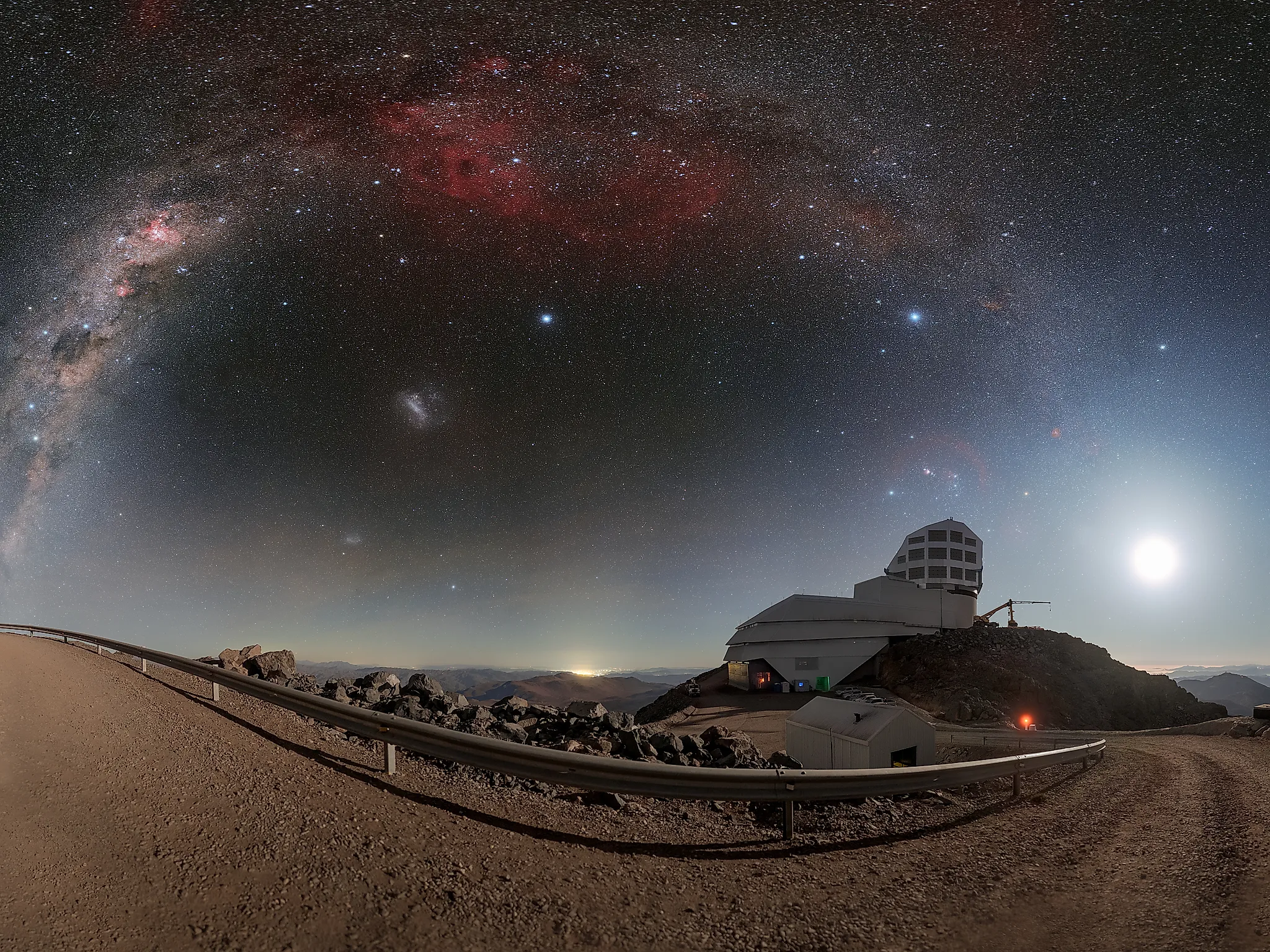
Every telescope before Rubin took the night sky's portrait. Rubin will shoot its movie. High on a Chilean mountaintop sits a 6,200-pound camera packing 3.2 billion pixels behind a lens wider than a grown adult. Its sensors run at about minus 148 degrees Fahrenheit so faint starlight reads clean. That machine will photograph the entire southern sky every few nights for ten straight years. The result is the widest and most repeated survey of space ever attempted. Rubin's real target is the invisible 95% of the universe that no one has ever seen.
The Vera C. Rubin Observatory is not just another powerful telescope. It is closer to a cosmic movie camera. While famous observatories such as the Hubble Space Telescope and the James Webb Space Telescope can stare deeply into selected regions of space, Rubin is built to sweep across the observable southern sky again and again. Over its ten-year Legacy Survey of Space and Time (LSST), Rubin will turn the night sky from a still photograph into a time-lapse record of motion, danger, explosions, and hidden forces.
A Camera The Size Of A Small Car

Rubin's greatest advantage begins with its camera. The Legacy Survey of Space and Time Camera is the largest digital camera ever built for astronomy and astrophysics. It is roughly the size of a small car and weighs about 6,200 pounds. Its front lens is wider than many people are tall, and its 3.2-billion-pixel sensor contains roughly as many pixels as 260 modern cell phone sensors.
The scale matters because Rubin does not aim to capture a single beautiful portrait of a nebula or galaxy. It aims to build a massive census of the sky. By the end of the survey, scientists expect Rubin's database to include about 20 billion galaxies, 17 billion resolved stars, and 6 million orbits of solar system bodies. In other words, the observatory will track far more cosmic targets than there are people on Earth.
Rubin's field of view is also enormous. A single image covers 9.6 square degrees of sky, an area as large as about 45 full moons. For a person looking upward from Earth, the full moon already looks bright and large. Rubin can capture a patch of sky dozens of times wider than that in one exposure, then move quickly to the next.
Why Rubin Sees The Sky Differently

Many telescopes work like powerful zoom lenses. They focus on a single target and collect as much detail as possible from that specific location. Rubin works more like a panoramic security system for the cosmos. It does not simply look far into space. It repeatedly returns to the same regions to detect any changes.
Repeated viewing is what makes Rubin so different. A star that suddenly brightens, an asteroid that shifts position, or a galaxy that flashes with the death of a star can stand out because Rubin has already seen the same patch of sky before. The telescope is not only asking what space looks like. It is asking what changed since the last time it looked.
Rubin will take hundreds of images every night during its survey. Every few nights, it will build a fresh snapshot of the observable southern sky. Over ten years, those snapshots will stack into one of the largest astronomical movies ever attempted.
A Survival Tool For Asteroid Detection

Rubin's sky survey also has a direct connection to Earth's safety. The solar system contains millions of rocky objects left over from the era when planets formed. Most asteroids never come near Earth, but some cross our planet's neighborhood. A large enough impact could damage a city, devastate a region, or cause far wider destruction.
Rubin will not stop asteroids from existing, but it can help scientists find them earlier. The observatory's repeated scans can reveal faint moving objects that other surveys might miss. During early observations, Rubin discovered more than 11,000 new asteroids in the solar system, including 33 near-Earth objects that posed no danger. The full survey is expected to uncover a few million previously unseen asteroids and raise the known count of near-Earth objects to around 127,000.
Early warning matters because distance gives humans options. A dangerous asteroid found years in advance is very different from one discovered only weeks before a close pass. Rubin's power lies in turning faint moving dots into known objects with measurable paths.
Explosions That Can Vanish Before Morning

The universe changes faster than most people imagine. Stars can explode, galaxies can flare, and distant objects can brighten or fade before ordinary telescopes get a second chance to look. Rubin is designed to capture short-lived events as they unfold.
When Rubin detects a change, its alert system can quickly notify astronomers. The observatory has already issued 800,000 alerts in a single night, and the system can produce about 7 million alerts per night. Those alerts can point scientists toward supernovae, variable stars, active galaxies, asteroids, and other objects that move or change brightness.
Picture the night sky as a city seen from above at night. Most lights hold steady. A few blink, drift, flare, or go dark. Rubin is built to catch those changes and tell astronomers exactly where they happened.
The Frozen Edge Of The Solar System

Rubin will also search the far edges of the solar system, beyond Neptune, where sunlight is weak and icy objects drift through deep cold. These distant bodies are difficult to detect because they are small, faint, and slow-moving from Earth's point of view. Some are leftover building blocks from the solar system's earliest days.
The observatory is expected to find many more trans-Neptunian objects, which are icy bodies beyond Neptune's orbit. These objects matter because they preserve clues from the solar system's formation. Studying them is like examining ancient debris from a construction site after the planets were built.
Rubin may even help test whether a larger undiscovered planet exists in the outer solar system. Scientists have not confirmed such a world, but Rubin's ability to scan wide areas repeatedly gives astronomers one of their strongest tools for searching the dark outer frontier.
Mapping The Invisible Universe

Rubin's most mysterious mission reaches far beyond asteroids and icy worlds. Ordinary matter, including people, planets, stars, and galaxies, makes up only about 5% of the universe. The rest consists of dark matter and dark energy, two invisible components that scientists still do not fully understand.
Dark matter does not shine, reflect light, or form stars, but its gravity appears to help hold galaxies together. Dark energy is even stranger. Scientists use the term to refer to the unknown force or property that drives the accelerating expansion of the universe. In simple terms, dark matter pulls, while dark energy helps push the universe apart.
Rubin will study these invisible forces by measuring billions of galaxies. Massive objects can bend the light from galaxies behind them, much like a glass lens bends light on Earth. By studying those tiny distortions across huge regions of space, scientists can map where dark matter appears to be hiding. Rubin will also help measure how the universe has expanded over time, giving researchers another way to test dark energy.
The observatory's name makes that mission especially fitting. Astronomer Vera Rubin helped provide convincing evidence for dark matter by studying how galaxies rotate. The new observatory that bears her name will now search for the invisible structure behind the universe on a scale she could not have achieved with the instruments of her time.
More Data Before Sunrise Than Most People Will Ever Store

Rubin's nightly output will be almost impossible to picture as ordinary files. During the ten-year LSST, the observatory will produce about 20 terabytes of data every night. Its running catalog of the sky will swell into the tens of petabytes.
A single petabyte equals 1,000 terabytes. Most people measure their phone storage in gigabytes, far below even one terabyte. Rubin will create enough data before sunrise to overwhelm ordinary computers many times over.
The data flood is why Rubin depends on advanced software as much as glass and metal. Automated systems will process images, identify changes, issue alerts, and make data available to scientists. Many astronomers who use Rubin's discoveries may never visit the telescope in Chile. They will explore its sky through online data instead.
The Sky Will No Longer Sit Still

Rubin will not be the largest telescope in every possible category, and it will not replace observatories that study narrow targets in deep detail. Its strength is different. Rubin will see the sky broadly, repeatedly, and quickly, turning the observable southern sky into a living record instead of a collection of separate snapshots.
Rubin's record could reveal millions of asteroids, billions of galaxies, exploding stars, hidden worlds, and clues to the invisible material that shapes the universe. If Rubin fulfills its promise, the night sky will no longer look like something fixed and silent above Earth. It will look like what it truly is: a moving, changing, dangerous, and mysterious place that humans are finally learning how to watch.