The 10 Largest Universities In The United States
Choosing a college usually comes down to location, cost, prestige, and vibe, but a few schools answer the question with pure scale. The ten below are the largest primarily in-person university campuses in the United States, each cramming a small city's worth of students onto a single campus, starting around 52,000 students and climbing toward 80,000. Enrollment figures are from the 2024-25 academic year. So what does all that company get you? Quite a lot, as it turns out.
| Ranking | University | Enrollment (2024-25) |
|---|---|---|
| 1 | Texas A&M University, TX | 79,114 |
| 2 | University of Central Florida, FL | 69,818 |
| 3 | The Ohio State University, OH | 66,901 |
| 4 | University of Florida, FL | 60,795 |
| 5 | University of Illinois Urbana-Champaign, IL | 59,238 |
| 6 | Purdue University, IN | 58,658 |
| 7 | University of Minnesota, MN | 56,666 |
| 8 | Arizona State University, AZ | 56,643 |
| 9 | Florida International University, FL | 55,687 |
| 10 | University of Texas at Austin, TX | 52,384 |
Texas A&M University

- Total Enrollment (2024-25): 79,114
- Main Campus Area: 8.13 mi2
- Campuses in the System: 3
Texas A&M sits at the top of this list the way Texas does most things, at scale. Nearly 80,000 students fill its 5,200-acre home in College Station, a campus so large it runs its own PBS and NPR stations under the call letters KAMU. Established in 1871 as the first public university in Texas and opened for classes in 1876, the school leans hard into tradition, whether that means the 12th Man (the entire student body stays on its feet all game, symbolically ready to play) or Midnight Yell, a pep rally that draws tens of thousands the night before kickoff. It is also one of the more affordable schools of its size, with generous financial aid, which helps explain why the place keeps growing.
University of Central Florida

- Total Enrollment (2024-25): 69,818
- Main Campus Area: 2.22 mi2
- Campuses in the System: 12
The University of Central Florida grew from a school built to feed the space program into the biggest university in Florida, with close to 70,000 students in Orlando. It opened in 1968 as Florida Technological University, tasked with supplying engineers to nearby Kennedy Space Center, and it still funnels graduates to NASA and SpaceX. Renamed UCF in 1978, it now offers more than 240 degree programs and runs a 24-hour jazz radio station, but its signature moment is Spirit Splash, the homecoming ritual where thousands of students wade into the reflecting pond and, for reasons lost to history, pelt one another with rubber ducks.
The Ohio State University

- Total Enrollment (2024-25): 66,901
- Main Campus Area: 2.76 mi2
- Campuses in the System: 6
Ohio State is large enough that it insists on the definite article. It is The Ohio State University, and yes, it trademarked the word "The" in 2022. About 67,000 students spread across the Columbus campus and pick among more than 1,000 student organizations, along with a set of traditions that Buckeyes take very seriously, including the Script Ohio formation the marching band spells out on the field and the call-and-response O-H-I-O chant. Founded in 1870 as an agricultural and mechanical college in Ohio, it welcomed its first 24 students in 1873, then kept adding zeros.
University of Florida

- Total Enrollment (2024-25): 60,795
- Main Campus Area: 3.12 mi2
- Campuses in the System: 1
The University of Florida traces its roots to the East Florida Seminary of 1853, making it the state's oldest public university, and today it ranks among the country's top public research universities. Around 61,000 students in Gainesville choose from more than 300 degree programs across 16 colleges, and on football Saturdays a good share of them turn up in orange and blue to cheer the Gators, a nickname Florida has carried since 1911. The university also runs one of the largest student-staffed newsrooms in the country, so campus news travels fast.
University of Illinois Urbana-Champaign

- Total Enrollment (2024-25): 59,238
- Main Campus Area: 9.95 mi2
- Campuses in the System: 3
The University of Illinois Urbana-Champaign draws roughly 59,000 students from more than 100 countries to the twin cities of Urbana and Champaign in central Illinois, and it has long been an engineering and computer science powerhouse, the sort of place where the first popular web browser and the plasma display were dreamed up. Founded in 1867, it guards a few quirks, chief among them the Morrow Plots, the oldest experimental crop field in the country and a fenced National Historic Landmark that the university famously will not let anyone trample. Illinois also lays claim to hosting one of the nation's first homecomings, in 1910, and the Marching Illini have been leading the party since 1907.
Purdue University

- Total Enrollment (2024-25): 58,658
- Main Campus Area: 3.86 mi2
- Campuses in the System: 5
Purdue is the newcomer on this list, and it arrives with serious bragging rights. The West Lafayette campus in Indiana enrolls close to 59,000 students and calls itself the "Cradle of Astronauts" for good reason. More than two dozen Boilermakers have flown to space, and here is the kicker: both the first and the last people to walk on the Moon, Neil Armstrong and Gene Cernan, were Purdue graduates. Founded in 1869 with a gift from businessman John Purdue, the school built its name on engineering and aviation, and it owns the oldest computer science department in the world and the first university-run airport in the country. Not bad for a school whose official mascot is a locomotive.
University of Minnesota

- Total Enrollment (2024-25): 56,666
- Main Campus Area: 1.04 mi2
- Campuses in the System: 5
The University of Minnesota anchors the twin cities of Minneapolis and Saint Paul with about 57,000 students and a catalog wide enough to cover astrophysics, economics, and American Indian studies under one maroon-and-gold banner. Founded in 1851, it runs the student radio station KUOM, better known as Radio K, and counts a genuinely mixed alumni roster: Bob Dylan briefly enrolled before folk music called, and Minnesota also claims actor Ron Perlman and pro wrestler Brock Lesnar. It has a reputation as a value pick too, with most students receiving some form of financial aid.
Arizona State University

- Total Enrollment (2024-25): 56,643
- Main Campus Area: 1.00 mi2
- Campuses in the System: 5
Arizona State takes the innovation crown, literally. U.S. News has named it the most innovative university in the country every year since 2016. The number here counts its Tempe campus and its roughly 57,000 students, though ASU is a bit of a shape-shifter: add its enormous online enrollment and the total soars well past 180,000. On the ground in Tempe, school spirit runs on sunshine, with the area averaging around 300 clear days a year, plus the freshman trek up "A" Mountain and Pat's Run, the race honoring alumnus and NFL-player-turned-Army-Ranger Pat Tillman. Downtown Phoenix and the West Valley host the rest of the footprint across Arizona.
Florida International University

- Total Enrollment (2024-25): 55,687
- Main Campus Area: 0.53 mi2
- Campuses in the System: 8
Florida International University turned Miami itself into a selling point. Founded in 1965 as part of the State University System of Florida, FIU now enrolls around 56,000 students and has grown into a major research university, all while sitting minutes from some of the best beaches in the state. Its campuses lean into that location, with a marine program that treats Biscayne Bay as an outdoor laboratory, and students can burn a between-class hour on archery, kayaking, or the reliably packed pool deck.
University of Texas at Austin

- Total Enrollment (2024-25): 52,384
- Main Campus Area: 0.66 mi2
- Campuses in the System: 8
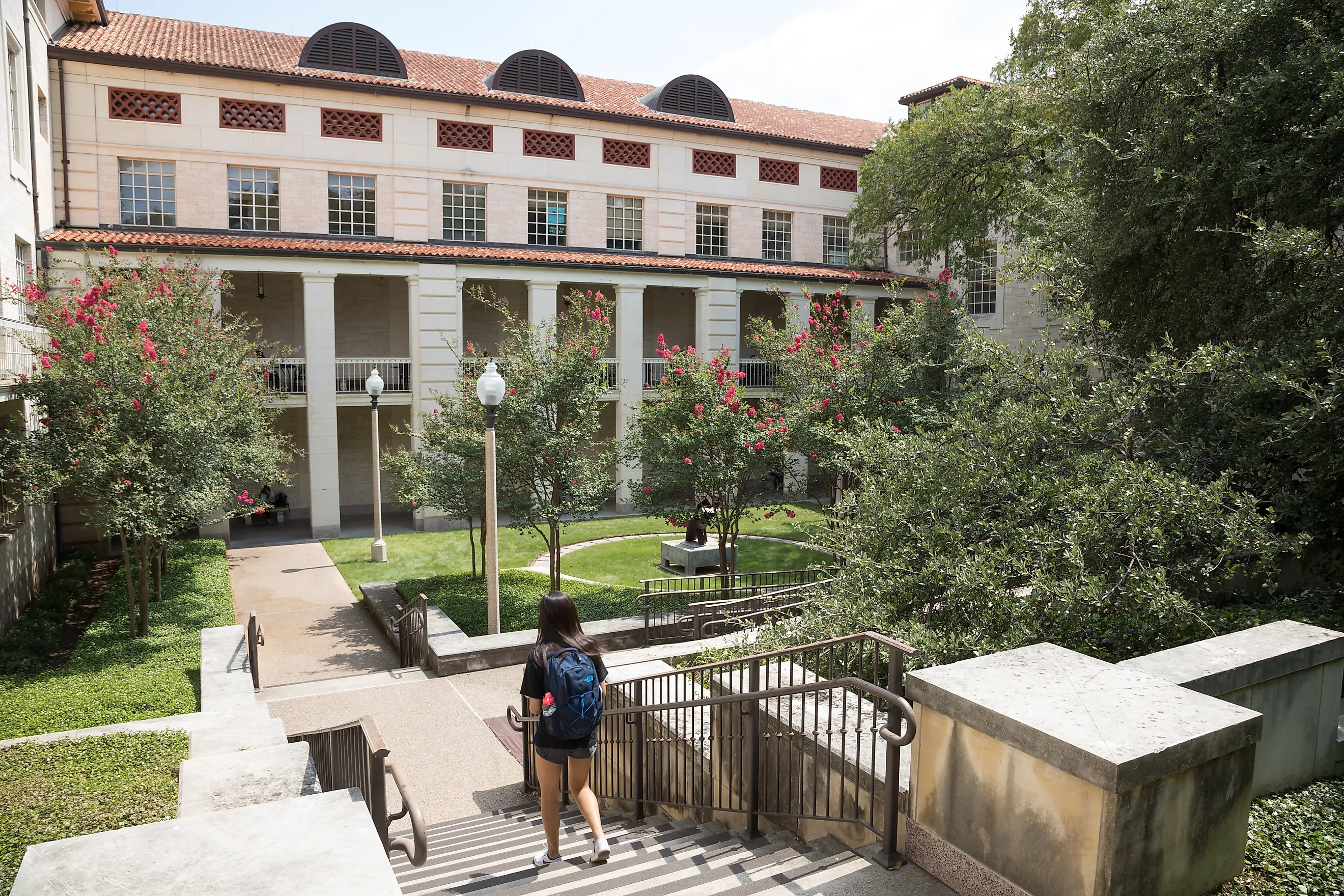
The University of Texas at Austin closes the list at about 52,000 students, but it punches far above that in the lab: UT researchers helped design the stabilized spike protein used in the first COVID-19 vaccines, one of the more consequential results of the decade. Founded in 1883, the school offers roughly 156 undergraduate and 139 graduate programs, and Longhorn fans flash the "Hook 'em Horns" sign in stadiums and airports as far away as Timbuktu. Campus lore runs to the endearing and the odd: students hunt for the resident albino squirrel, said to bring luck before an exam, and turn out for intramural quadball, the broomless real-world sport once known as quidditch.
Bigger is not automatically better, but scale buys options: hundreds of majors, deep research budgets, and a built-in community of tens of thousands. Every school here hands its students a small city to explore. The real question is whether you would rather be a big fish in a small pond, or a perfectly happy minnow in an ocean of 60,000.