10 US States With the Most Atheists
In Pew Research Center's 2023-24 Religious Landscape Study, the share of adults who explicitly identify as atheist sits well below the share who say they have no religion at all. Most religiously unaffiliated Americans call themselves agnostic or "nothing in particular," so the states below are not simply the least religious in the country. They are the ones where residents are most willing to claim the atheist label outright, a more deliberate stance than drifting away from church.
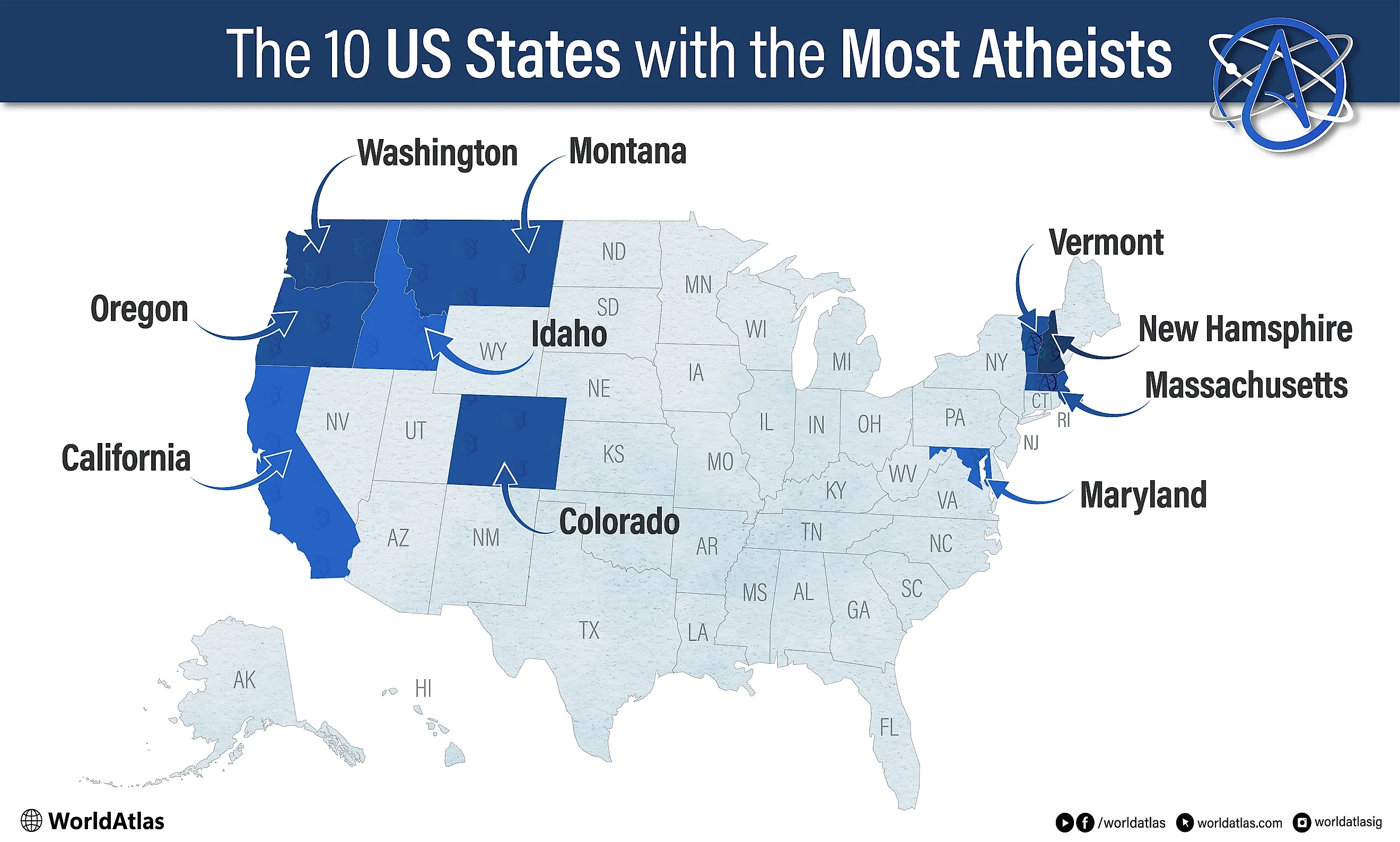
The ten leaders cluster in two regions: New England, where formal affiliation has thinned faster than anywhere else, and the Pacific Northwest and Mountain West, where churchgoing communities and large secular populations often share the same state. Idaho and Montana make the list despite heavily Christian majorities, while New Hampshire tops it at 11%. The figures that follow come from Pew's 2023-24 survey and describe self-identified adults, not estimates of private belief.
10 US States With the Most Atheists
| State | Adults identifying as atheists |
|---|---|
| New Hampshire | 11% |
| Washington | 9% |
| Colorado | 8% |
| Massachusetts | 8% |
| Montana | 8% |
| Oregon | 8% |
| Vermont | 8% |
| California | 6% |
| Idaho | 6% |
| Maryland | 6% |
New Hampshire

At 11%, New Hampshire has the highest atheist share of any state in Pew Research Center's 2023-24 Religious Landscape Study. Add the 8% who call themselves agnostic and the 29% who say "nothing in particular," and close to half the state reports no religious affiliation. That makes the unaffiliated, not any church, the largest single bloc in New Hampshire's religious profile. No Christian tradition comes close to filling the gap. Catholics account for 20% of adults, mainline Protestants 13%, and evangelical Protestants 10%, leaving Christianity split three ways with no clear center. The state has no religious test for office and was among the last to drop one from its constitution in 1877. Jewish and other non-Christian residents each register below 2%, and historically Black Protestant adults make up a negligible share statewide.
Washington

Washington's atheists, at 9%, are outnumbered by its agnostics at 11%, and both trail the 17% who claim no particular religion. Combined, the unaffiliated make up well over a third of adults. The Christian side looks different from New England's: evangelical Protestants lead at 23%, ahead of Catholics at 14% and mainline Protestants at 9%. That evangelical edge separates Washington from coastal states where Catholicism usually dominates. It also carries more non-Christian variety than most states here, with Buddhists at 3%, Muslims at 2%, and Jews and Hindus at 1% each. The Seattle metro area concentrates much of the state's religious diversity, while the agricultural counties east of the Cascades lean more heavily Christian. Historically Black Protestants and Latter-day Saints each account for roughly 2% of adults.
Colorado

Roughly four in ten Colorado adults report no religious affiliation: 8% atheist, 10% agnostic, and 22% "nothing in particular." What sets the state apart is how evenly its Christians divide. Pew puts evangelical Protestants at 17%, Catholics at 14%, and mainline Protestants at 13%, three groups close enough that none functions as a default. Jews account for 2% and Buddhists 1%. Colorado Springs anchors a sizable evangelical community on the state's southern Front Range and hosts the headquarters of Focus on the Family, while Denver and Boulder skew markedly more secular. The state's Latino population supports a substantial share of its Catholic adults, concentrated in the south and in the metro areas. Latter-day Saints and Muslims each register around 1% statewide.
Massachusetts

Catholicism still claims more of Massachusetts than any other faith, at 29% of adults, a legacy of Irish, Italian, and Portuguese immigration that built the parishes still scattered across Boston and the old mill cities. Yet the state also posts an 8% atheist rate. Another 5% are agnostic and 25% say "nothing in particular," so the unaffiliated now rival Catholics for the largest share. Among Protestants, mainline churches reach 10% and evangelicals 8%. The non-Christian presence is among the broadest on this list: Jewish adults at 4%, Muslims and Hindus at 2% each, and Buddhists at 1%. The Boston area, home to dozens of colleges and universities, pulls the statewide figures toward the secular end, while older industrial cities like Worcester and Lowell retain denser Catholic populations.
Montana

Montana is the one state here where a heavily Christian population and a high atheist share sit side by side. Evangelical Protestants make up 28% of adults, the largest Christian group, alongside Catholics at 12%, mainline Protestants at 11%, and Latter-day Saints at 3%. By the usual measures that should make Montana a religious state. Even so, 8% of Montanans identify as atheist, 12% as agnostic, and 19% as "nothing in particular," which puts the unaffiliated at nearly four in ten adults. Buddhists round out the picture at 2%. The state's churchgoing communities cluster in rural and ranching areas, while college towns like Missoula and Bozeman hold younger, more secular populations. The Latter-day Saint share is heaviest in the southern counties near the Idaho and Wyoming borders.
Oregon

Despite its secular reputation, Oregon's single largest religious group is evangelical Protestants at 25%, with Catholics and mainline Protestants tied at 8% each. The unaffiliated still dominate overall: agnostics at 12% outnumber atheists at 8%, and 23% claim no particular religion, which together account for well over a third of adults. Jews and Buddhists each register 2%, Hindus 1%. Oregon shares the low-affiliation pattern of the wider Pacific Northwest, a region sometimes called the "None Zone" for its high share of residents who report no religion. Portland and the Willamette Valley hold most of the state's population and pull the figures toward the secular end. Eastern Oregon, sparsely populated and rural, retains a stronger evangelical presence than the coast or the interstate corridor.
Vermont

Vermont reports 8% atheist and 8% agnostic, an even split, with another 29% saying "nothing in particular." That pushes the unaffiliated close to half the adult population, among the highest such shares in the country. Its Christians break from the regional norm in one way: Catholics at 18% barely edge out mainline Protestants at 17%, while evangelicals trail far behind at 8%. That near-parity between Catholic and mainline Protestant adults is unusual, since one or the other tends to dominate in most states. Jews account for 2% and Buddhists 1%. Vermont is the second least populous state, and its religious figures reflect a largely rural, older population spread across small towns rather than concentrated in any major city. Burlington, its largest, holds fewer than 45,000 residents.
California

California's 6% atheist rate is modest, but in the most populous state it represents several million people, more atheists in raw numbers than live in most states ranked above it. Catholicism leads at 25%, a reflection of the state's large Latino population, followed by evangelical Protestants at 16% and mainline Protestants at 8%. The non-Christian map is the most varied on this list, with Jews, Buddhists, and Hindus at 2% each and Muslims at 1%, supported by long-established immigrant communities across Los Angeles and the Bay Area. Agnostics come in at 7% and the "nothing in particular" group at 20%. Historically Black Protestants account for roughly 3% of adults, concentrated in cities like Los Angeles, Oakland, and the inland areas around Sacramento.
Idaho

Idaho is the most religiously conservative state in the top ten. Evangelical Protestants reach 31%, the highest figure of any group on this entire list, and Latter-day Saints add another 14%, concentrated heavily in the state's southeast near the Utah border. Catholics account for 9% and mainline Protestants 7%. Against that backdrop, 6% identify as atheist and 6% as agnostic, with 22% claiming no particular religion. Muslims register 2%, and other non-Christian groups stay below 1%. Boise, the state's fastest-growing city, has drawn migrants from California and the Pacific Northwest who have nudged the metro area in a more secular direction. The Latter-day Saint counties around Rexburg and Idaho Falls remain among the most religiously observant in the country.
Maryland

Maryland's Christians spread across four roughly comparable groups: historically Black Protestants and evangelical Protestants at 15% each, mainline Protestants at 13%, and Catholics at 12%. That four-way balance, with a sizable historically Black Protestant share, sets Maryland apart from the other states here, where one or two traditions usually dominate. Its non-Christian communities are sizable too, with Muslims at 4%, the highest on this list, Jews at 3%, and Hindus at 1%, anchored by the diverse suburbs ringing Washington, D.C. The atheist share sits at 6%, agnostics at 7%, and "nothing in particular" at 19%. The state's Catholic roots run deep, since the colony was founded in 1634 as a refuge for English Catholics and passed an early religious toleration act in 1649.
Even in the states where atheists are most willing to claim the label, they remain a minority of the unaffiliated, outnumbered everywhere by agnostics and those who simply check "nothing in particular." New England leads on declining affiliation, while Idaho and Montana show that a high atheist share and a churchgoing majority can hold the same ground. New Hampshire's 11% still tops the country.