The Largest Baseball Stadiums In The United States
Major League Baseball has spent the last thirty years quietly shrinking its own ballparks. Teams keep tearing out bleacher rows and dropping in wider seats, bars, social decks, and group patios, trading raw capacity for comfort and higher-priced real estate. The result is a league where the biggest parks tend to be the ones that resisted the trend, or got caught mid-renovation. Dodger Stadium sits on top precisely because it never shrank, holding at 56,000 since 1962 while nearly everyone else came down. Here are the ten largest ballparks in the country today, along with the renovations that explain how most of them ended up smaller than they started.
1. Dodger Stadium

Dodger Stadium is the giant that refused to shrink. It opened in 1962 at 56,000 seats and has stayed there for over sixty years, which is most of the reason it leads this list. A conditional-use permit caps it at exactly 56,000 no matter how badly the Dodgers might want more, so even recent work rebuilding the outfield pavilions and adding a center-field plaza did not add a single net seat. It is the only park in the majors over 50,000, and the third-oldest, behind only Boston's Fenway Park (1912) and Chicago's Wrigley Field (1914). While the rest of baseball downsized, Los Angeles stood still and let everyone else come down to meet it.
2. Chase Field

Chase Field in Phoenix has barely budged from the roughly 48,500 it opened with in 1998, which in this company counts as defiance. It was the first ballpark in the country to put a retractable roof over real grass, and its air conditioning can hold the inside in the high seventies while the desert outside clears 100. The signature flourish is the swimming pool beyond the right-center field wall, about 415 feet from home plate, which fans can rent as a suite for a few thousand dollars a game. Mark Grace was the first player to splash a home run into it, still the most Arizona thing that has ever happened in a baseball game.
3. T-Mobile Park

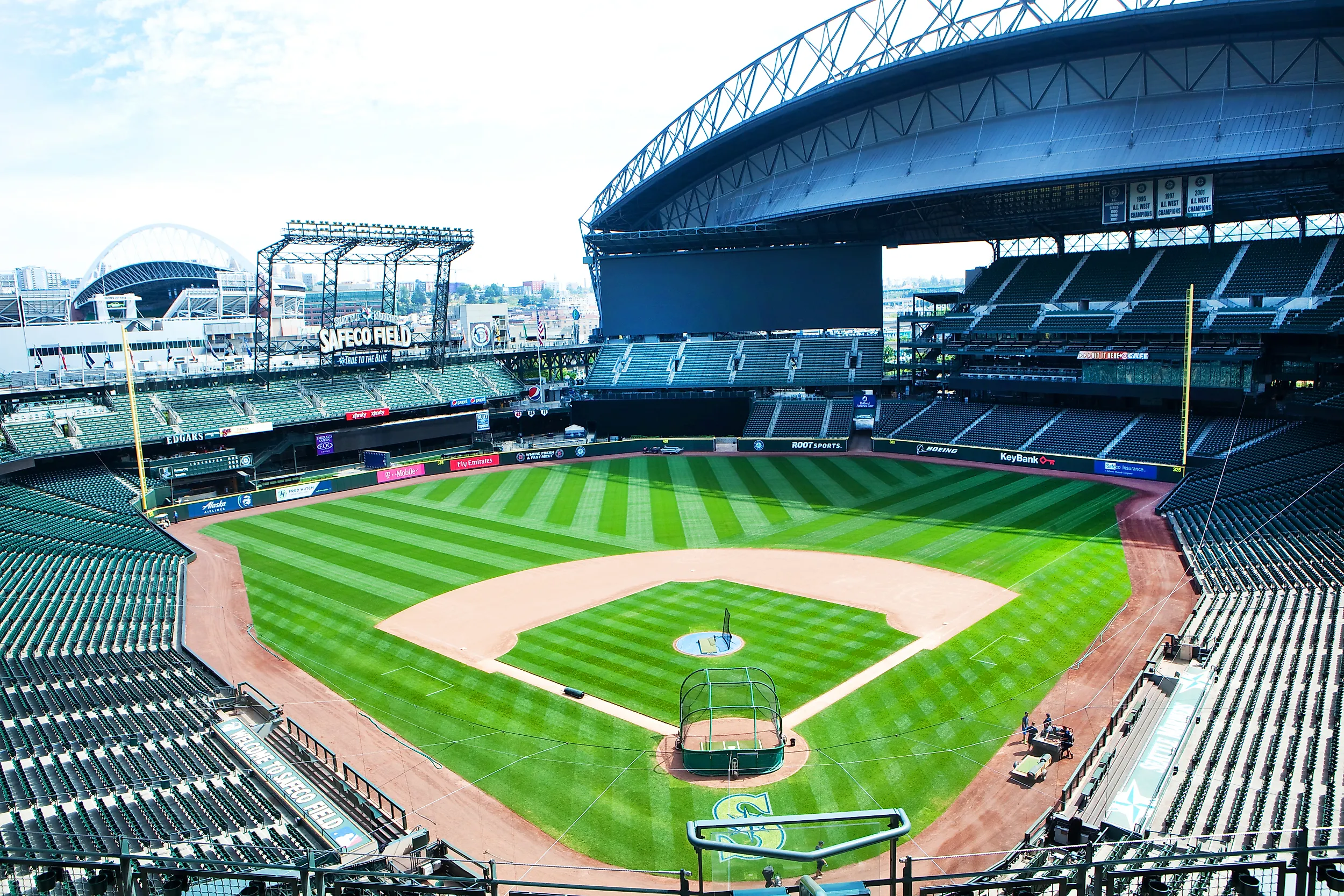
T-Mobile Park in Seattle, which plenty of locals still call Safeco Field after the name it carried until 2019, has also held roughly steady near the 47,000 it opened with. Its calling card is the roof, which does not seal the building like a dome but parks over the top like a giant umbrella and rolls away on rails, keeping the rain out without trapping anyone in. That suits a wet, mild city better than a sealed box would. The roof takes under twenty minutes to close, and Mariners fans have spent the entire life of the building waiting for a pennant beneath it, which is a stubbornness all its own.
4. Coors Field

Coors Field is where the shrinking starts to show. It opened in 1995 seating just over 50,000, after the Rockies hurriedly padded the original plan with thousands of extra seats when their first season drew record crowds. Then reality set in. Before the 2014 season the team ripped out most of the right-field upper deck, roughly 3,500 seats, and replaced it with a rooftop party deck. What remains seats 46,897 a full mile above sea level, with one row of purple chairs marking the exact spot where the elevation hits 5,280 feet. The thin air still launches home runs, which is why the Rockies store their baseballs in a humidor.
5. Yankee Stadium

Yankee Stadium has been shrinking almost since the day it opened. The current version went up in 2009 seating just over 50,000, and the Yankees have steadily pared it back to 46,537 by swapping ordinary seats for suites, bars, and premium space. It is still the most expensive ballpark ever built, a roughly 2.3 billion dollar replacement for the 1923 House That Ruth Built, which now survives as a public park one block south. Construction also produced a minor curse scare, when a Red Sox fan on the crew buried a David Ortiz jersey in the concrete. The Yankees jackhammered it out over five hours, then won the World Series in the new building's first season anyway.
6. Angel Stadium

Angel Stadium owns the most dramatic shrink on this list, because it once doubled as a football field. It opened in 1966 as a tidy baseball park seating about 43,000, then ballooned to 64,593 in 1980 when the city enclosed the outfield to lure the NFL's Rams to Anaheim. After the Rams left for St. Louis, the Angels spent the late 1990s tearing all that football seating back out, returning the place to a baseball-sized 45,517. It is now the fourth-oldest ballpark in the majors, behind Fenway, Wrigley, and Dodger Stadium, and its signature Big A sign, once the actual scoreboard, now just towers over the parking lot looking important.
7. Oriole Park at Camden Yards

Oriole Park at Camden Yards is the park almost every other entry here is partly copying, and it has been shrinking too. When it opened in 1992 it seated about 48,000 and single-handedly launched the retro-ballpark era, sending every team scrambling to build brick-and-steel parks downtown instead of concrete bowls in parking lots. Three decades of tweaks have pulled it down to 44,487, most recently in 2022 when the Orioles shoved the left-field wall back nearly 27 feet and raised it to 13, erasing around a thousand seats to make the place less of a home run piñata. Cal Ripken Jr. played his record 2,131st straight game on this field, which is still the building's defining night.
8. Busch Stadium

Busch Stadium in St. Louis opened in 2006 and has stayed close to its original size, seating 44,383 with the Gateway Arch framed beyond the outfield. It is the rare entry that trimmed itself on purpose for fun rather than physics: in 2018 the Cardinals pulled out six sections of seats to build the Budweiser Terrace, a standing-and-lounging area better matched to how people actually watch a game now. The infield lines of the old Busch Stadium are marked in the pavement a block away, so you can stand on the footprint of the ballpark this one replaced.
9. Great American Ball Park

Great American Ball Park in Cincinnati holds 43,500 on the bank of the Ohio River, and it is one of the few here that never really shrank. It opened in 2003 to replace Cinergy Field, the kind of round concrete stadium the Camden Yards revolution made extinct, and it faces the river and the bridges across to Kentucky. The Reds trace their line to the 1869 Red Stockings, the first openly all-salaried team in the sport, which gives this otherwise modern park the longest pedigree of any franchise on the list.
10. Citizens Bank Park

Citizens Bank Park in Philadelphia rounds out the ten at 42,901, down a touch from the roughly 43,500 it opened with in 2004. Its landmark is the giant illuminated Liberty Bell in right-center, which lights up and swings every time a Phillie hits a home run, an excuse the home crowd takes very seriously. The park replaced Veterans Stadium, a concrete multipurpose bowl so disliked that its main legacy was teaching Philadelphia exactly what it did not want next. What it wanted, apparently, was a smaller park that is twice as loud.
Which Are The Largest Baseball Stadiums In The United States?
Here is the full ranking of every Major League ballpark in the United States by current seating capacity. The figures reflect each park's listed baseball capacity for the 2026 season, and because several venues have changed names lately, a few entries will look unfamiliar even to regular viewers.
| Rank | Stadium | Capacity | City | State |
|---|---|---|---|---|
| 1 | Dodger Stadium | 56,000 | Los Angeles | California |
| 2 | Chase Field | 48,330 | Phoenix | Arizona |
| 3 | T-Mobile Park | 47,368 | Seattle | Washington |
| 4 | Coors Field | 46,897 | Denver | Colorado |
| 5 | Yankee Stadium | 46,537 | New York City | New York |
| 6 | Angel Stadium | 45,517 | Anaheim | California |
| 7 | Oriole Park at Camden Yards | 44,487 | Baltimore | Maryland |
| 8 | Busch Stadium | 44,383 | St. Louis | Missouri |
| 9 | Great American Ball Park | 43,500 | Cincinnati | Ohio |
| 10 | Citizens Bank Park | 42,901 | Philadelphia | Pennsylvania |
| 11 | Tropicana Field | 42,735 | St. Petersburg | Florida |
| 12 | Citi Field | 41,922 | New York City | New York |
| 13 | American Family Field | 41,900 | Milwaukee | Wisconsin |
| 14 | Wrigley Field | 41,649 | Chicago | Illinois |
| 15 | Nationals Park | 41,373 | Washington | District of Columbia |
| 16 | Oracle Park | 41,331 | San Francisco | California |
| 17 | Daikin Park | 41,168 | Houston | Texas |
| 18 | Truist Park | 41,084 | Cumberland | Georgia |
| 19 | Comerica Park | 41,083 | Detroit | Michigan |
| 20 | Rate Field | 40,615 | Chicago | Illinois |
| 21 | Globe Life Field | 40,300 | Arlington | Texas |
| 22 | Petco Park | 39,860 | San Diego | California |
| 23 | PNC Park | 38,747 | Pittsburgh | Pennsylvania |
| 24 | Target Field | 38,544 | Minneapolis | Minnesota |
| 25 | Kauffman Stadium | 37,903 | Kansas City | Missouri |
| 26 | Fenway Park | 37,755 | Boston | Massachusetts |
| 27 | LoanDepot Park | 37,000 | Miami | Florida |
| 28 | Progressive Field | 34,820 | Cleveland | Ohio |
The Biggest Drop In Baseball
For one last twist, consider the team that used to sit at the very top of this list. Through the 2024 season, the biggest ballpark in the majors was not Dodger Stadium at all. It was the Oakland Coliseum, a hulking concrete relic that could pack in 56,782 for baseball. Then the Athletics left Oakland, and rather than trade up they moved into Sutter Health Park in West Sacramento, a minor-league yard that seats 13,416, while the team waits on a future home in Las Vegas. In a single offseason one franchise dropped clean off the bottom of the chart after years at the top, a fair reminder that in baseball the biggest stadium is only ever the biggest until somebody packs the moving truck.