The Oldest Restaurant Still Serving In America
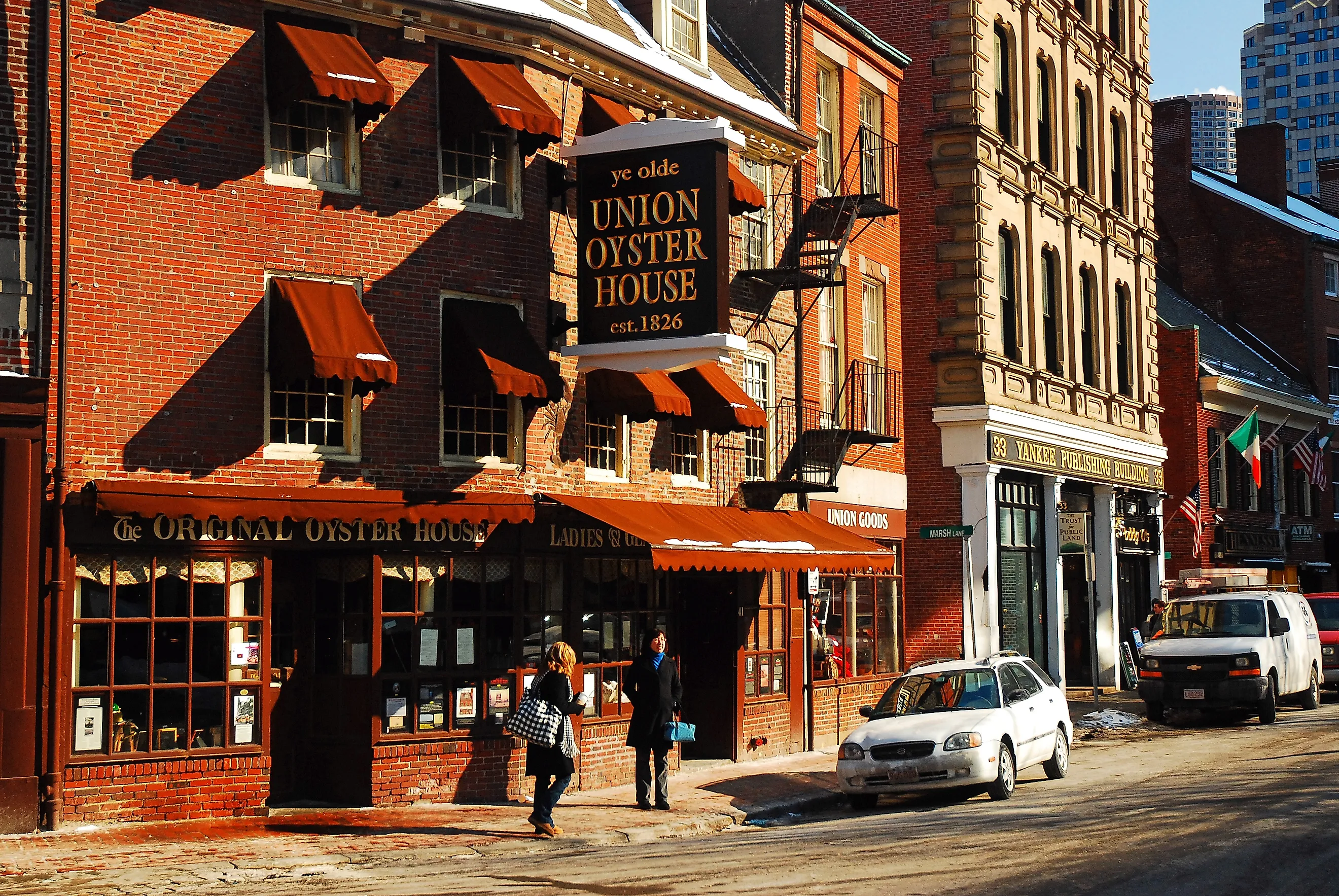
The Union Oyster House has been feeding folks at the same Boston address since 1826, making it the oldest continuous operating restaurant and oyster bar in the United States. The brick building is even older than that, dating from 1716 or 1717. But before a single oyster was sold there, the upper floors sheltered a revolutionary printer, an exiled French prince, and the paymaster of the Continental Army in Boston. The restaurant marked its 200th year in 2026, serving up delicacies from the same semicircular oyster bar. Here’s how a humble Boston dry goods store became a National Historic Landmark, and America’s oldest still-serving eatery.
The Georgian Brick House

The oldest building in Boston’s Blackstone Block went up more than a century before anyone ever shucked an oyster in it, with a landmark nomination tracing a newly build brick tenement on Union Street to a deed dated September 13, 1717. The recorded sale suggested that a tailor named John Savell sold the building to a John Green for an estimated 50 pounds and no known dwelling at the time.
The house has an unusual, angled front, five bays wide, following the point where Marshall Street and Union Street meet. Three of those bays face Union Street and were laid in a Flemish bond brick pattern, using darkened headers, with shallow curved structural arches over the second-floor windows and a horizontal band of stone between the upper stories. The two bays on Marshall Street got plainer English bond and none of the ornament, a standard economy on the less visible side of a building.
The building was purchased in 1742 by Thomas Stoddard alongside his daughter, Patience, and her husband, Hopestill Capen, a shopkeeper who would inherit the building years later, turning it into a dry goods store under the name At the sign of the Cornfields. Boston’s shoreline at that time reached the back door where ships arriving from Europe unloaded cloth almost directly into the shop. The silk trade that made the store’s name came a generation later, under Capen’s son, Thomas, who inherited it in 1807 and imported silks and fancy dress goods from London and Paris until his death in 1819.
While Capen was known for his dry goods business, he was also known for hiring an influential British spy. Benjamin Thompson was only a 16-year-old from Woburn when Capen hired him in 1769 as an apprentice where he lodged in the attic which he clerked downstairs. Thompson was charged with being a Tory in 1776, later leaving for England, where he took the title of Count Rumford and earned fame for demonstrating that heat is a form of motion rather than a fluid. He is also well-known as the first person to use invisible ink in America, which he put to work spying for the British between 1773 and 1775.
The Massachusetts Spy

Revolutionary politics arrived on the upper floors of what’s now Union Oyster House in 1771. That year, printer Isaiah Thomas set up his newspaper, The Massachusetts Spy, in the building producing pages for the next four years. Thomas designed the paper in a small format aimed at working people who had little time to spare from business, and the post riders who delivered them also carried correspondence for the patriot committees. The Spy was read and quoted throughout the Thirteen Colonies and Thomas later became known as the father of modern American printing and publishing.
Tensions around the print shop turned nasty on March 10, 1775, when Thomas Ditson was caught trying to persuade a British grenadier to desert, or to part with his musket for a price. Rather than risk a civil trial, the commanding officer had him stripped, tarred, feathered, and paraded through the streets. The procession halted in front of the Spy office, where soldiers reportedly shouted that the printer would be next. The last issue produced in the building was dated April 6, 1775, less than two weeks before the fighting at Lexington and Concord. Thomas abandoned the office on April 16 and restarted the paper in Worcester.
Another wing of the Revolution operated one floor down. Ebenezer Hancock, deputy paymaster general for the Continental Army’s Eastern Department and a younger brother of John Hancock, used Hopestill Capen’s shop as his headquarters in the war’s early years, handing out war wages in the same rooms where diners now order chowder.
The building’s strangest tenant showed up two decades later. In 1796, the exiled Duc d’Orléans, later Louis Philippe, took the second floor and earned a living teaching French, and possibly dancing, to fashionable Bostonians. He moved on to England in 1800 and returned home to rule France as Louis Philippe, the last king of the French, from 1830 until 1848.
The American Oyster Craze

Oysters were the fast food of 19th-century America. Street peddlers worked the larger cities with containers slung from shoulder yokes or pushed along in carts, and oyster cellars, oyster saloons, and oyster lunchrooms soon followed. The first known public serving of oysters in the American colonies came in 1763, at a primitive saloon in a New York cellar.
Boston developed an appetite for the shellfish, and the Atwood family, who’d been running oyster shops around the city since at least 1818, worked hard to satisfy the demand. Hawes Atwood opened his own house at 41 and 43 Union Street on October 7, 1826, taking over the rooms where the Capens’ dry goods store had traded for the better part of a century.
The business changed names repeatedly as partners came and went, trading as Atwood’s Oyster House, then Atwood & Hawes from about 1842 to 1860, then Atwood & Bacon, before finally becoming Union Oyster House in 1916. A newspaper ad from 1854 offered prime oysters from the old, noted house of W. and H. Atwood at 50 cents per bushel, with liquors at 62 and a half cents per gallon. The volumes were enormous: the house is reputed to have sold 35,000 oysters in a single day at its peak, and was still shelling out more than 7,000 a day by 1949.
Ownership changed hands three times in the restaurant’s first two centuries. The Atwood family sold it in 1913 to the Fitzgerald family; the Greaves brothers of Nova Scotia had the restaurant by 1940 and sold it in 1970 to Joseph Milano and his family, who ran it for the next 56 years. Through the middle of the 20th century, the operation also supported two satellite restaurants, one on Stuart Street from 1932 and one on Canal Street from 1940, both lasting into the 1960s.
The Only Oyster Bar of Its Kind

There’s nothing like the counter inside the front door of Union Oyster House anywhere in the country. An open semicircular oak counter is wrapped around an inner shucking table cut from soapstone and fitted with a drain. Sheet copper had been laid over the soapstone by the 1940s to satisfy health codes, and a second wooden top was added later for extra working space. Nine cast-iron stools with flat round wooden seats are bolted to the floor around it.
The Italianate stall booths along the walls are equally rare, each built of white-painted wood, with a four-foot table on cross legs and benches framed into the partition walls on either side. Gilded wooden wreaths on the transoms carry the booth numbers, and louvered half doors once swung across the fronts for privacy. The classic Greek cast-iron column design runs along the interior walls near the bar, installed when the building was converted from a dwelling into a commercial space.
There were plenty of early regulars, too. Senator Daniel Webster came in constantly through the 1840s and 1850s, reportedly working through a tall tumbler of brandy and water with every half dozen oysters, and seldom taking fewer than six plates in a sitting. James Farren, known to everyone as Pop, shucked at the same counter for nearly 65 years, from an estimated 1869 until 1934, and a Brockton man named Frank Kelleher once ate 120 oysters in a single sitting, breaking the record of 84 set by a Harvard student in 1916.
Booth 18, Famous Regulars, And The Toothpick

A brass plaque upstairs marks booth 18 on the second-floor dining room in honour of former President John F. Kennedy. According to the plaque dedicated in May 1977, he preferred the booth for its privacy of the upstairs room where he would spend his Sunday lunch times eating lobster stew and reading the newspaper during his years as a Boston Congressman.
The list of other guests reads like a who’s who of American public life. Presidents Calvin Coolidge, Franklin D. Roosevelt, and Bill Clinton have all eaten there, along with the tenor Luciano Pavarotti, who sang happy birthday to the table next to his own when he realized what the group was celebrating. Jack Coleman, president of Haverford College in Pennsylvania, spent part of a sabbatical working the salad station in complete anonymity, part of a project to sample demanding American jobs from the inside.
Union Oyster House has another claim to fame, too. Charles Forster, a businessman from Maine, had seen South Americans whittle slivers of wood to clean their teeth and had built a machine to manufacture them in quantity, but he could not get restaurant owners interested. Around 1890, Forster picked the oyster house for an experiment, paying a group of Harvard students to eat a good meal and then loudly demand toothpicks afterward. Once five or six well-dressed young men had made a scene, the restaurant began offering toothpicks on small trays, and other Boston restaurants followed.
Landmark Status and the 200th Year

Federal recognition arrived on May 27, 2003, when the property was designated a National Historic Landmark. The building had already been on the National Register of Historic Places since 1973 as part of the Blackstone Block Historic District, but the citation cemented the establishment’s claim to be the oldest continually operating restaurant and oyster bar in the United States, recognized as one of the earliest standing brick buildings in Boston and a rare survivor of the city’s Georgian period. The Blackstone Block itself covers about 2.3 acres and holds the largest intact fragment of Boston’s 17th-century street plan.
Older dining rooms do exist. The White Horse Tavern in Newport, Rhode Island, has been pouring since 1673 and is widely billed as the country’s oldest restaurant. The distinction rests on that word continually: the White Horse spent decades as a rooming house after 1895 and did not reopen as a tavern until 1957, while Union Oyster House has served food from the same address without a break since 1826.
What you see today is actually three connected buildings. The original is flanked by a south addition at 37 Union Street, built in 1851 and bought by the Milano family in January 1995, and a north addition at 14 to 22 Marshall Street, built in 1916 and bought in 1982. Only the middle building counts toward the landmark designation.
Interior walls were cut through to join the three, producing rooms that include the Union Bar, that opened in August 1983 with seating for 300, Webster’s Den, which seats 125 in booths modeled on the ones downstairs, and the 50-seat Heritage Room. The latter is decorated with three-dimensional dioramas of the stops along the Freedom Trail, the 2.5-mile red brick walking route through downtown Boston’s Revolutionary sites.
The kitchen still leans on New England standards, with the house clam chowder recipe essentially unchanged in 200 years. Other menu fixtures include broiled Boston scrod, a cut of young cod or haddock topped with seasoned crumbs, along with a shore dinner of chowder, steamers, and boiled lobster served with corn and red bliss potatoes. Baked beans still arrive free on Saturdays, and iced tea is on the house whenever the temperature tops 85 degrees.
The 200th anniversary milstone was hit in 2026, and a change came with it. The Fertitta family of Houston, whose hospitality holdings include the Landry’s restaurant group, moved to acquire the business in August 2026, ending the Milano family’s 56-year tenure with a promise that operations and staff would continue as before.
Two Centuries on Union Street
Few American businesses can claim an unbroken line dating back to 1826. Even fewer still operate from the same building. In its 200 years, Union Oyster House has outlasted better-known people and places, and the counter inside the front door is still doing exactly what it did when Daniel Webster was working his way through his sixth plate.