11 Most Scenic Drives in New York
New York stretches from the Canadian border to the Atlantic, and threaded through its towns are highways and byways that reveal some of the state’s best scenery. The Catskill Mountains Scenic Byway offers lush green views of the Hudson Valley region, with reservoirs and small mountain hamlets along Route 28. For lakeside scenery, the Seneca Lake Scenic Byway pairs vineyard country with water views, breweries, and easy access to the Finger Lakes National Forest. From river roads and mountain corridors to urban drives and waterfront routes, these scenic roads show just how varied New York can be from one region to the next.
Upper Delaware Scenic Byway

Located where New York meets two of its neighbors, Pennsylvania and New Jersey, this scenic route follows New York State Route 97 alongside the Delaware River and has drawn motorists since it was constructed in the late 1920s. Starting in Port Jervis and ending in the town of Hancock, the roughly 70-mile Upper Delaware Scenic Byway offers a scenic drive for car enthusiasts, bicyclists, motorcyclists, and travelers interested in classic Americana.
The drive itself allows for easy access to the majority of activities in addition to the residential hamlets dotted throughout which is just asking you to take a weekend to make all the visits. Keep in mind, however, gas stations are few and far in between so it might be best to have a full tank prior to the trek. Fishing opportunities are available along the river throughout much of the year, though seasons and regulations vary by species, and the warmer months are often the most productive for anglers. If you’re visiting in the colder months, anglers sometimes target Walleye, which inhabit sections of the Delaware River and can be caught outside the peak spring runs of other species.
Palisades Interstate Parkway

Running for about 40 miles, the Palisades Interstate Parkway is an engineering marvel that's shared by New York and New Jersey. Its route takes passengers from just north of the George Washington Bridge in the Big Apple to Bear Mountain Bridge, further up the Hudson River. Passenger cars and motorcycles are the only vehicles allowed to take in the scenery, however; cars with trailers, RVs and vehicles with commercial plates aren’t permitted.
Completed in 1958, the Palisades Interstate Parkway runs along the cliffs of the Hudson River for much of its route, offering frequent views of the river from its elevated perch. Drivers wishing to fully enjoy the surrounding area should stop at one of three main overlooks; the Rockefeller, Alpine and State Line Lookout. Moreover, the State Line Lookout is the starting point for hikers eager to experience a more natural setting. Motorists should be aware that sections of the parkway may occasionally be closed for maintenance or repairs, so it’s a good idea to check current conditions before traveling.
Catskill Mountains Scenic Byway

A little less than two hours north of New York City, the Catskill Mountains Scenic Byway is the perfect drive to soak up the vacationland of New Yorkers for generations. Mostly following Route 28, from the town of Olive to the hamlet of Andes, the byway is 52 miles of stretch which weaves through the breathtaking Catskills. Visitors can expect a wide variety of pleasant distractions, no matter what your interests fall into.
Both Olive and Andes, in addition to the small settlements of Shandaken, Middletown, Fleischmanns and Margaretville, contain amenities which are as diverse as they are eccentric. Be it the Greater Fleischmanns Museum of Memories, which documents the region’s rich history, the many shops and restaurants of Olive, or the world’s largest kaleidoscope, travelers will witness something special.
If a more strenuous outing is calling, hiking trails abound, while aquatic recreation, such as kayaking and rafting can be found at multiple sites along the byway. In the winter, visitors can enjoy skiing and snowboarding at several nearby resorts, including Belleayre Mountain Ski Center and Plattekill Mountain, which offer a variety of trails for all skill levels.
Route 20 Scenic Byway

If you’re up for a transcontinental adventure look no further than Route 20, the longest road America has up its sleeve. Lasting a whopping 3,365 miles, the highway literally goes coast to coast, with endpoints in Newport, Oregon and Boston, Massachusetts, respectively. However, the route which runs through New York arguably has the most bang for its buck.
Originally a Native American trail prior to the country’s founding, Route 20 turned into a major passageway for horses and wagons. The advent of automobiles increased traffic even more, causing the road to officially become Route 20 in 1926. The highway which ranges 108 miles between Duanesburg and LaFayette is a cornucopia of sites connected to New York’s long history and lush, rolling landscapes. There you’ll see towns from the colonial era scattered up and down the route featuring Federal and Greek Revival architecture amidst farms which are just as old.
Great Lakes Seaway Trail

A drive adjacent to the majestic Great Lakes will clear most minds. The Great Lakes Seaway Trail rings the entire northern and western border of New York, with Lake Ontario and Erie becoming a serene, never-ending feast for the eyes. Lasting a mammoth 454 miles, the highway begins on Route 37 in Massena parallel to the Saint Lawrence River and Canadian border, stretching all the way down to where Pennsylvania and New York meet.
While driving you’ll also pass through the cities of Rochester and Buffalo, each offering their own urban delights, not to mention numerous towns situated throughout the Trail. Boldt Castle, an impressive architectural structure, can be visited near the northern end of the trail, standing atop Heart Island on the Saint Lawrence. When passing through the Buffalo region be sure to stop and take in the spectacular Niagara Falls, one of the wonders of the natural world. Finally, the Thousand Islands between America and Canada provides recreational delights for the whole family.
FDR Drive

Whereas the previous roads emphasize much of the natural beauty of New York, FDR Drive is all about the metropolitan grandeur of New York City. Starting in the 1930s, the drive was constructed over unused lots riddled along the eastern portion of Manhattan until finally completed during the Second World War. Named after President Franklin Delano Roosevelt, FDR Drive is a prominent highway in Manhattan, officially starting at 14th Street and First Avenue and running north to 125th Street, providing access to the east side of Manhattan and connections to other boroughs via bridges and highways.
Though primarily utilized as a method for commuting within the city, the thoroughfare is also littered with leisurely spots on its path, such as Carl Schurz Park, General Douglas MacArthur Memorial Park and Robert Moses Playground. Be forewarned, keeping eyes on the road will be difficult due to the splendor of the Big Apple being all around you.
Lakes to Locks Passage

Speaking of major New York cities, those in the Albany area should seriously consider the Lakes to Locks Passage, a 230-mile corridor first starting as US Route 4 then turning into NY State Route 22, US Route 9, and ultimately New York State Route 9B, respectively, from the town of Waterford to the border community of Rouses Point. Here you’ll find that the locale hasn’t always been so peaceful, as the Revolutionary War and War of 1812 played out at various points along what is now the passage.
History aside, the highway is also part of the Lake George, Champlain Canal and Lake Champlain regions, each privy to numerous activities to occupy yourself with. While driving you can stop and immerse yourself in parks, such as the North Woods Nature Preserve and New Skete Monasteries, plus the Fort William Henry Museum and vibrant cultural organizations, such as the Seagle Music Colony and Pember Library.
Seneca Lake Scenic Byway

Wanting a visit to upstate, western New York? If you can, try exploring the Seneca Lake Scenic Byway, you’ll very likely not be disappointed. At 19 miles, the byway goes from the southern tip of Seneca Lake to the town of Lodi via New York State Route 414 with plenty to do in between: restaurants, bed and breakfasts, gift shops and more.
Travelers wanting to wet their whistle can make a pit stop at the Graft Wine and Cider Bar when starting or finishing their journey, situated in the town of Watkins Glen. Further up the road is Two Goats Brewing where craft beer awaits as well as several other breweries. Those on the hungrier side can reserve a table at the Seneca Cheese Company or Johnny’s Kitchen, depending on what your palette craves. Once you’re done engaging in the culinary arts the Finger Lakes National Forest provides over 16,250 acres of untouched land for hiking, snowmobiling, biking and camping.
Western New York Southtowns Scenic Byway

As usual, upstate New York has no end of beautiful byways to enjoy. Next up is the Western New York Southtowns Scenic Byway, a 108-mile road southeast of Buffalo. Officially following Routes US Route 219, New York State Route 240, and New York State Route 242, the byway falls under the shadow of the Allegheny Mountains and showcases history centuries old.
Nearby towns like Ashford and Ellicottville, stemming from the 19th century, hold annual autumn and summer festivals that draw thousands, in addition to various shops. However, more rustically inclined wanderers can choose to travel to surrounding attractions such as the Chestnut Ridge Park, Sprague Brook Park, Knox Farm State Park and Sinking Ponds Archaeological Site. Not to your liking? More a purveyor of the arts? Then make a visit to Griffis Sculpture Park, an outdoor gallery of steel sculptures established in the 1960s that stands on 450 acres.
Whiteface Veterans Memorial Highway

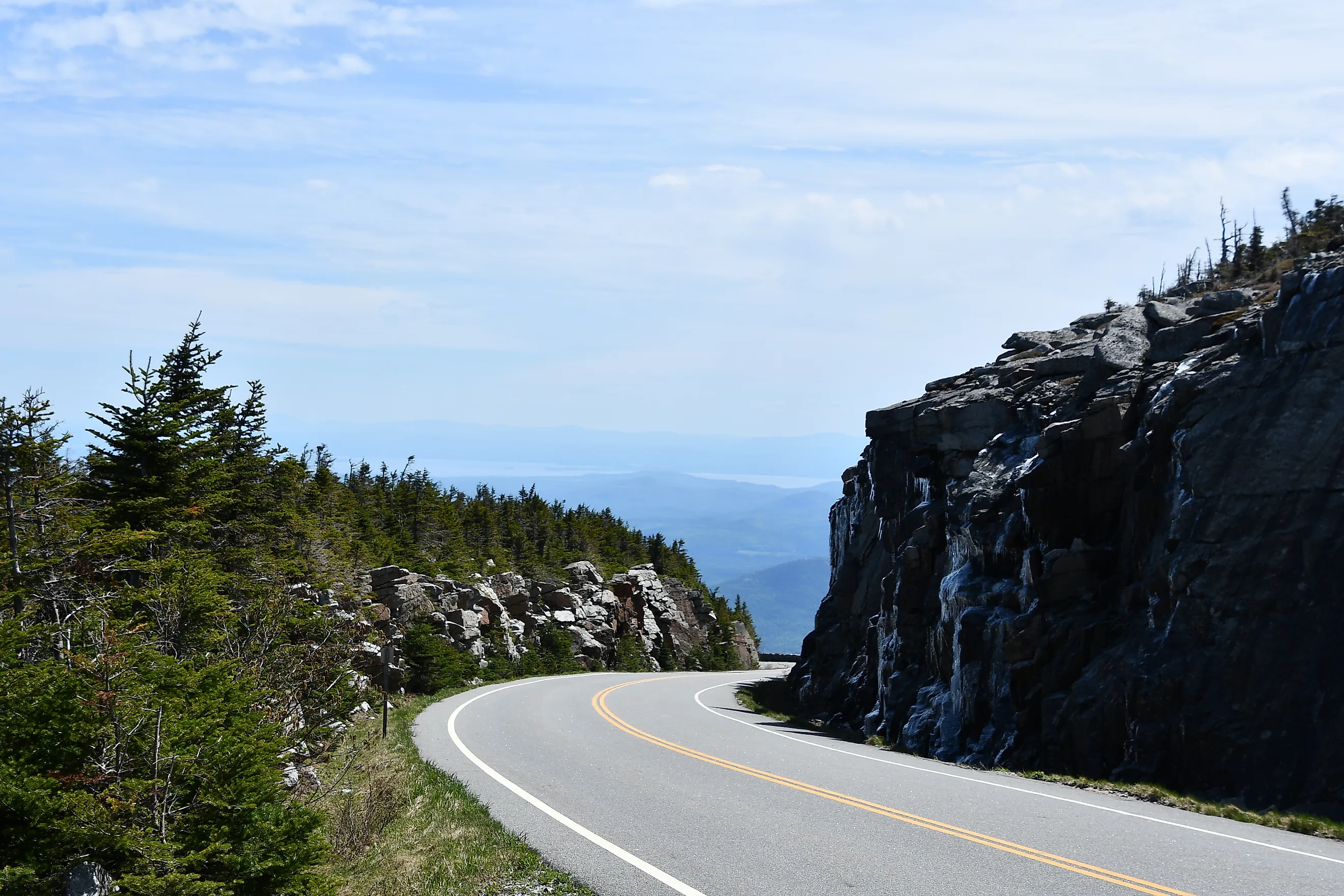
The most vertical route on this list, the Whiteface Veterans Memorial Highway will take you 2,300 feet up toward the clouds. Just outside Wilmington, New York, Whiteface’s steep incline gives a stupendous view in every direction, where even Vermont and Canada are visible. Officially opening in 1935, the highway is meant as a dedication to American lives lost in war. The tollhouse area, an impressive gatehouse constructed in the alpine-style, serves as an entrance to the highway’s opening and also sits next to Lake Stevens, a pond which can be used for fishing and leisure. Sightseers are urged to visit during the fall months, when the autumn foliage is at its peak and most magnificent. Following that, the highway is closed for the winter season due to unpredictable snowfall.
Fifth Avenue

Finally, our expedition through the pathways of New York comes to a close with one of the most recognizable streets in New York City. Home of luxurious shopping, visitors can browse Saks Fifth Avenue, Tiffany & Co., Louis Vuitton, Cartier, Gucci or Chanel stores to pick up something special.
The avenue traces its origins to the 19th century but truly became the “Avenue of Wonders” in the 1930s when department stores revealed their iconic facades personifying opulence. But retail isn’t the only worthwhile offering on Fifth Avenue; notable buildings include Saint Patrick's Cathedral, the Rockefeller Center and the main branch of the New York Public Library. Culturally speaking, New York City is practically unequaled, where some of her most well-known museums, the Metropolitan Museum of Art and Guggenheim Museum, also reside on Fifth Avenue. Needless to say, you won’t be bored.
New York certainly lives up to its imperial nickname, a state hosting a plethora of sights to see via the open road. From mountain highways that climb into the clouds to riverside routes steeped in history, every mile reveals a different side of the Empire State’s character. Travelers can wander from bustling city avenues to quiet rural backroads in the span of a single day, discovering everything from world-class landmarks to hidden local gems along the way. Check your tire pressure, add some motor oil and ready the music tunes — New York is your oyster. (P.S., they have great oysters in Long Island.)