6 England Small Towns With Unmatched Friendliness
England's small towns are often where the country feels most welcoming, with local traditions and residents who are quick to share a story or point a visitor in the right direction. The six towns below come out of a recent trip across the country. Cirencester's Civic Society offers free tours led by some of the kindest local guides going. Ventnor offers a proper High Tea at The Royal Hotel with sweeping garden views. These towns paint a clear picture of why England remains one of the most-visited parts of the United Kingdom.
Cirencester, Gloucestershire

The case for Cirencester being one of England's friendliest towns is an easy one to make. The Cirencester Civic Society has been running volunteer-led town walks since 1966, covering 2,000 years of history in around 90 minutes. Guides are trained local volunteers who clearly enjoy what they do.
The walks are free, though donations are welcome and go toward community projects. They run most days from April through September, departing from the historic Market Place, and provide the background needed to keep exploring this Roman-founded town on your own afterward.

The Parish Church of St John the Baptist on Market Square is one of England's great wool churches. Built starting in the 12th century, its scale reflects the wealth the wool trade brought to the Cotswolds in medieval times. The tower is open for tours from March to October, led by friendly volunteers and staff, and the climb is worth it for the views over the town and out toward Cirencester Park.
The Corinium Museum is the place to go for Cirencester's Roman history. Known then as Corinium Dobunnorum, the town was Roman Britain's second-largest city after London, and the museum's Roman mosaic collection is one of the best in the country. Other displays cover Iron Age and Anglo-Saxon artifacts.
Glastonbury, Somerset

Whatever you make of Glastonbury's mythology, the town's welcoming reputation is well-known across the UK. Home to the Glastonbury Festival, a multi-day music event that started in 1970 in a farmer's field and now draws around 200,000 fans each year, Glastonbury is also the country's go-to destination for everything from mystics to modern-day witches.
That association with New Age beliefs largely traces back to Glastonbury Tor, the conical hill that has defined this corner of Somerset for millennia. Rising 518 feet above the Somerset Levels, this geological feature formed when softer deposits eroded around it, leaving its harder cap exposed. Its seven distinct terraces have fueled countless theories, including that it is the site of King Arthur's Avalon.

St Michael's Tower, the roofless three-story remnant of a 14th-century church, sits at the top of the Tor and adds to the landmark's mystique. The climb is long, and with no parking nearby, it is best to leave the car in town and walk the 25 minutes to the base before winding up the spiral path. The views are worth it.
If you can stay a few days, book a self-catering cottage at The Middlewick. Part of an old farm dating back to 1656, it sits within walking distance of the Tor, which is visible from most of the property. Other amenities include a full-service spa with a swimming pool, steam room, and sauna, plus an on-site café serving breakfast and lunch with a menu built around local produce.

Glastonbury is also home to Queen of Cups, one of Somerset's most talked-about restaurants. Owned by MasterChef: The Professionals contestant Ayesha Kalaji, the food draws on Middle Eastern technique using local West Country produce. The friendly staff make it the kind of meal you remember.
Marlow, Buckinghamshire

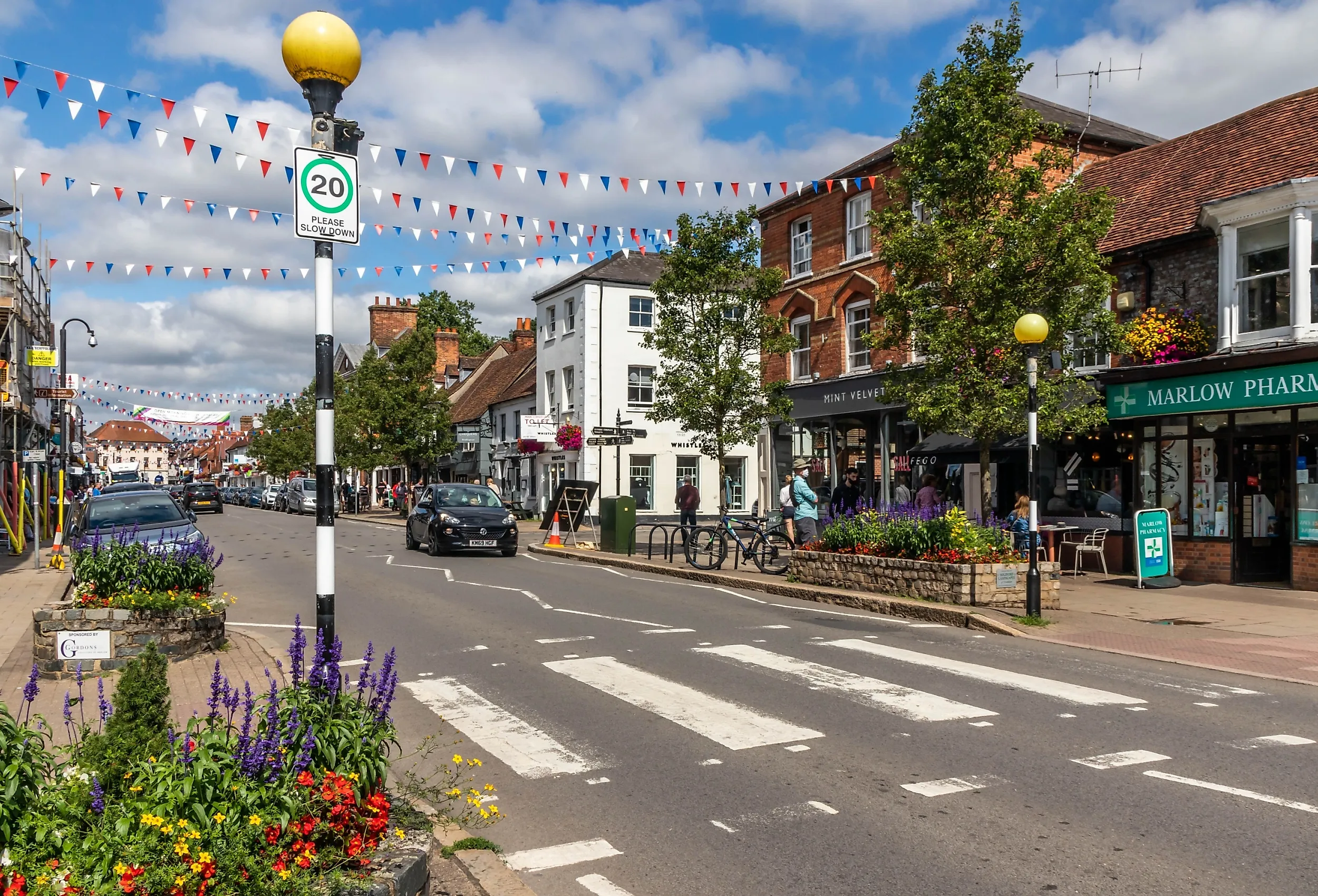
The market town of Marlow on the Thames in Buckinghamshire, just 33 miles from central London, frequently appears on lists of the best places to live in Britain. It is genuinely pretty, especially down by the River Thames.
The suspension bridge here, completed in 1832 and designed by William Tierney Clark (the same engineer behind Budapest's Chain Bridge), is the town's most photographed landmark. Good views are easy to find from Higginson Park or from the riverside cemetery of All Saints Church.

After wandering from the bridge along Marlow's High Street, drop into The Chequers for a pint or a meal (better still, both). One of the town's oldest pubs, the steak and chips are excellent, the beer goes down a treat, and the staff know a thing or two about being welcoming. For longer stays, The Chequers prides itself on being a "pub with rooms."
Alternatively, head to Danesfield House Hotel and Spa, a five-minute drive away. The former country house was completed in 1901, sits on a hilltop with views over the Thames, and has 65 acres of grounds. It also served as an RAF photographic intelligence unit during World War II, and photos from that period are displayed throughout the public spaces.
Warwick, Warwickshire

The county town of Warwickshire has a long tradition of hospitality. In 1571, the Earl of Leicester (a favorite of Queen Elizabeth I) founded the Lord Leycester Hospital on High Street under royal charter.
Built within a complex of older medieval half-timbered buildings, the Hospital provided a permanent home for 12 veteran soldiers and their wives. The principle was simple: those who had served their country deserved to be cared for. Retired service personnel still live there 450 years later. Guided tours are available and are given by residents, which makes for a personal experience you do not get many other places.

The town is also home to Warwick Castle. Set above the River Avon and one of England's most visited historic sites, this nearly 1,000-year-old castle was first fortified by William the Conqueror after his victory at the Battle of Hastings in 1066. Plan to spend at least a full day here, especially if you want to take in the jousting and banquets.
For the best castle views, head to Mill Garden on the banks of the Avon. The walls and towers loom directly overhead. Tip: arrive early, beat the crowds, and treat yourself to a full English breakfast and pastries at Wildflour Bakery and Café.
Ventnor, Isle of Wight

The list of notable figures who have visited Ventnor on the Isle of Wight reads like a "who's who" of Victorian England. Charles Dickens stayed at what is now The Royal Hotel in 1849. Queen Victoria herself visited in 1846 and returned regularly during her time on the island.
The Queen's habit of taking afternoon refreshments in the hotel's gardens is considered the precursor to what is now one of the country's most popular pastimes: afternoon tea. The Royal Hotel keeps the tradition alive by serving up the Isle of Wight's best afternoon ("High") tea, complete with sandwiches, cakes, pastries, and a pot of your preferred tea.

Ventnor sits in one of England's most sheltered microclimates, and the consistent sunshine has led visitors to compare it to the Italian Riviera. Head to Ventnor Botanic Garden on the nearby Undercliff to see plants normally found only around the Mediterranean.
Christchurch, Dorset

The market town of Christchurch sits at the eastern end of Dorset, where the Stour and Avon rivers meet before flowing into Christchurch Harbour. Settled since the Iron Age, fortified during the Saxon period, and granted its first market in the Middle Ages, the town has spent more than a thousand years welcoming visitors arriving by sea and by road.
The town's leading landmark, Christchurch Priory, is England's longest parish church, stretching 311 feet end to end. It is also one of only a handful of monastic churches that survived Henry VIII's Dissolution intact, spared after townspeople petitioned the King. Tours of the 15th-century tower involve climbing 176 steps, and the views from the top are worth the climb.

Five miles east of the town center, Highcliffe Castle is one of England's finest examples of Romantic and Picturesque architecture. Built between 1831 and 1835 by a wealthy British Ambassador to France, this Gothic Revival mansion is unusual in that it includes substantial quantities of medieval Norman and Renaissance stonework salvaged from ruined abbeys in Europe.
Notable guests included Germany's Kaiser Wilhelm II, who stayed for three weeks in 1907, and Harry Selfridge, founder of the famous London department store. Head down to Highcliffe Castle Beach, a quiet stretch of sand and shingle with views across Christchurch Bay all the way to the Isle of Wight. The Castle Pantry, the on-site café, also does a top-notch afternoon tea; weather permitting, take it on the terrace overlooking the castle.
England's Friendliest Small Towns
England's best small towns are not always the ones with the most attractions. They are often the ones where the people who live, work, and volunteer there take the time to stop for a chat. Whether you are interacting with volunteer guides or with the staff at the local hotels and eateries, you are guaranteed a warm welcome at all six of these towns.