11 Cutest Small Towns In Pennsylvania For 2026
One of Pennsylvania’s small towns still lights every block of Main Street with gas lamps that have burned since 1895. Another sits at the edge of a gorge so deep locals call it the Pennsylvania Grand Canyon. A third has three concrete castles built by hand in the early 1900s by a man who spent years quietly stockpiling 40,000 pre-industrial artifacts before they vanished. Pennsylvania’s 19th-century railroad economy built fast and left a lot behind. The towns on this list pair that historic core with something else worth the drive.
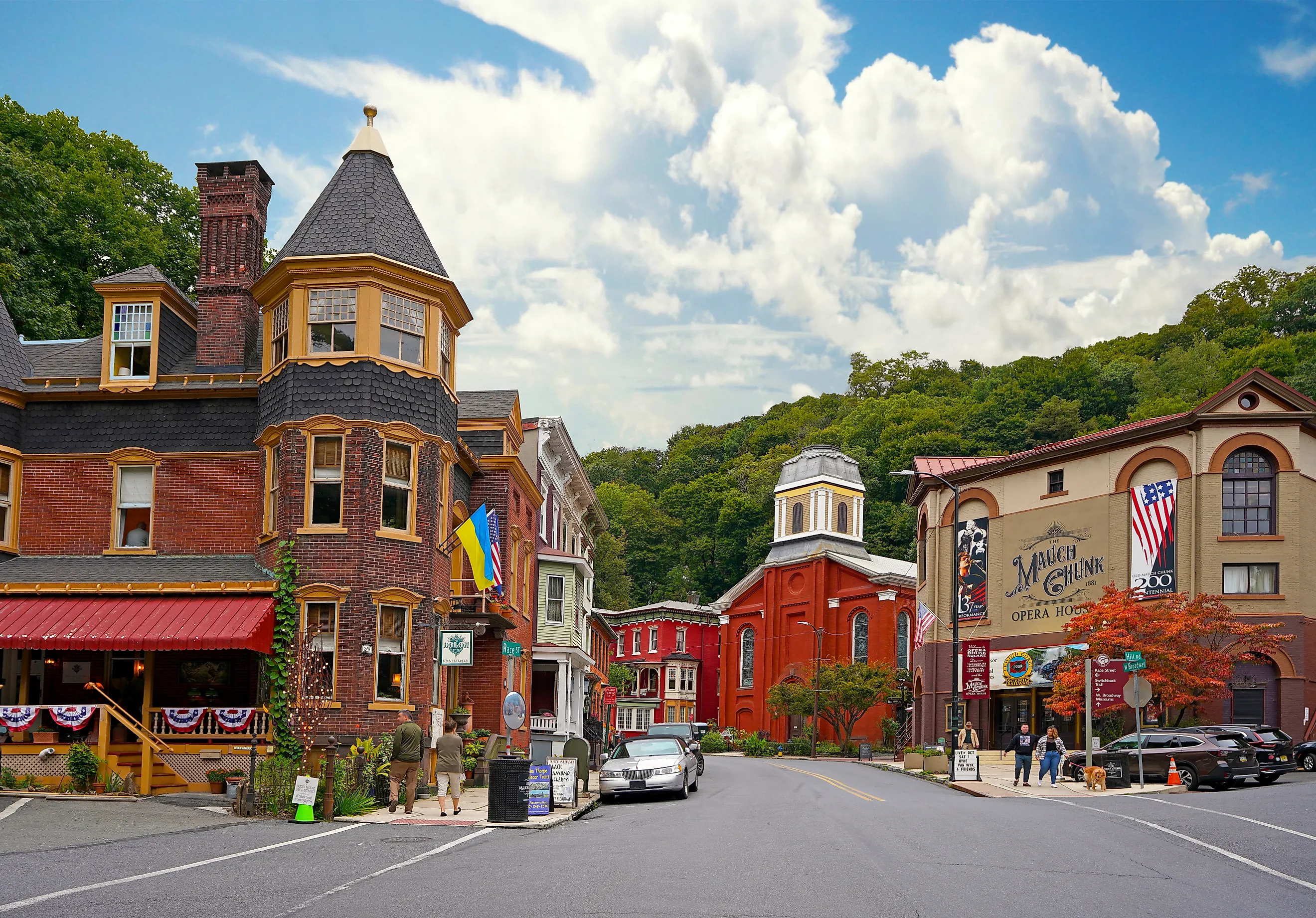
Jim Thorpe

In a narrow valley in the southern Pocono Mountains along the Lehigh River, Jim Thorpe is a Victorian-era coal town that has a Swiss Alps feel in northeastern Pennsylvania. The Lehigh Gorge Scenic Railway departs from the 1888 Mauch Chunk Station and runs a 16-mile round trip through Lehigh Gorge State Park over bridges and alongside the Lehigh River. The narration traces the area’s industrial railroading history, with the full ride running 70 minutes most of the year, with vintage coaches built as early as 1917. From there, a walk up to the Asa Packer Mansion reveals one of the best-preserved examples of Italianate architecture in the country. Completed in 1861 as the home of railroad magnate and Lehigh University founder Asa Packer, the mansion’s interior, including its mahogany staircase, period furnishings, and self-playing organ, has remained essentially unchanged since the 19th century.

A few blocks down Broadway, the 1871 Old Jail Museum, a two-story stone fortress, held Carbon County prisoners until 1995 and is best known as the site where seven accused Molly Maguires were hanged in the 1870s. Guided tours take visitors through 72 rooms, into the solitary confinement dungeon, and past Cell 17, where Alexander Campbell’s handprint, left before his 1877 execution as a declaration of innocence, still appears on the wall. For a view over the entire town, Kemmerer Park, perched above the Lehigh River, offers a quiet retreat from Broadway, with walking trails and overlooks framing Jim Thorpe.
New Hope

On the Delaware River, New Hope has grown into one of Pennsylvania’s best-known arts towns. The Bucks County Playhouse, a converted 1790 grist mill on the Delaware riverbank, opened as a theater in 1939. It quickly became known as "America’s Most Famous Summer Theater," with Neil Simon’s Barefoot in the Park receiving its world premiere here in 1963 and performers including Grace Kelly, Robert Redford, and Helen Hayes having graced its stage. The playhouse continues to produce full mainstage seasons today and attracts over 80,000 patrons annually. Running directly through the heart of downtown is the Delaware Canal, a 59-mile-long National Historic Landmark. The mostly flat gravel towpath along its banks is open year-round for walking and cycling.

South of town, Bowman’s Hill Wildflower Preserve is an accredited museum and botanical garden on 134 acres. The attraction boasts over 700 of Pennsylvania’s native plant species across habitats that include hardwood forests, a meadow, steep hillsides, and two ponds. Rounding it out, the Parry Mansion, the Georgian-style home of town founder Benjamin Parry, features 11 rooms that span 125 years of American decorative styles. It has hand-blocked Empire-era wallpaper and a Victorian-period bedroom, and is open to the public for tours.
Lititz

Recognized as "Coolest Small Town in America" by Budget Travel Magazine, Lititz still makes its case through long-running local traditions. At the 1861-established Julius Sturgis Pretzel Bakery, visitors can take a 25-minute guided tour of America’s first commercial pretzel bakery, which includes the original brick ovens Julius Sturgis built himself, a hands-on pretzel-twisting lesson, and a look at the baking methods the Sturgis family has used for over five generations. Just down the block, Wilbur Chocolate has been operating since 1894 and remains a working chocolate facility. Its retail store sells Wilbur Buds, the teardrop-shaped milk chocolate candies for which the company is best known, along with peanut butter meltaways and seasonal specialties.
Smack in the town center, Lititz Springs Park attracts with a fountain fed by natural underground springs, shaded picnic areas, and a Wall of Remembrance. It hosts the town’s annual Fourth of July celebration along with a summer concert series. For local history, the Lititz Historical Foundation leads guided walking tours of Main Street and the historic district. It offers one of the most grounded introductions to the town’s Moravian roots and colonial-era architecture available anywhere in Lancaster County.
Milford

The Victorian downtown, conservation history, and proximity to some of the state’s most dramatic waterfalls give Milford a character all its own. Grey Towers National Historic Site, a French Gothic mansion completed in 1886 on 102 acres, was Gifford Pinchot’s residence and is the birthplace of the American conservation movement. Tours take visitors through the manor and the grounds, including the famous "Finger Bowl" outdoor dining table. In the heart of downtown, The Columns Museum is in a 1904 neo-classical mansion. It holds the Lincoln Flag, the 36-star flag draped over the balustrade of the presidential box at Ford’s Theatre the night Abraham Lincoln was shot, alongside two floors of Pike County artifacts, a restored Hiawatha Stagecoach, and Civil War-era exhibits.
The Milford Theater is a community standout in a restored downtown venue. Hosting live music, plays, and the annual Black Bear Film Festival every October, it brings independent films and filmmaker panels to venues across town. Another essential stop is the Delaware Water Gap National Recreation Area. It is an outdoor lover’s dream, from the Milford Knob Trail, which climbs sharply from the edge of the borough to a summit overlook for the town and flowing river views, to Raymondskill Falls.
Wellsboro

Perhaps one of the only towns in Pennsylvania where gas lamps still light every block of Main Street, Wellsboro is a Victorian gem. On the eastern rim of Pine Creek Gorge, often called the Pennsylvania Grand Canyon, Leonard Harrison State Park is a popular getaway. The park’s Turkey Path Trail descends one mile to the canyon floor past a waterfall on Little Four Mile Run, while the shorter Overlook Trail loops 0.6 miles to Otter View, a south-facing vista over the gorge. At the base of the canyon, the Pine Creek Rail Trail follows a former railroad corridor for 62 miles along Pine Creek. It is rated by USA Today as one of the ten greatest bike tour routes in the world.

In town, the Penn Wells Hotel, a Historic Hotels of America property that has been anchoring Wellsboro’s downtown since the 1860s, is worth stopping into for a meal or drink, even if you aren’t staying. Displayed inside is the Corning Glass Bulb Flag, a majestic American flag made from 1,438 Christmas bulbs, which was featured in Life magazine in 1960 and remains one of the most unusual artifacts in any Pennsylvania hotel. For a quieter stop, Oregon Hill Winery offers a tasting room for the family-run winery, where visitors can try handcrafted blush, mountain, and red wines.
Doylestown

Doylestown earns its place on this list in large part because of one person: Henry Chapman Mercer, who spent the early 1900s building three concrete castles by hand within walking distance of each other in a small Pennsylvania town. The result is a heritage district unlike any other in Pennsylvania. Fonthill Castle, Mercer’s personal home, completed in 1910, has 44 rooms across seven floors, with walls, floors, and ceilings covered in thousands of handcrafted tiles. A mile away, the Mercer Museum holds over 40,000 pre-industrial American artifacts that Mercer collected. You can find an antique fire engine, a whaling boat, and a Conestoga wagon, while 55 rooms contain cobblers’ tools, threshing machines, and tinsmithing wares, among more than 60 documented crafts.

Completing what locals call the "Mercer Mile," the Moravian Pottery and Tile Works is a working history museum still producing handmade tiles using its original methods and designs. Visitors can watch the production process and purchase tiles in the shop. Adjacent to the Mercer complex, the James A. Michener Art Museum is noted for its collection of the largest number of Impressionist paintings in the state.
Ambler

40 minutes from Philadelphia, Ambler covers less than a square mile in Montgomery County. Within that compact footprint, it has built a cultural life that feels far larger. The Ambler Theater, a Spanish Colonial Revival building from 1928, features a restored terra-cotta facade and a 30-foot neon vertical sign. It is now a nonprofit community arthouse cinema with three screens showing independent films, foreign cinema, classic Hollywood, and National Theatre Live broadcasts. Around the corner, Act II Playhouse, a 130-seat professional theater operating out of a restored Victorian firehouse since 2003, produces six full mainstage seasons annually, including world premieres, musicals, and comedies.
Since 1998, the Ambler Farmers Market has run from May to October, drawing vendors and locals with locally grown produce, baked goods, artisan foods, and live music. In the evenings on the first Friday of those same months, First Fridays transforms the main commercial strip into an outdoor festival with merchant events and food trucks. Between bouts of theater and film, Mondauk Common Park offers maintained walking trails, open lawns, and picnic areas within easy reach of downtown.
Bedford

Bedford is a well-preserved mountain town holding onto its colonial-era bones more completely than almost anywhere in the state. The Fort Bedford Museum harbors exhibits spanning the French and Indian War, the Whiskey Rebellion, Forbes Road, and the town’s transportation history. Its collection includes the only surviving British Red Ensign flag identified with a North American British fort, along with Native American artifacts and colonial household items. At Old Bedford Village, more than 40 authentic log and stone structures moved from original locations across the county re-create life in western Pennsylvania from 1700 to 1899, with reenactors demonstrating blacksmithing, weaving, and colonial crafts throughout the grounds.
South of downtown, the National Museum of the American Coverlet is the sole organization in the United States committed to antique woven coverlets. Its collection of over 1,000 pieces spans 1771 to 1889 and is displayed alongside historic barn-frame looms, spinning wheels, and a rare Jacquard head. Finally, the Covered Bridge Driving Tour connects 9 historic covered bridges throughout the county, with the longest being the 1902 Heirline Bridge, extending 136 feet. It can be completed as a loop from downtown in under two hours.
Stroudsburg

Stroudsburg is home to one of the most walkable downtown corridors in Pennsylvania. The 1928 Sherman Theater can hold up to 1,800 people standing and hosts a year-round calendar of national touring acts, comedy shows, and community festivals, including StroudFest, a free Labor Day weekend block party with over 200 vendors that takes over downtown Main Street. Outside of town, Quiet Valley Living Historical Farm sits on 114 acres and is listed on the National Register of Historic Places. Costumed interpreters re-create daily life on a 1800s Pennsylvanian German farmstead, from hearth cooking and spinning to blacksmithing, and the property includes a one-room schoolhouse and heritage breeds of farm animals.
In the main square, the restored 1890 Monroe County Courthouse dominates with its Romanesque architecture, characterized by heavy stone arches and rough-cut masonry. On Main Street, the Monroe Farmers Market has been operating for over four decades. It draws producers from throughout the region every week from spring through fall with fresh seasonal produce, baked goods, and local artisan goods.
Bellefonte

Bellefonte has been called Pennsylvania’s "Victorian Secret," with its Painted Ladies, Italianate storefronts, and gingerbread-trimmed wood-frame homes dating to as early as 1785. The centerpiece of downtown is Talleyrand Park, a 3.5-acre green space along the banks of Spring Creek, known for wild trout fishing year-round. The park features a Victorian gazebo, a suspension footbridge over the creek, and a George Grey Barnard sculpture garden, and hosts the Summer Sounds concert series every Sunday from June through August. Harbored in the Georgian-style Linn House, the Bellefonte Art Museum displays rotating works by regional and national artists and contains a permanent third-floor exhibit on the Underground Railroad, documenting Bellefonte’s documented role as a stop on the network.

At the corner of the park, the 1888 Bellefonte Train Station, now home to the Bellefonte Historical Railroad Society and the Chamber of Commerce, is the departure point for seasonal excursion trains through the hills of Center County. Headquartered in the landmark 1889 Pennsylvania Match Factory building, the American Philatelic Society is the biggest nonprofit association for philatelists, or stamp collectors, worldwide. Its library, research archives, and rotating exhibits are open to the public and free to visit.
State College

Recently ranked No. 1 among small college towns in America by USA Today’s 10Best readers, State College’s identity is inseparable from Penn State. The Palmer Museum of Art, Penn State’s free-admission museum, is the state’s most significant academic art museum. Its 20 galleries hold nearly 11,000 works spanning American and European paintings, African art, Asian ceramics, modern and contemporary sculpture, and a 13-foot Dale Chihuly installation anchoring the main staircase. Adjacent to the Palmer, The Arboretum at Penn State spans 370 acres with 10 acres of specialty H.O. Smith Botanic Gardens. Notables include a Pollinator and Bird Garden designed to attract every native pollinator and bird species in the region, a Childhood’s Gate Children’s Garden, and a wildflower trail through old-growth Hartley Wood.
The Berkey Creamery, operating continuously on the Penn State campus since 1865, now holds the title of being the country’s biggest university creamery. It produces over 100 flavors of ice cream year-round, with rotating seasonal offerings alongside staples like Peachy Paterno, WPSU Coffee Break, and the Alumni Swirl. And Beaver Stadium is the home of Penn State Nittany Lions football, with an official seating capacity of over 106,000, drawing crowds that swell the area dramatically on game days. It is a spectacle that’s worth experiencing once, even for visitors with no particular attachment to the sport.
Pennsylvania makes a strong case for being the most underrated state in the United States when it comes to small-town character. These towns aren’t destinations you stumble through. They are places you return to. You come back for a second bowl at the Berkey Creamery, for another November weekend in Jim Thorpe when the leaves have turned the gorge gold, for a street lined with gas lamps that have burned since 1895. That return-trip feeling is what these towns do best.