7 Must-See Historic Forts In South Carolina
South Carolina’s forts have outlasted the wars they were built for. Fort Moultrie’s palmetto-log walls were still incomplete when a British fleet attacked in 1776. Fort Sumter hadn’t been finished either when Confederate artillery opened fire on it eighty-five years later. Fort Johnson changed hands four times across four separate conflicts before becoming a marine research center. Fort Lamar is largely overgrown today, its earthworks near Folly Beach untouched since the fighting stopped. Seven South Carolina forts worth visiting are below.
Fort Sumter

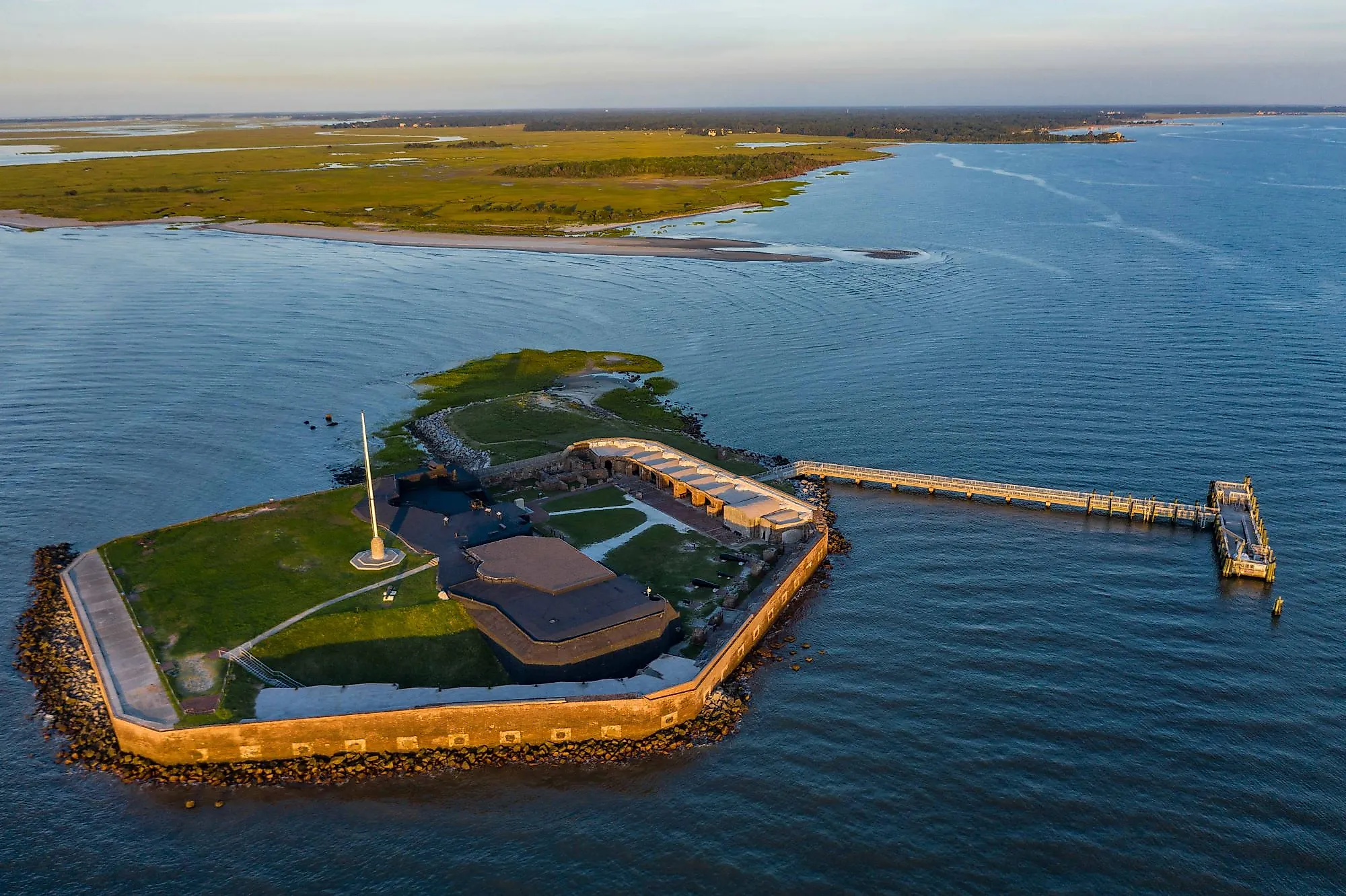
At the entrance of Charleston Harbor stands Fort Sumter, perhaps the most famous fort in the state of South Carolina. Fort Sumter was ordered in response to the War of 1812, during which American coastal fortifications struggled to defend themselves. Confederate forces fired the first shots of the Civil War upon Federal troops at Fort Sumter in April 1861. The fort would continue to serve as the focal point in Charleston for the remainder of the war. Fort Sumter was never fully completed and is only accessible by ferry. Visitors reach the fort via the National Park Service-authorized ferry service.
Fort Moultrie

Located on Sullivan’s Island, Fort Moultrie was constructed of palmetto logs and sand in the late 1700s. On June 28, 1776, the still-incomplete fort was attacked by British warships. After a nine-hour battle, the British ships were forced to retire. After the revolution, Fort Moultrie was neglected and began to decay. A second Fort Moultrie was built in 1798, but was destroyed by a hurricane in 1804. A third Fort Moultrie, made of brick, was built in 1809. Fort Moultrie was abandoned in favor of Fort Sumter during the Civil War and was eventually modernized in the 1870s. Today, the fort has been restored to showcase its major historical periods.
Fort Johnson

Located on the northeast point of James Island, Fort Johnson is one of the oldest military sites in South Carolina. The fort was constructed around 1708 and occupied by three companies of South Carolina troops until 1780, when it was abandoned during the Revolutionary War. By 1827, little of the fort remained. During the Civil War, Fort Johnson was rebuilt and turned into an entrenched camp mounting 26 guns and mortars. After the Civil War, the fort was converted into a quarantine station. In 1961, the Marshlands House was relocated to the Fort Johnson site. By 1970, the majority of the Fort Johnson property was transferred to the S.C. Wildlife and Marine Resources Department. The historic Fort Johnson site is now largely occupied by the South Carolina Marine Resources Center and open to the public.
Fort Fremont

Built during the Spanish-American War in the late 1890s, Fort Fremont was part of the Endicott-era coastal defense modernization program, and one of six fortifications constructed during the war to protect the southeastern coast. The fort site encompassed 170 acres and included several outbuildings, such as a hospital and a bakery. By 1906, the War Department considered closing Fort Fremont due to budgetary constraints, and the fort was officially deactivated in 1912. Several private individuals acquired the property, which was eventually subdivided into beach lots and a hunting/fishing lodge. In 1989, the hospital building was listed in the National Register of Historic Places, and the Fort Fremont Battery was listed in 2010. Construction of the History Center at Fort Fremont was completed in 2021, and the remaining structures are now open to the public.
Fort Jackson
Unlike the others on this list, Fort Jackson in Columbia is still an active US Army training installation. Founded in 1917 at Camp Jackson as the US entered World War I, Fort Jackson was eventually abandoned in 1922 and was later reactivated for World War II. Franklin D. Roosevelt and George C. Marshall hosted a demonstration of several divisions’ combat readiness for Winston Churchill and Alan Brooke at the fort, ahead of the planned Operation Roundup. Fort Jackson was subsequently used during the Korean War and remains active today. Still, some parts of the installation, including the U.S. Army Basic Combat Training Museum, are open to the public.
Fort Lamar

Near Folly Beach are the remains of Fort Lamar, which was built in 1862. Initially called the Tower Battery because of its 75-foot observation tower, the fort was renamed for Col. Thomas G. Lamar, who commanded Confederate troops at the fort during the battle of Secessionville on June 16, 1862. The fort was later abandoned. Today, the site is largely overgrown, offering a quieter and less developed visit than many larger historic sites in the state. Fort Lamar is open during daylight hours year-round for visitors to explore and learn about the site’s history.
Fort Dorchester at Colonial Dorchester State Historic Site

Along the Ashley River, near the town of Summerville, is the Colonial Dorchester State Historic Site, which includes the remains of Fort Dorchester, built to protect the colonial town of Dorchester. Fort Dorchester, made of oyster-shell ‘tabby,’ was constructed in July 1775, restored, and occupied by both British and Patriot troops during the Revolutionary War. After the war, the fort housed a tile yard, which was later abandoned. Today, visitors can explore the remaining tabby fort walls and archeological remains, as well as trails that explain the area’s part in the war.
These seven forts do not survive in the same way, and that is part of what makes them worth seeing together. Fort Fremont’s History Center only opened in 2021, while Fort Dorchester’s tabby walls have been exposed to the elements for generations. Fort Jackson, still training soldiers more than a century after its founding, is the only site on the list where the original purpose remains intact. Taken together, the seven sites reflect different periods of South Carolina’s military history, and they show just as clearly what was preserved, adapted, or left behind.