Why The Deep Ocean Has No Plants At All
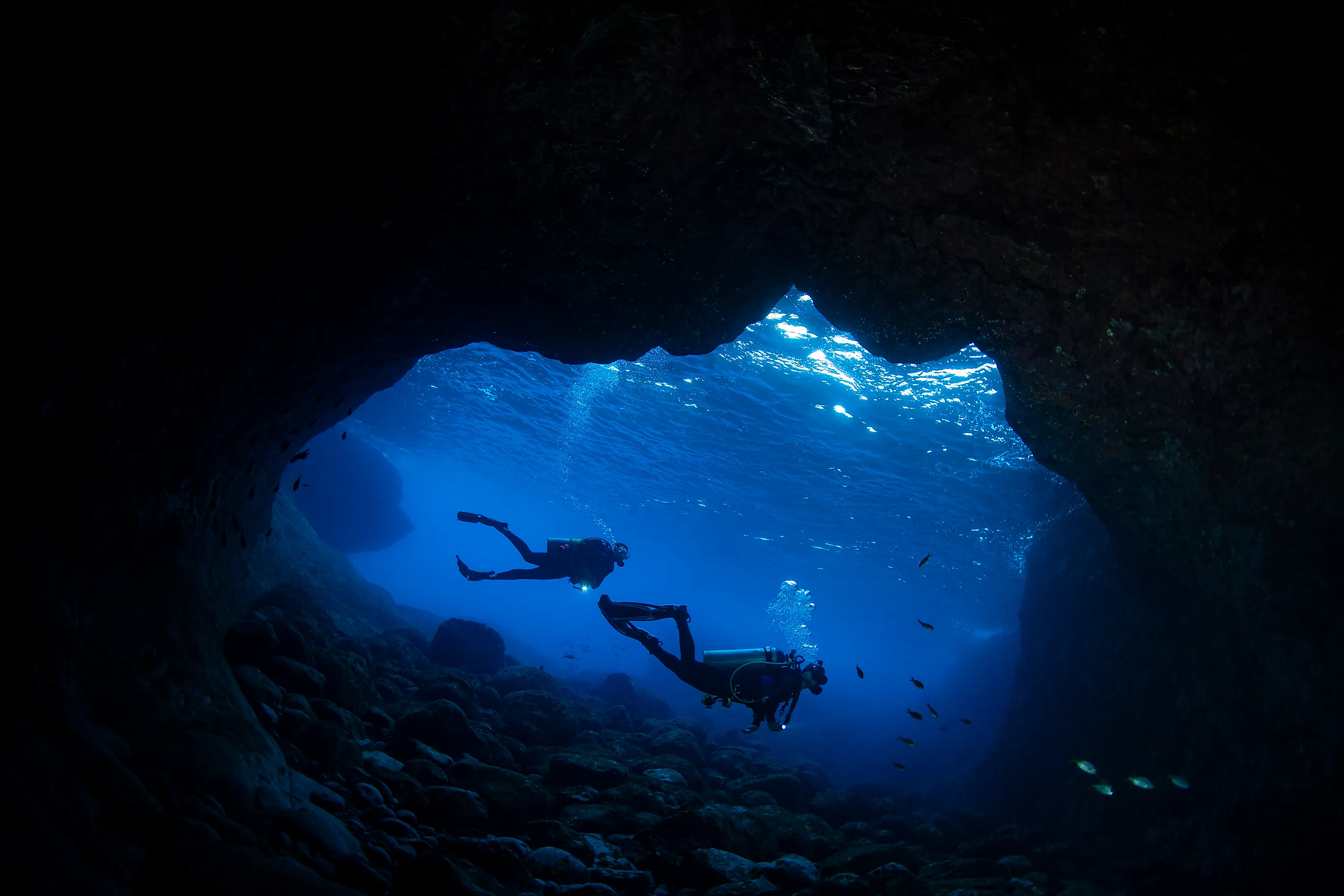
The deep ocean has no plant life because sunlight cannot reach far enough below the surface. In the Mariana Trench, the deepest point on Earth's ocean floor, miles of dark water separate the seafloor from the sunlit zone above. Animals and microbes survive in these extreme depths, but no seagrass meadows, kelp forests, or rooted plants grow there. Crushing pressure and near-freezing temperatures make the environment harsh, but darkness is the main barrier to plant growth. Plants depend on sunlight to produce food through photosynthesis, and seawater absorbs that light long before it reaches the deep seafloor. Leaves, wood, and other plant material may sink into the deep ocean, but without usable sunlight, plants cannot grow or reproduce there.
The Sunlight Boundary Plants Cannot Cross
Most plants make sugars through photosynthesis, although some nonphotosynthetic plants obtain organic carbon through fungal partners or host plants. Those sugars supply the energy needed for growth, repair, and reproduction. Without enough light, a plant gradually consumes its stored energy and dies.
Sunlight begins disappearing almost as soon as it enters the ocean. Water absorbs some wavelengths and scatters others, leaving progressively less energy available at greater depths. According to NOAA, the upper 656 feet is known as the euphotic or sunlight zone. It receives enough light to support photosynthesis.
Between about 656 and 3,280 feet lies the dysphotic or twilight zone. A faint glow may remain, but it's too weak to support photosynthesis. Below approximately 3,280 feet begins the aphotic zone, where sunlight doesn't penetrate at all. Any flashes seen here come from bioluminescent organisms rather than the Sun.
The exact depth of usable light varies with water clarity, sediments, seasons, and plankton levels. Nevertheless, the biological boundary remains. Once sunlight is too weak for photosynthesis, photosynthetic plants and algae cannot maintain self-sustaining populations, and no nonphotosynthetic plant lineage is known to have colonized the aphotic deep sea.
Why Coastal Waters Can Be Green but the Deep Ocean Cannot

The contrast is clear along the US coastlines. The shallow waters of the Florida Keys contain approximately 1.5 million acres of seagrass meadows. Seagrasses are flowering plants with roots, leaves, pollen, flowers, and seeds. They grow on the seafloor only where sunlight remains strong enough to fuel photosynthesis.
Along the Pacific Coast, underwater kelp forests grow as far north as Alaska and as far south as Baja California. Kelp can resemble enormous leafy plants, but it's actually brown algae. The root-like holdfast anchors it to rock without absorbing nutrients like a plant's roots. Gas-filled structures help lift its blades toward the sunlight.
Phytoplankton near the surface also perform photosynthesis, although most are microscopic algae or cyanobacteria rather than flowering plants such as seagrasses. Together, these organisms capture solar energy and form the base of major marine food webs.
Seagrasses, kelp, and phytoplankton differ biologically, but all need light. That's why productive green habitats cluster near coasts and the ocean's surface, while the water beneath them is devoid of plants.
What About "Plants" Seen on the Ocean Floor?

Deep-sea cameras frequently record organisms that look remarkably like flowers, ferns, bushes, or grasses. Their appearance can create the impression that strange plants grow in the darkness. In nearly every case, however, these organisms are animals.
Sea lilies, for example, have stalks and feathery arms that wave in the current. Despite their name and flowerlike shape, they are echinoderms related to sea stars and sea urchins. They catch drifting food particles with their arms. Sea fans, corals, anemones, sponges, and branching colonies of small animals can also create seafloor scenes that resemble gardens.
The Venus fly-trap anemone is an especially convincing impersonator. This deep-sea animal spreads its tentacles like the open leaves of its namesake, then uses stinging cells to capture passing prey.
Actual plant material also reaches the depths. Storms, floods, currents, and underwater landslides can transport leaves, wood, seeds, seaweed, and pieces of seagrass far from shore. Finding such debris on the bottom doesn't mean plants grew there. It's more like finding fallen leaves inside a dark cave.
How Life Survives Without Plants

Most deep-ocean life still depends indirectly on sunlight. The energy simply arrives from above rather than being produced where the animals live.
Near the surface, phytoplankton and other photosynthetic organisms create organic matter. Some is eaten, while some sink after the organisms die. As it descends, it mixes with shells, sediments, and other particles. This continuous fall of material is called marine snow.
The journey to the bottom can take weeks. Bacteria and animals consume much of the material on the way, so only a fraction reaches the deepest habitats. Animals there may filter marine snow from the water, swallow sediment containing organic particles, or prey on creatures that have already consumed it.
Food scarcity helps explain many of the deep ocean's unusual adaptations. Some animals grow slowly, conserve energy, or wait motionless for prey. Others have expandable stomachs or oversized mouths that allow them to take advantage of rare meals.
Occasionally, a much larger package of food arrives. A sunken tree can support wood-eating organisms, while a whale carcass may nourish several waves of scavengers and microbes for years. These temporary feasts are important, but their energy usually originates in the sunlit world.
The Ecosystems That Do Not Need Sunlight

Hydrothermal vents and cold seeps reveal another way life can flourish without plants. Hydrothermal vents release water heated beneath the seafloor, while cold seeps discharge fluids containing compounds such as methane or hydrogen sulfide. Neither habitat depends on sunlight as its immediate energy source.
Instead, bacteria and archaea perform chemosynthesis. Rather than capturing light, these microorganisms obtain energy from chemical reactions and use it to build organic compounds. They become the primary producers at the base of local food webs, filling a role similar to that played by plants and algae near the surface.
Some vent and seep animals eat the microbes directly. Others maintain remarkable partnerships with them. Giant tube worms lack a conventional digestive system and rely on symbiotic bacteria living inside their bodies. Certain mussels and clams also house chemosynthetic microbes that provide much of their nutrition.
Chemosynthesis doesn't sustain the entire deep ocean. Most animals away from vents and seeps remain dependent on marine snow, migrating prey, and other food sources that ultimately trace back to surface photosynthesis.
Could Plants Ever Evolve to Live in the Deep Ocean?

Deep-sea animals have evolved ways to tolerate cold temperatures, extreme pressure, darkness, and scarce food. Could plants eventually do the same?
Pressure isn't the decisive obstacle. The deeper problem is that natural selection cannot adapt a photosynthetic organism to capture sunlight where no sunlight exists. A plant might become more efficient in dim water or develop pigments that absorb the remaining wavelengths, but those adaptations would stop helping once it entered complete darkness.
An organism could theoretically evolve to obtain energy from chemical reactions, but no plant is known to perform chemosynthesis or maintain chemosynthetic symbionts in the deep sea. At that point, it would also no longer operate like a conventional photosynthetic plant. The more important distinction is that known chemosynthetic primary producers are microbes rather than plants, while deep-sea animals obtain their energy from those microbes or from organic matter produced elsewhere.
Humans could grow a plant inside an illuminated deep-sea laboratory, provided it received light, nutrients, and suitable conditions. Its light would still be supplied artificially, so the experiment would show only that a plant can be kept alive at depth, not that wild plants can sustain themselves there.
A World Beyond Green
No known rooted plants grow in aphotic deep-sea habitats: sunlight-driven photosynthesis is impossible there, and no nonphotosynthetic plant lineage is known to occupy that environment. Below the reach of useful sunlight, oxygen-producing photosynthesis effectively stops, although one deep-vent bacterium has been shown to use faint geothermal radiation for anoxygenic photosynthesis.
Life doesn't end in the deep sea, though. Animals feed on organic matter falling from the surface, hunt one another, or gather around chemically powered microbial communities. Sea lilies and anemones may resemble flowers, while hydrothermal vents can support dense colonies, but neither represents plant life. The deep ocean isn't a lifeless desert. It's something stranger: an enormous living world built without a single plant.