The US Lakes Behind America’s White Bass Records
Most white bass never reach a pound and a half. The one Ron Sprouse pulled from Virginia's 124-acre Lake Orange in 1989 weighed 6 pounds, 13 ounces, several times that, and it still shares the all-tackle world record. Michigan's Saginaw Bay has produced one over six pounds. Large white bass also turn up in the branching arms of Ozark reservoirs and across North Dakota's Devils Lake, where the 2026 forecast expects mostly 14- to 16-inch fish. White bass feed in open-water schools and gather near spawning areas as spring water warms, and anglers follow those movements into tributaries or out over submerged gravel flats.
Lake Huron's Saginaw Bay, Michigan

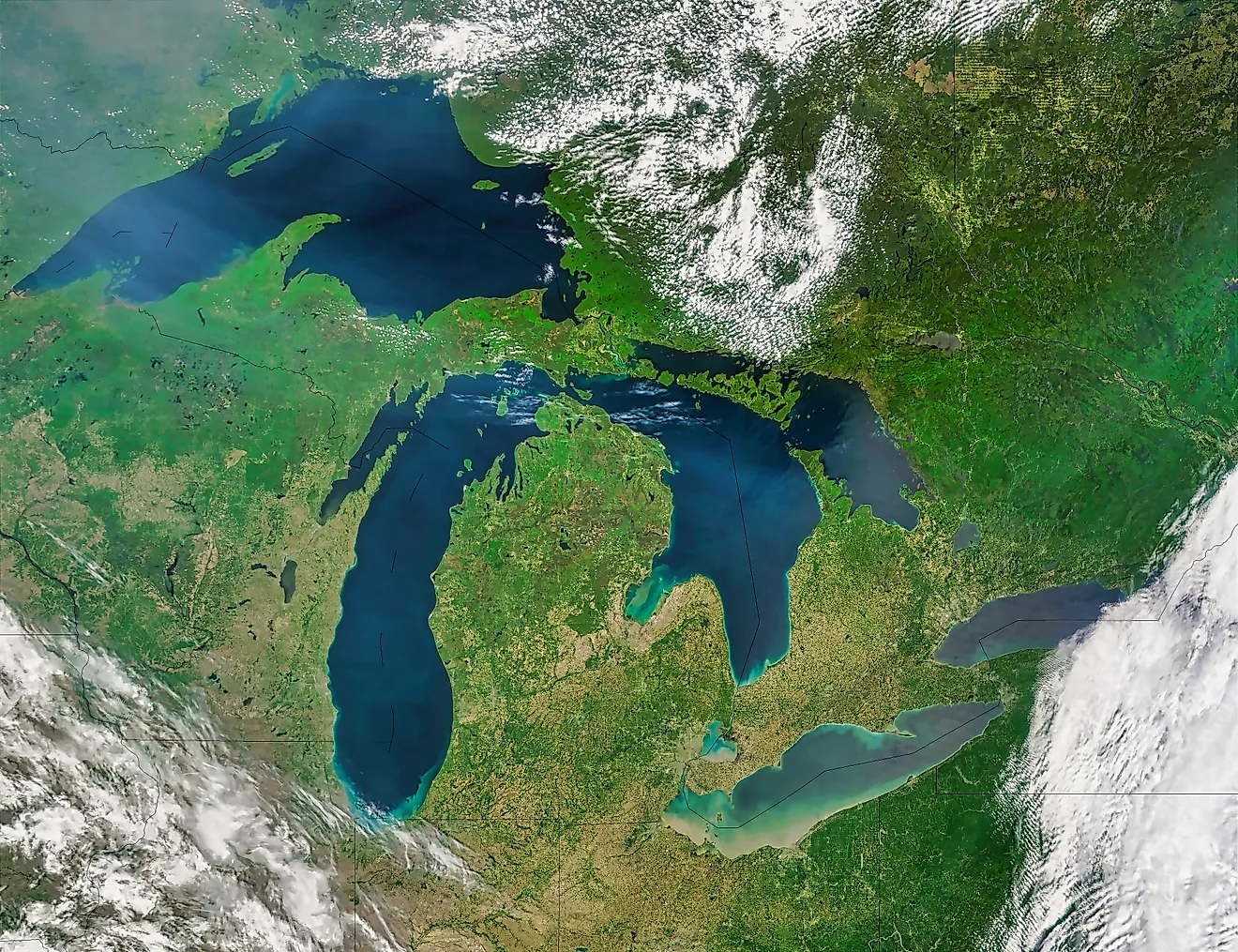
Saginaw Bay opens into Lake Huron between mainland Michigan and the Thumb. Its shallow inner waters stay warmer than the lake's deep main basin. Here, in Arenac County waters, an angler trolling a Hot 'N' Tot caught Michigan's record white bass in 1989. The fish weighed 6.44 pounds, approximately 6 pounds, 7 ounces, and measured 21.9 inches. The inner bay averages about 15 feet deep. It supports a cool- and warm-water fish community, and the Saginaw River is its largest tributary system. White bass are native to Michigan and hunt in schools, sometimes pushing smaller fish against the surface. Across Michigan, their spawning migrations generally occur during May and early June. Females move onto spawning shoals, release their eggs, and return to deeper water, while males remain near the spawning grounds longer.
Kerr Lake, North Carolina and Virginia

Jim King was fishing a bucktail when he caught a 5-pound, 14-ounce white bass at Kerr Reservoir on March 15, 1986. It remains North Carolina's state record. Also called Buggs Island Lake, the reservoir spreads across roughly 50,000 acres along the Virginia border, where the Dan and Roanoke river systems meet.
Those river connections become particularly useful to anglers in spring. White bass leave the reservoir and enter the lower Dan, with the migration typically beginning around early April. The stretch between Danville and Milton offers fishing for these traveling schools. On the Virginia side of the Kerr system, a 14-inch minimum protects smaller white bass, with a daily limit of 10. The lake itself also has shore access: Bullocksville on the North Carolina side includes an accessible fishing pier.
Table Rock Lake, Missouri and Arkansas

Before the spring spawning run at Table Rock, white bass gather in deeper channel holes along the lake's river arms. Anglers can find them by trolling during February and early March. As the water warms, the fish move farther upstream into shallower tributaries, with March offering the main spawning opportunity.
White bass commonly exceed 15 inches here, according to Missouri's 2026 forecast. Scott Flood's March 19, 2002, catch weighed 5 pounds, 6 ounces and set Missouri's pole-and-line record.
Missouri rates the overall white bass fishing as fair for 2026, even with those larger fish present. Summer fishing shifts toward submerged gravel flats, often 25 to 50 feet deep. Anglers troll or lower jigging spoons to reach schools away from the shoreline.
Lake Lanier, Georgia

Spring white bass runs have returned to Lake Lanier's tributaries following a rebuilding effort. Georgia's record white bass came from this reservoir: J. M. Hobbins caught the 5-pound, 1-ounce fish on June 16, 1971.
The population later declined in the early 2000s after blueback herring became established. Georgia began annual white bass stockings in 2016 to restore spring fishing. By April 2024, state biologists reported that the program had achieved that goal, finding good numbers in the Chattahoochee and Chestatee rivers.
Survey catches were particularly strong in the Chestatee. The Chattahoochee above Belton Bridge is another specific spring fishing area identified by the state. Anglers use small crappie jigs and in-line spinners to catch white bass moving through these tributaries during the spawning run.
Herrington Lake, Kentucky

The Dix River enters Herrington through the same upper-lake country that helped popularize white bass fishing in Kentucky. During the mid-1900s, spring runs drew anglers to the river near the KY 52 bridge between Danville and Lancaster. B. B. Hardin caught a 5-pound white bass in Herrington on June 3, 1957, a catch that shares Kentucky's state record. The reservoir fills a deep river gorge with steep, rocky banks. In spring, anglers follow white bass upstream toward the transition between lake water and the Dix River's pools and riffles. Bryants Camp has a boat ramp for the upper lake. In 2020, Herrington stood out among central Kentucky fisheries for its larger white bass, including many reaching 14 inches. During the spawning run, smaller males generally arrive first; the larger females follow as conditions warm.
Devils Lake, North Dakota

Six Mile Bay produced North Dakota's record white bass on June 10, 2012. Charlie Vang's fish weighed 4 pounds, 10 ounces and measured 19 inches. The state's 2026 outlook describes white bass as more abundant than average, with most expected to measure about 14 to 16 inches.
White bass were introduced into this lake and established a reproducing population. Their schooling behavior is a visible clue on calm days, when feeding groups disturb the surface as they pursue prey. Windblown shorelines are another place to find them. Small fish imitations or live minnows suit these predators, which also eat aquatic insects.
Nearby Stump Lake belongs to the wider Devils Lake fishing system and has abundant white bass of its own. Most are expected to measure around 12 to 15 inches in 2026.
Lake Orange, Virginia

A small public fishing lake east of the town of Orange holds Virginia's white bass record. Ron Sprouse caught the 6-pound, 13-ounce fish on July 31, 1989. The catch also shares the all-tackle world record with a white bass landed in Louisiana's Amite River in 2010.
Lake Orange occupies just 124 acres among farmland and hardwood woods. It was impounded in 1964, and anglers began fishing it in 1967. White bass were never officially stocked here; Virginia's fisheries agency still describes their arrival as a mystery.
The lake's present-day fishing concentrates on largemouth bass and black crappie. Its white bass fame rests on that exceptional historical catch. Visitors reach the water along a peninsula on the western side, with a fishing pier and boat ramp. Anglers can launch small boats here, but gasoline motors must be kept raised out of the water; electric trolling motors are permitted.
Telling a White Bass From a Hybrid

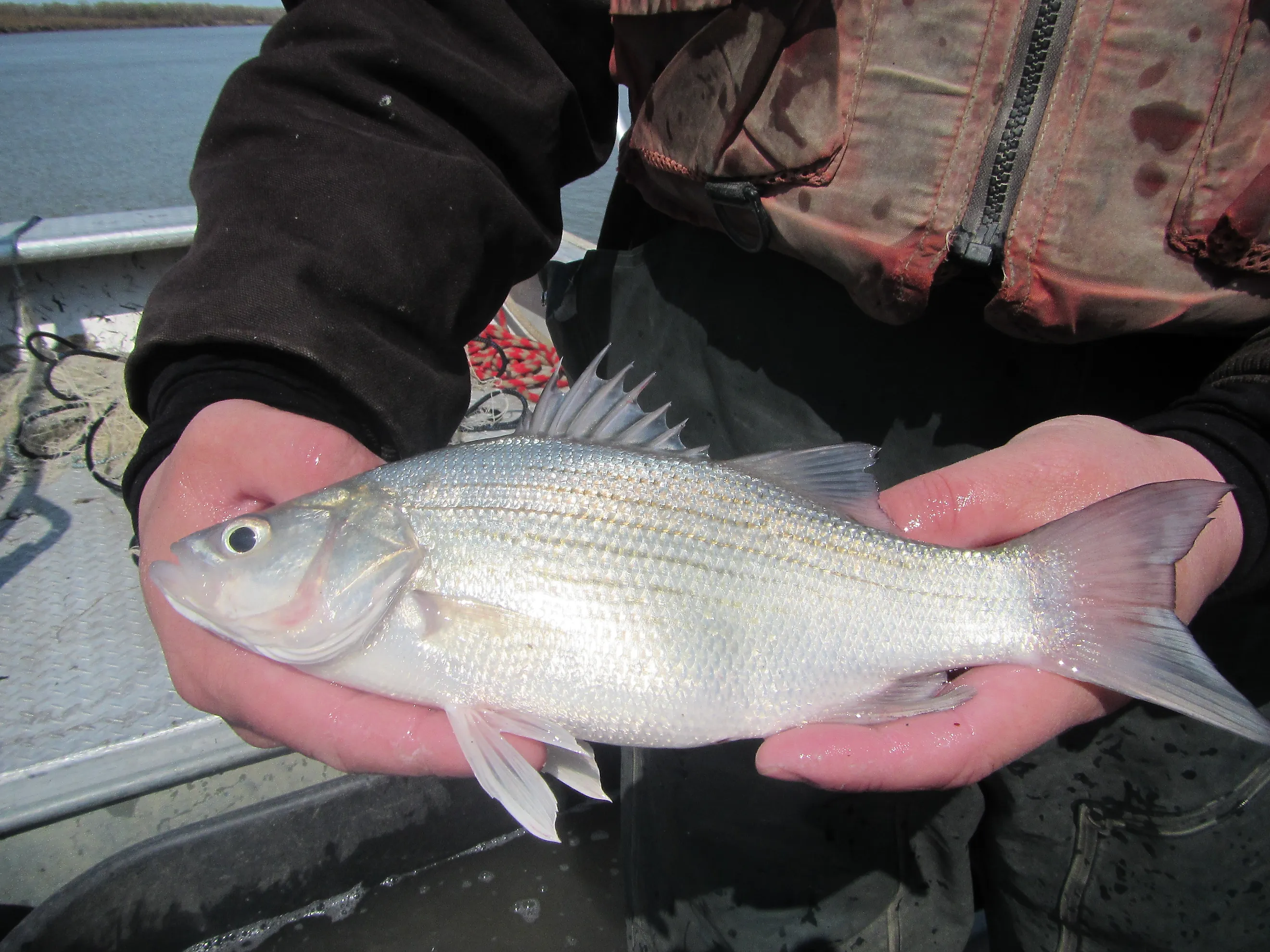
A trophy-weight catch is worth a second look anywhere on this list. Kentucky stocks hybrid striped bass in Herrington, and a hybrid's deep body resembles a white bass closely enough to be mistaken for one. A few markings separate them. White bass typically have a single stripe that runs all the way to the tail, while hybrids show several. White bass usually have one tooth patch toward the back of the tongue, and hybrids generally have two. Because individual fish vary, those features work best checked together. The hybrid is itself a cross between striped bass and white bass, which is why the two can look so much alike.