The Biggest Things Ever Pulled Up In American Fishing Nets
A commercial fishing crew does not know what's in the net until it comes aboard. Most hauls in American waters are routine, but every so often the gear brings up something no one planned for, and the crew has to work out quickly what to do with it. For the five people aboard a squid trawler out of Virginia in 2017, the trouble started the morning after they left port. Within hours, their boat was gone.
Basking Shark, Virginia

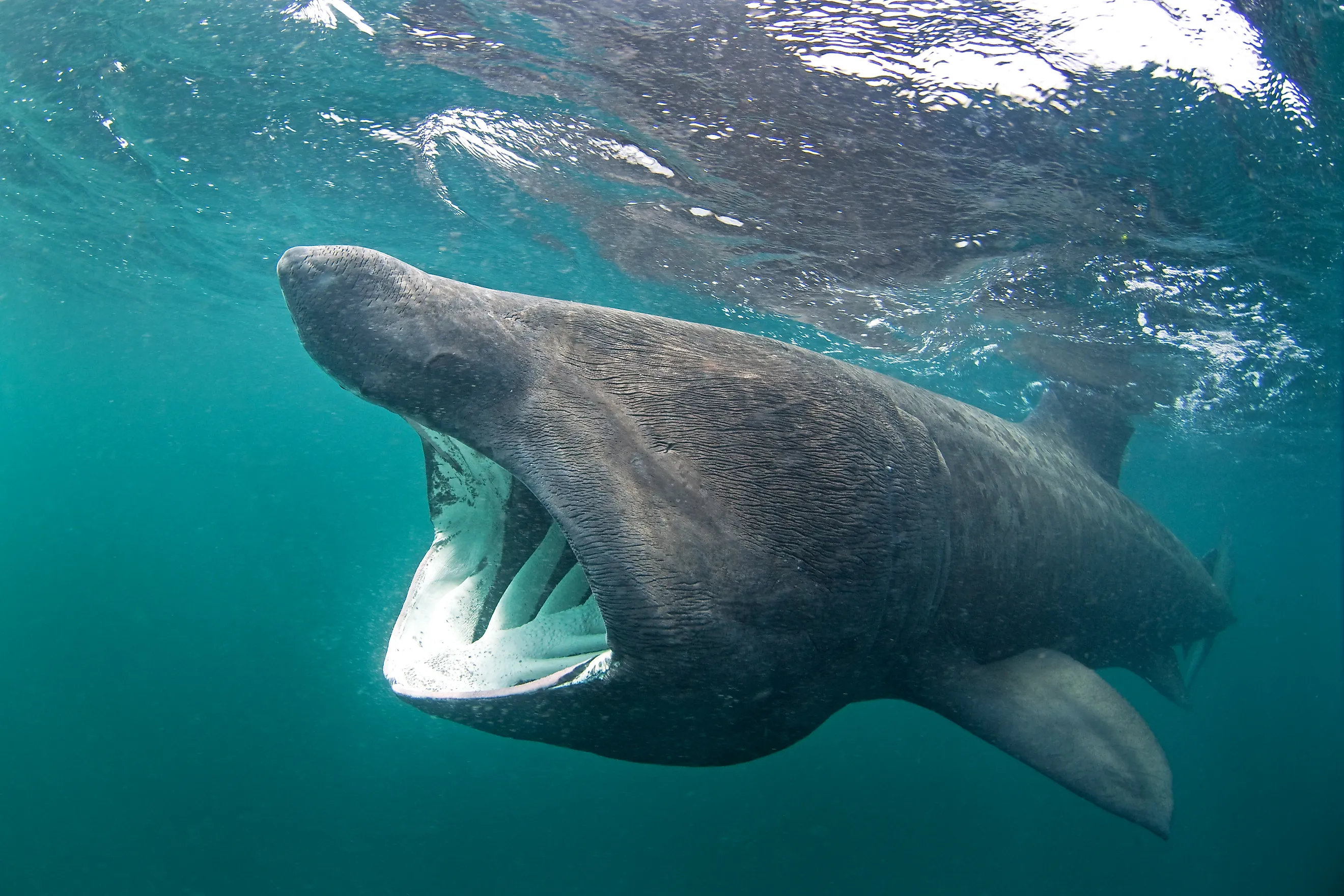
The 79-foot trawler Langley Douglas left Hampton, Virginia, on September 10, 2017, for a four-day squid-fishing trip. The following morning, about 60 nautical miles east of Cape Charles, the crew hauled in its net containing a 25-foot basking shark. A NOAA observer said the shark had likely died in the net. The crew estimated the entire catch weighed about 35,000 pounds, including around 10,000 pounds for the shark.
As the crew emptied the net into a raised deck area called a hog pen, squid spilled over onto the port side, causing the vessel to list. Waves washed over the deck, the catch shifted, and squid blocked the drainage openings. The trawler continued listing before capsizing and sinking. The NTSB identified the decision to unload a catch that exceeded the hog pen's capacity as the probable cause. A Coast Guard helicopter rescued all five people aboard.
Basking Shark, Florida

Fishermen James Rogers, Ralph Smith, and Victor Smith caught an adult female basking shark in a nylon gill net near Grassy Point in Sarasota County, Florida, on April 2, 1969. The shark measured 27.2 feet and weighed about 4,365 pounds, making it the first recorded basking shark from the Gulf of Mexico. Marine biologists Stewart Springer and Perry W. Gilbert documented the catch in a 1976 paper published in Copeia.
The fishermen caught the shark alive about 246 feet from shore, in water just 10 to 13 feet deep. They transported it to Mote Marine Laboratory with help from staff at the Kiekhaefer Mercury Testing Station, but it died before researchers could conduct physiological tests. After examining its skin, teeth, gill rakers, vertebrae, and internal organs, scientists noted that it was unusually thin for its length.
World War II Torpedo, Rhode Island

A 20-foot World War II Navy torpedo became tangled in the nets of the 78-foot fishing trawler Ingtoffer II about 22 miles southeast of Block Island, Rhode Island, in December 1985. The crew was fishing at a depth of about 185 feet. Military officials identified the live weapon as an MK-14 torpedo with its warhead intact. It may have been underwater for more than 40 years.
The Coast Guard escorted the trawler to a Navy base off Gould Island, where divers lowered the torpedo into 30 feet of water. Explosive ordnance specialists attached a timed charge and detonated it underwater. Standard Mark 14 torpedoes weighed around 3,000 to 3,280 pounds, depending on the modification. However, the exact weight and configuration of the torpedo recovered by the Ingtoffer II were not reported.
Megamouth Shark, California

On October 21, 1990, commercial fisherman Otto Elliott caught a 15-foot megamouth shark in a drift gill net about seven miles off Dana Point, California. He was fishing for swordfish and other sharks aboard his boat, Moonshiner, when the rare animal became entangled. Contemporary reports estimated its weight at around 1,200 pounds, although underwater photographer Tom Haight later put it closer to 2,000 pounds.
Haight spent nearly four hours in the water filming and photographing the shark. He also helped researchers measure it, collect tissue samples, and attach two tracking transmitters. Elliott had kept the shark alive for about 39 hours before releasing it offshore on October 22. Researchers then tracked it for about 50 hours. Their study found that it stayed at depths of about 394 to 545 feet during the day and rose to 39 to 82 feet at night.
Live Depth Charge, Rhode Island

A live 520-pound World War II depth charge came up in a trawler's net about four nautical miles east of Block Island, Rhode Island, on October 25, 2022. The crew called the Coast Guard, and the captain and two crew members were taken off the boat. The Navy identified the device as a Mk 6 depth charge containing 267 pounds of TNT, according to The East Hampton Star.
The trawler was fishing near the site of a World War II battle in which a US Navy destroyer and a Coast Guard frigate sank the German submarine U-853 on May 6, 1945, using 195 depth charges. On October 26, Navy bomb-disposal specialists detonated the charge about a mile offshore. They coordinated with Rhode Island officials and NOAA to protect people and wildlife. The Navy warned people not to touch or move suspected military explosives. Anyone who finds one at sea should contact the Coast Guard.
More Than Just a Big Catch
A fishing net cannot tell a squid from a shark, or a shark from a bomb. It takes in whatever crosses its path, and the crew sorts it out on deck. One haul can bring up a 10,000-pound shark packed in with 25,000 pounds of squid. Another can contain a live explosive that has been lying on the seafloor since World War II. The heaviest catch is not always the most dangerous, and the strangest discoveries can have decades of history behind them.