How Much Snow Adds To The Great Lakes In One Winter
Every winter, staggering amounts of snow pile up across the Great Lakes region, from the lake-effect belts around Buffalo to the deep snowpack of Michigan's Upper Peninsula. Much of that snow is not just a headache for drivers; it is water in waiting, destined to end up in the lakes themselves. But just how much does a single winter's snow actually add to the Great Lakes? The answer is a staggering volume in absolute terms, and yet a surprisingly thin sliver of these enormous inland seas. Here is how much snow adds to the Great Lakes in one winter.
Snow Is a Core Part of the Water Budget

To understand snow's role, you first have to understand how the Great Lakes gain and lose water. Hydrologists track what they call net basin supply: the precipitation that falls directly on the lakes, plus the runoff that drains in from the surrounding land, minus the water lost to evaporation. Snow feeds two of those inputs at once, falling straight onto the lake surface and piling up across the watershed to melt later in the year. That makes it one of the single most important sources of water for the whole system. In the cold months especially, most of the precipitation across the northern basin arrives not as rain but as snow.
Snow Falling Straight Onto the Lakes

The most direct way snow adds water is by landing straight on the lakes. The five Great Lakes cover a combined surface of roughly 94,000 square miles, a target so vast that even a modest snowfall translates into an almost unimaginable amount of water once it melts. To put it in perspective, a single inch of water spread across all that surface area equals about 1.6 trillion gallons. So when several inches of water-equivalent snow fall onto the open water and ice of a lake like Lake Michigan over a winter, the lakes are gaining trillions of gallons directly, before a single flake on the surrounding land has even melted.
The Spring Snowmelt Does the Heavy Lifting

As big as direct snowfall is, the bigger contribution comes from the land. All winter long, snow accumulates across the enormous watershed that drains into the lakes, essentially storing months of precipitation on the ground. When spring arrives and that snowpack melts, the water pours off the landscape and into the rivers and streams that feed the lakes. The scale is remarkable: studies have found that more than half of all the annual runoff in the Great Lakes basin comes from snowmelt. In other words, melting snow, not rain, is the single dominant source of the water running into the lakes each year.
Putting a Number on It

Adding it all up gives some genuinely jaw-dropping figures. Each year, the combined input of snowmelt and spring rain helps lift the Great Lakes through a normal seasonal rise of roughly 12 to 20 inches between their winter low and their summer high. Since every inch of water across the lakes is worth about 1.6 trillion gallons, that seasonal rise represents somewhere in the neighborhood of 20 to 30 trillion gallons of net water gained, a large share of it delivered by snow. A single snowy winter, in short, hands the lakes tens of trillions of gallons of water, enough to raise one of the planet's largest freshwater systems by well over a foot.
Why the Lakes Rise Every Spring

Snow is the reason the Great Lakes follow such a predictable yearly rhythm. Lake levels are typically at their lowest in winter, precisely because so much of the season's precipitation is locked up as snow sitting frozen on the land rather than flowing into the lakes. Once temperatures climb in spring, that stored snow finally releases all at once, and the runoff surges into the lakes just as spring rains pick up and evaporation stays low. The result is a steady climb that peaks in late summer. Without that winter snowpack and its spring release, the lakes' seasonal rise would be far weaker and far less reliable.
Lake Superior Gets the Most
Not every lake gets the same snowy windfall. As the northernmost and most upstream of the five, Lake Superior receives the greatest amount of seasonal snowfall of any Great Lake, both on its surface and across its vast, cold watershed. Snow-smothered shoreline cities like Duluth sit in the thick of it, routinely buried under feet of snow that will eventually find its way into the lake. Because Superior is also the largest and deepest of the lakes, that enormous snow input is a crucial part of keeping the headwaters of the entire Great Lakes system topped up each year.
The Lake-Effect Snow Belts

A big slice of the region's snow is manufactured by the lakes themselves. As frigid air sweeps across the warmer, open water, it picks up moisture and dumps it as lake-effect snow on the downwind shores, which is exactly why cities like Buffalo are so famously buried each winter. In the shoreline snow belts, lake-effect events can account for anywhere from 10 percent to more than 70 percent of all the snow that falls. It is a remarkable loop: the lakes effectively pull their own water back out of the sky as snow, much of which then returns to the lakes once it melts.
A Huge Number, a Tiny Fraction

For all those jaw-dropping numbers, there is an important reality check. The Great Lakes hold around six quadrillion gallons of water in total, so even a huge winter delivery of 20 or 30 trillion gallons works out to only about half of one percent of the whole. The lakes are simply so colossal that a full winter's snow barely nudges the needle on their total volume. It helps that the lakes are a through-flowing system, constantly draining out toward the St. Lawrence River and the Atlantic, so much of the water that snow adds does not pile up at all but flows steadily onward.
Lake by Lake

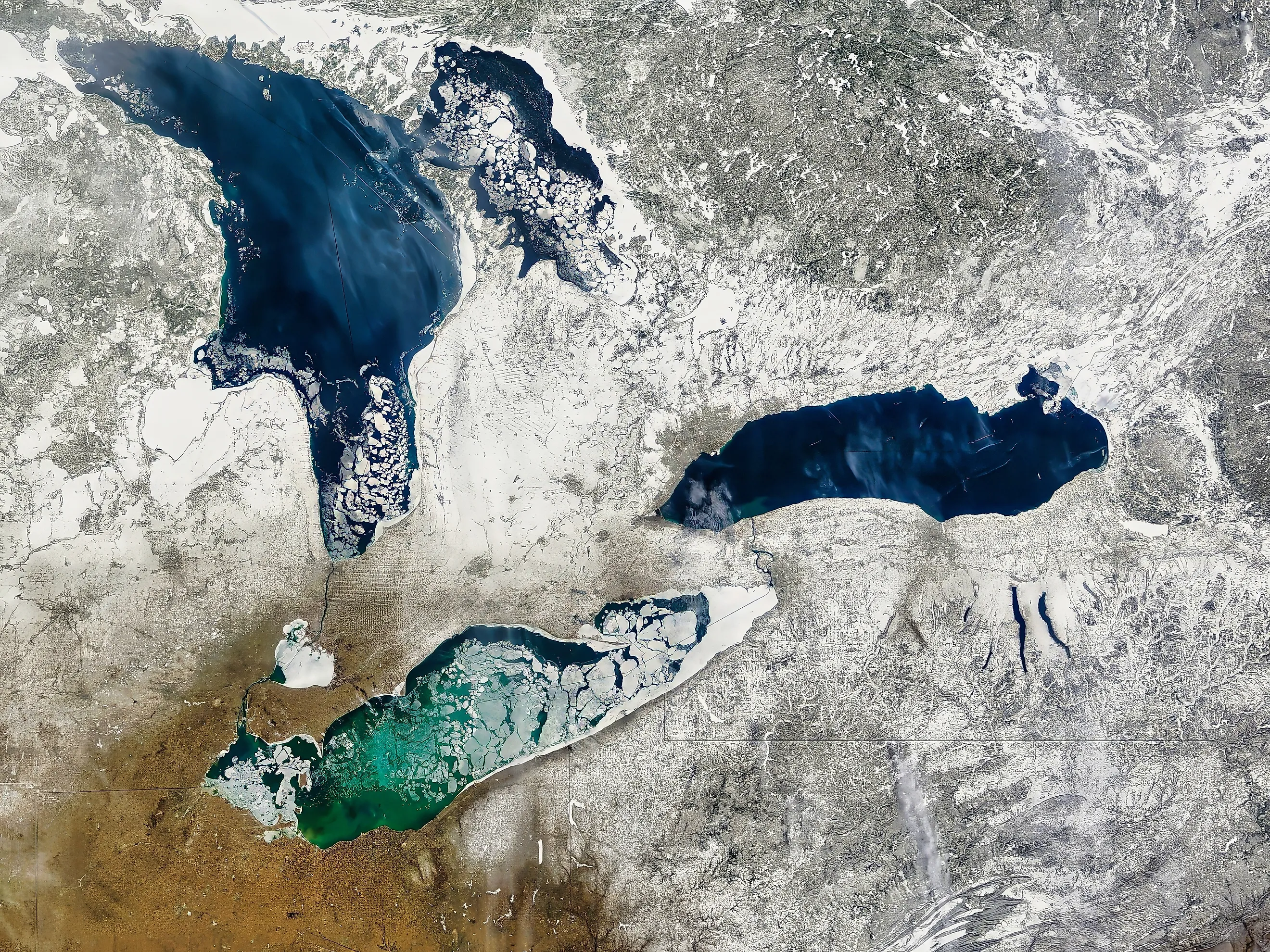
Each lake's snow story is shaped by its geography. Superior leads the pack, while Lake Huron and Lake Michigan both draw heavily on the deep snows of the upper Midwest.

Farther south and east, shallow Lake Erie and Lake Ontario sit beneath some of the most intense lake-effect snow belts anywhere, so a large portion of their snowy input lands in concentrated bands right along their shores.

Add those contributions together, lake by lake, and snow emerges as a steady, basin-wide engine quietly refilling all five lakes every single winter.
A Changing Snow Supply

Snow's contribution to the lakes is not fixed, and it is already shifting. As the climate warms, more of the region's winter precipitation is falling as rain instead of snow, and the snow that does fall tends to melt earlier in the year. That is nudging the big spring runoff surge earlier and changing the timing of the lakes' annual rise, while warmer, more open water can also boost evaporation. None of it changes the basic truth, though: in a single winter, snow still delivers tens of trillions of gallons to the Great Lakes, quietly doing more to refill them than almost anything else that falls from the sky.