The Biggest Creatures Ever Filmed In The Deep Sea
Some of the largest animals alive do not live under an open sky or on the African plains, and they may never visit the surface either. These behemoths spend their entire lives half a mile or more beneath the ocean's surface, in permanent darkness and crushing pressure, a realm scientists simply call the deep sea. Biologists have a name for what tends to happen to several of the species that live their whole lives down there: deep-sea gigantism, the pattern in which deep-water animals grow far larger than their shallow-water relatives. The animals below are the biggest of these true deep-sea residents ever caught on camera alive, each one a creature people knew mostly from carcasses and legends until a robot finally found it in the dark.
Filming Deep Sea Giants

Nobody has one single proven cause of deep sea gigantism, but the leading explanations reinforce each other. Near-freezing water slows metabolism, and a slower metabolism appears to let cells, and eventually whole bodies, keep growing over unusually long lifespans. Food is scarce and unpredictable at depth, so a bigger body that can go longer between meals and store more energy has a real survival edge. Predators are fewer and hunting is harder in total darkness under crushing pressure, so there is less pressure to stay small and hidden.
This article focuses specifically on animals that live at true depth their entire lives, not surface or mid-water species that merely dive deep to feed before coming back up for air. For most of history, people only knew these giants existed by finding an old carcass that washed ashore or a strange shape blurred in a fisherman's net. Actually filming one alive, in its own world, is a much newer story, made possible mostly in the last fifteen years by specialized low-light cameras, tethered robots, and deep-diving submersibles.

A striking number of the breakthrough sightings have happened in American waters or aboard American research vessels: NOAA's Okeanos Explorer, the Ocean Exploration Trust's E/V Nautilus, and California's Monterey Bay Aquarium Research Institute (MBARI) all send robotic eyes into the Gulf of Mexico, remote Pacific waters, and the ocean's darkest reaches on a near-constant basis. Even the map of the ocean recently changed: in 2021, National Geographic joined NOAA in officially mapping the Southern Ocean as the world's fifth ocean, a name the U.S. Board on Geographic Names had used since 1999. A squid was caught on camera off Florida. A shark swam past a robot's lens years before anyone realized what the video showed. These are the biggest true deep-sea creatures ever filmed alive, the science behind why they grow so large, and the footage that finally proved they were real.
Colossal Squid

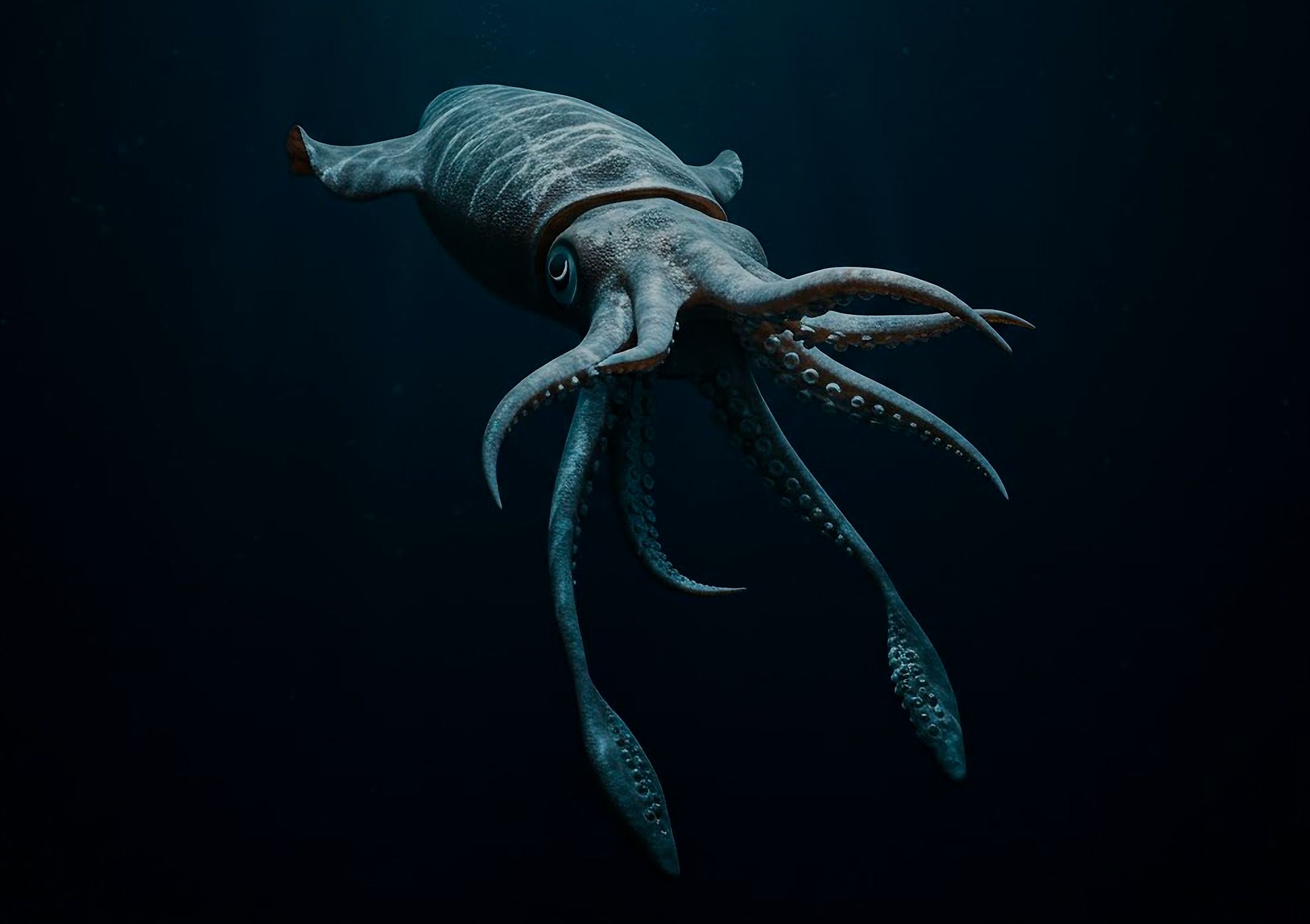
For more than a century, the colossal squid was known only from carcasses and half-digested remains pulled from the stomachs of sperm whales, meaning its size was inferred rather than observed. That changed on March 9, 2025, when the ROV SuBastian, launched from the research vessel Falkor (too) and operated by the Schmidt Ocean Institute, filmed a roughly one-foot-long juvenile swimming at 1,968 feet (600 meters) near the South Sandwich Islands in the South Atlantic during an Ocean Census expedition. This is the first confirmed video of a live colossal squid in its natural habitat, and adults are believed to live even deeper, in the frigid water of the Southern Ocean. Adults are thought to reach 23 feet and 1,100 pounds, making the species the heaviest invertebrate on Earth, heavier even than the giant squid, though its arms and tentacles are proportionally stubbier and lined with rotating hooks instead of just suckers. No adult has ever been filmed alive; everything known about full-grown colossal squid still comes from a small number of specimens hauled up by fishing trawlers, including one preserved and displayed at New Zealand's Te Papa Museum. Researchers on the expedition called the footage a reminder of how much of the deep sea remains undocumented, even for an animal built by deep-sea gigantism to be large enough to prey on whales.
Giant Squid

The giant squid inspired centuries of kraken legends before anyone managed to film one alive in its own habitat, hundreds of feet down in permanent darkness. Japanese researchers achieved that first in 2012 off the Ogasawara Islands. For years after, nobody had captured a giant squid on camera in United States waters. That changed on June 19, 2019, when a NOAA-supported team led by researcher Edith Widder used a specialized low-light rig called the Medusa, baited with a glowing electronic jellyfish, to film a 10- to 12-foot juvenile about 100 miles southeast of New Orleans in the Gulf of Mexico, roughly 3,280 feet down. The encounter lasted less than 30 seconds before the squid released and vanished back into the dark.

Giant squid are famous for their size, reliably measured past 30 feet and reportedly reaching over 40 feet including their two long feeding tentacles. Their eyes may be even more remarkable: at up to 10 inches across, they are the largest eyes of any animal alive, evolved to catch the faintest bioluminescent flicker from a hunting sperm whale in total darkness.
Bigfin Squid

Few deep-sea animals look stranger than the bigfin squid, a genus known scientifically as Magnapinna. Its short arms and tentacles trail off into thin, elbow-bent filaments many times the length of its body, an alien, spindly silhouette entirely unlike a giant or colossal squid's. Fewer than 20 confirmed sightings exist worldwide, and nearly all come from deep-water cameras rather than nets. The animal lives far too deep and is too fragile for a trawl to bring one up intact. One of the clearest American sightings came on the Windows to the Deep 2021 expedition, when NOAA's ROV Deep Discoverer, working off the ship Okeanos Explorer, filmed a bigfin squid near the West Florida Escarpment in the Gulf of Mexico at roughly 7,825 feet (2,385 meters). Other confirmed sightings have come from as deep as 15,535 feet (4,735 meters), among the deepest ranges of any squid known to science. Total length, including those extraordinarily long filaments, is difficult to measure from video alone, but estimates for large individuals run past 20 feet. Because it has never been caught, weighed, or studied outside of remote camera footage, much of the bigfin squid's biology, including how large it truly gets, remains a mystery, one more entry on the growing list of animals that live only in the deep ocean and nowhere else.
Giant Phantom Jelly

The giant phantom jelly, Stygiomedusa gigantea, is one of the largest jellyfish ever documented, with a bell that measures more than 3 feet (1 meter) across and four broad, ribbon-like oral arms that can stretch beyond 30 feet (10 meters), instead of the trailing stinging tentacles most jellyfish have. Despite that size, it is also one of the least-seen large jellyfish species on the planet: researchers at California's Monterey Bay Aquarium Research Institute have logged thousands of ROV dives since the 1990s and encountered it only a small handful of times.
It lives in the deep midwater column, typically several hundred to well over a thousand meters down, one of many animals that live only in the deep ocean. It drifts rather than swims, and uses its oral arms to wrap and trap prey rather than to sting. During one MBARI dive, researchers watched a small fish called a pelagic brotula sheltering safely inside the jelly's oral arms, seemingly immune to whatever the jelly used on other prey. First collected as a specimen in 1899, it was not formally described as a distinct species until 1960, and it was not filmed alive with any regularity until deep-diving ROVs like MBARI's became available. It remains so rarely observed that scientists still cannot say with confidence how long it lives or how it reproduces.
Seven-Arm Octopus

Named for the way one arm on males stays coiled in a pouch near the eye, the animal appears to have only seven arms instead of eight. The seven-arm octopus, Haliphron atlanticus, is by some measures the heaviest octopus species on Earth. Confirmed females have reached roughly 13 feet in total length and an estimated 165 pounds, edging out even the giant Pacific octopus by mass, though males are dramatically smaller, sometimes under a foot long. It lives deep in the water column across the world's oceans, and is part of the same deep-sea gigantism pattern that produced several other animals on this list.
This creature is filmed so rarely that MBARI, which has logged tens of thousands of ROV dives off California since the 1980s, had only ever documented it four times, most recently in 2025, when researchers filmed one consuming a helmet jelly in the deep water off Monterey Bay. An earlier 2017 encounter captured a large female clutching an egg-yolk jelly, behavior scientists still debate: some believe females carry jellyfish as a food source, others suspect it is closer to camouflage or protection. Because sightings are so infrequent, basic facts about its lifespan, reproduction, and population remain largely unknown, even for an animal competing for the title of the world's largest octopus.
Giant Oarfish

Long before anyone filmed a live giant oarfish, most of what scientists knew about the world's longest bony fish came from carcasses that washed ashore. The animal normally lives hundreds of feet down in the ocean's twilight zone and only reaches the surface when it is sick, injured, or dying. That distinction matters: a live giant oarfish, filmed swimming upright in its own habitat, is a rare event, and entirely separate from the dead specimens that occasionally wash up on beaches. The clearest such video came in August 2011, when a remotely operated vehicle surveying damage from the Deepwater Horizon oil spill filmed a live oarfish swimming upright at 364 feet (111 meters) in the Gulf of Mexico. The footage, led by Louisiana State University researcher Mark Benfield and published in the Journal of Fish Biology in 2013, was called the clearest video yet of the species in its natural habitat.

Confirmed giant oarfish have been reliably measured up to 26 feet, with a Guinness-verified record of 25 feet from a fish caught off Maine in 1885; older, unverified reports claim lengths closer to 50 feet. California had an unusually active 2024 for oarfish strandings, dead specimens rather than live sightings, when two washed ashore months apart: one at La Jolla Cove in August, just over 12 feet long, and one in Encinitas that November, examined by Scripps Institution of Oceanography researchers. Together they were only the 20th and 21st oarfish recorded on California beaches since 1901.
Goblin Shark

Before 2019, every goblin shark, Mitsukurina owstoni, ever seen alive by humans had been hooked by accident on a fishing line and hauled up from deep water, and shark biologists had never observed it swimming in its own habitat. That changed on a July 2019 dive by the Ocean Exploration Trust's ROV Hercules. The dive took place off an unnamed seamount near Jarvis Island, an uninhabited U.S. territory in the central Pacific that is part of the Pacific Remote Islands Marine National Monument. At roughly 4,058 feet (1,237 meters) down, the ROV's cameras passed a solitary goblin shark, an 11-foot male estimated to be more than 50 years old, gliding calmly past. Nobody on board recognized what they had, and the clip stayed unremarked in the expedition archive until a University of Hawaii researcher spotted it years later and published the finding in 2026, alongside a second goblin shark sighting from 2024 in the Tonga Trench at about 6,552 feet (1,997 meters), the deepest confirmed record for the species. Goblin sharks can reach roughly 20 feet, among the largest sharks alive, with a distinctive protruding snout and jaws that shoot forward to snatch prey.
Giant Isopod

The giant isopod looks like an armored, dinner-plate-sized version of the pill bugs found under a garden rock, and that is not a coincidence. Both creatures are in fact isopods, but the giant isopod evolved in the cold, high-pressure water of the deep sea through deep-sea gigantism, the same process that produced several of the animals that live only in the deep ocean on this list. Confirmed specimens have measured up to about 20 inches long, and the species spends its entire life scavenging dead whales, fish, and other carrion on the Gulf of Mexico and Caribbean seafloor at depths from roughly 1,000 to 7,000 feet, part of the abyss's permanent, sunless population. NOAA's Okeanos Explorer has filmed giant isopods on numerous Gulf of Mexico expeditions, including one just under a foot long recorded crawling across the seafloor at 2,660 feet in 2021, its size made clear by laser dots spaced about 4 inches (10 centimeters) apart on the camera rig. Despite its unsettling resemblance to a deep-sea cockroach, the giant isopod is harmless to humans and has become one of the most recognizable faces of true deep-sea exploration.
Why Giants Thrive In The Deep
Every animal on this list spends its entire life at true depth, not visiting from the surface or the sunlit shallows, and every one of them grows unusually large doing it. That is the pattern deep-sea gigantism describes, and it shows up again and again in unrelated groups of animals, among them mollusks, crustaceans, and cartilaginous fish. This is, in part, why scientists take the cold-water, low-food, low-predation explanation seriously even without a single smoking-gun cause.
Most of the footage that finally proved these giants were real is less than fifteen years old, and some of it, like the goblin shark filmed in 2019, sat unrecognized for years afterward. That is not a coincidence. Only a fraction of the global seafloor has been mapped at high resolution, and a 2025 study in Science Advances calculated that humans have directly observed less than 0.001% of the deep seafloor, an area roughly the size of Rhode Island. All of that unmapped, unseen ocean surrounds the deepest known point on Earth, Challenger Deep in the Mariana Trench, measured at roughly 35,876 feet (10,935 meters) down, a spot that sits inside the Marianas Trench Marine National Monument, entirely U.S. territory. Every year, ROVs like Hercules and Deep Discoverer, and research vessels like E/V Nautilus, R/V Falkor (too), and MBARI's fleet, spend more time in that unmapped territory than ever before, which means the next true deep-sea giant nobody has filmed yet is probably still out there, waiting for a camera with the right kind of patience, and the right kind of red light, to find it.