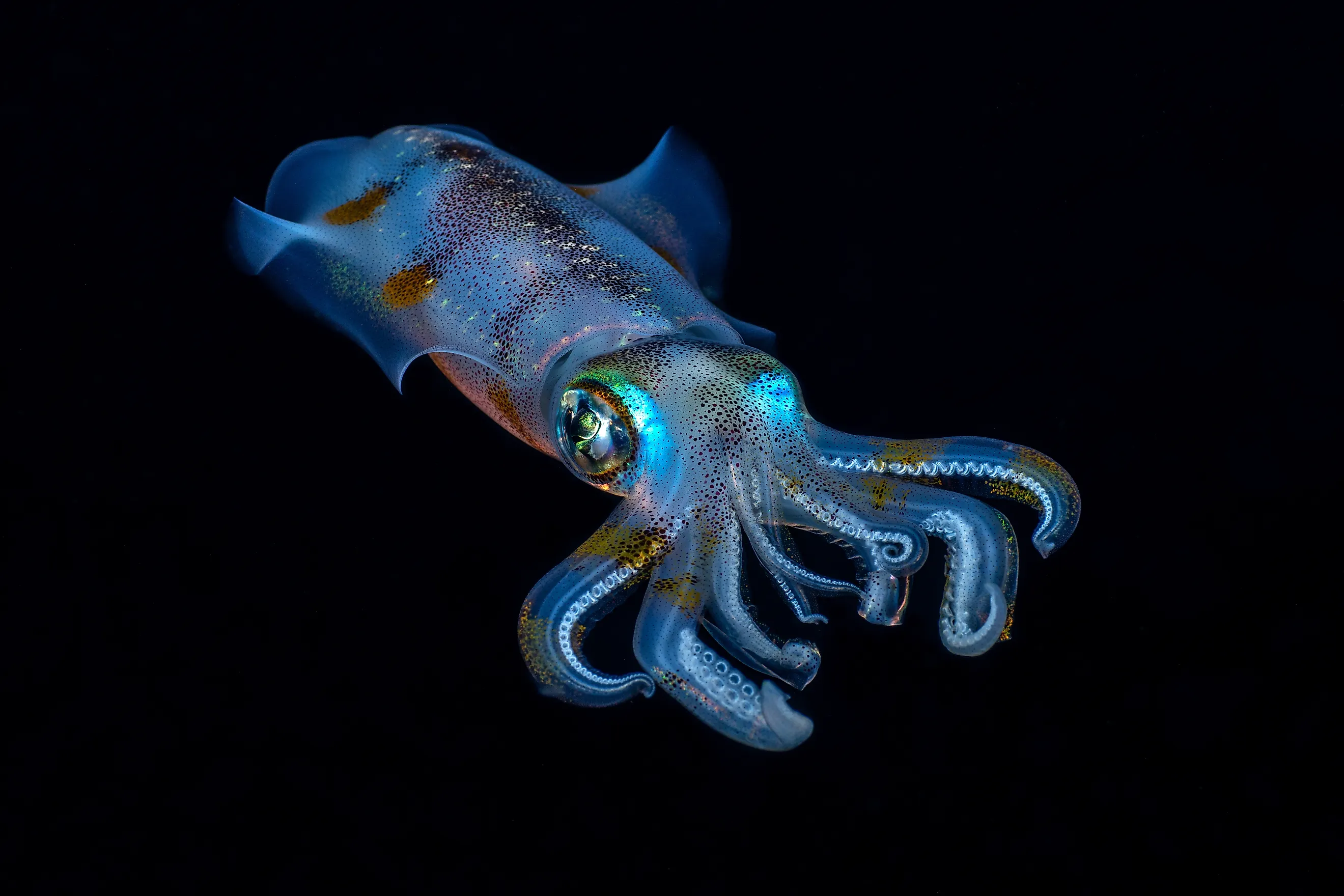
What Lives In The Ocean's Darkest Zone
The ocean below 1,000 meters stays black every hour of every day. This is the aphotic zone. It reaches almost 11 kilometers down in the deepest trenches. Anglerfish dangle glowing lures to draw prey through the dark. Giant tubeworms crowd hydrothermal vents and live on chemical energy alone. A single whale carcass can feed seafloor scavengers for years. Snailfish have been filmed swimming more than 8 kilometers below the surface. Life fills the darkest ocean at every depth science has managed to reach.
The Midnight Zone: Life Between 1,000 And 4,000 Meters

The bathypelagic zone, often called the midnight zone, extends from about 1,000 to 4,000 meters. Sunlight is completely absent, so animals rely heavily on smell, vibration, touch, and bioluminescence.
Deep-sea anglerfishes are among the best-known residents. Female ceratioid anglerfishes carry a modified dorsal spine tipped with a glowing lure. The light can attract prey close enough for the fish to strike. Many have oversized mouths and flexible stomachs, adaptations that allow them to take advantage of rare feeding opportunities.

Dragonfishes and viperfishes are equally specialized predators. Many have long teeth, expandable jaws, and rows of light-producing organs called photophores. Some dragonfishes carry luminous barbels beneath the jaw, while certain species can produce red bioluminescence that most deep-sea animals cannot see.

Fangtooth fish also occur in the midnight zone. Their teeth are extremely large relative to their body size, while their sensory systems help them detect nearby prey in darkness. Whalefishes take a different approach. Adult whalefishes have severely reduced eyes and rely instead on sensory pores that detect movement and vibration in the water.
Other bathypelagic fishes include black swallowers, gulper eels, tubeshoulders, and rattails. Black swallowers can consume prey much larger than themselves because of their expandable stomachs. Gulper eels possess enormous mouths and long, slender bodies. Rattails, meanwhile, are common near the deep seafloor and use smell, barbels, and touch to locate carrion and small animals.
Tripod fishes live near the bottom. They use elongated fin rays to raise themselves above the sediment while waiting for small prey to drift within reach.
Squid, Octopuses, Jellyfish, And Other Midwater Animals

Deep water also contains a large community of cephalopods and gelatinous animals. Dumbo octopuses, members of the genus Grimpoteuthis, are among the deepest-living cephalopods. One was documented at nearly 7,000 meters in the Java Trench, proving that octopuses can survive well into hadal depths.

Bigfin squids are another unusual deep-sea group. They have extremely long arm and tentacle filaments that can hang several meters beneath the body. Confirmed observations place them deep into abyssal waters.

Siphonophores are also common predators in dark midwater. Although they appear to be single animals, they are colonies made of many specialized individuals called zooids. Some species use bioluminescent structures to lure prey.

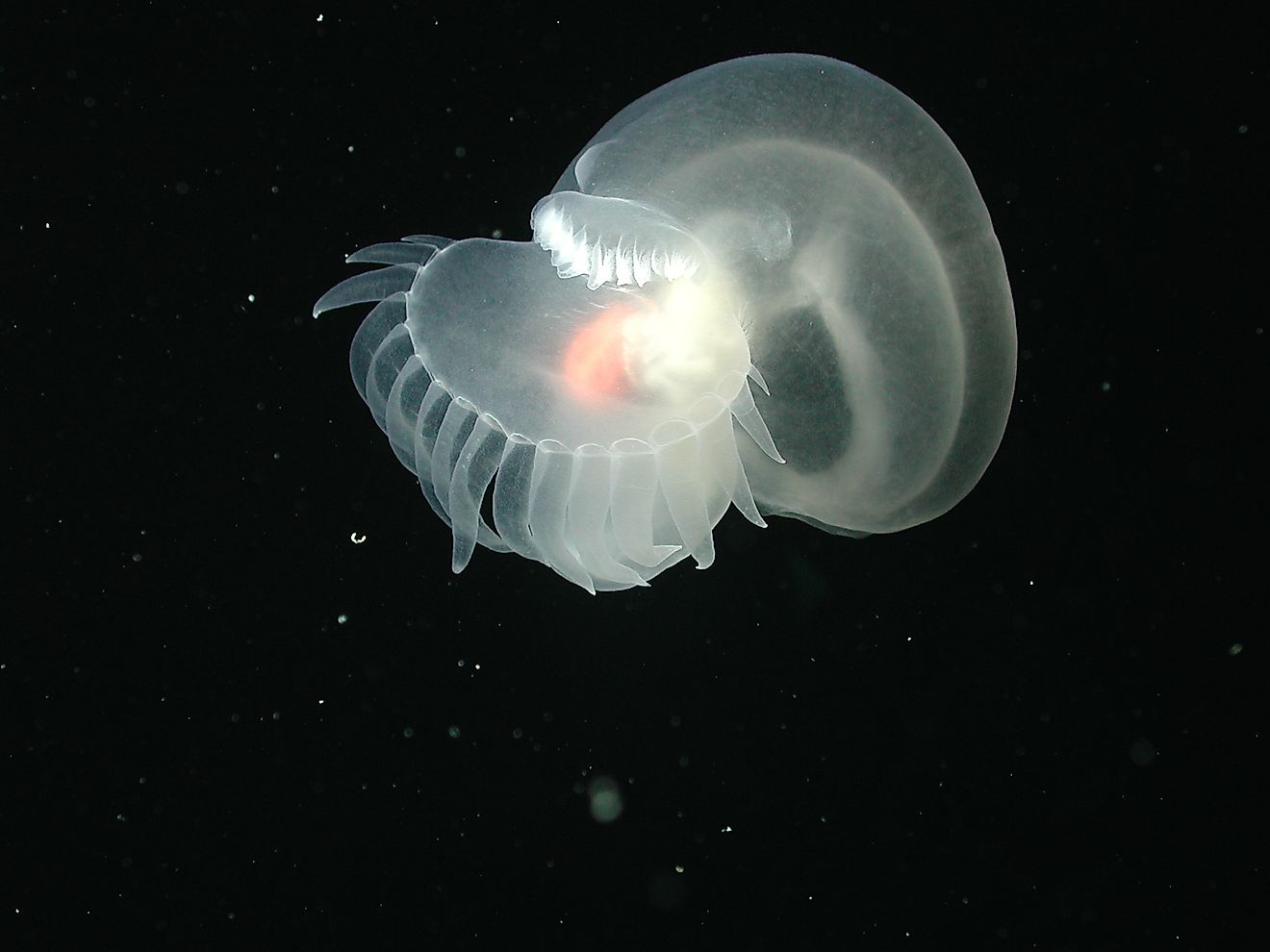
Deep-sea jellyfish and comb jellies are widespread as well. Because their delicate bodies are easily destroyed by nets, their abundance was historically underestimated. Remotely operated vehicles have shown that gelatinous animals are major components of deep-ocean food webs.
Other unusual organisms include bomber worms of the genus Swima. When threatened, some species release glowing green structures that may distract predators.

Larvaceans occupy a very different ecological role. These small tunicates build mucus filters that trap particles drifting through the water. Giant larvaceans can capture large amounts of marine snow and help transport carbon from surface waters into the deep ocean.
Life Across The Abyssal Seafloor

Below about 4,000 meters lies the abyssal zone. Much of this habitat consists of broad, cold plains covered in fine sediment.
Sea cucumbers are some of the most conspicuous animals here. They move slowly across the seafloor, swallowing sediment and extracting organic material. Sea pigs, a specialized group of sea cucumbers in the genus Scotoplanes, use enlarged tube feet to walk across soft sediment while feeding on detritus.

Brittle stars, sea stars, and sea urchins are also common. Some graze on deposited organic matter, while others prey on worms, mollusks, or smaller invertebrates.

Sponges and deep-sea corals create some of the most structurally complex abyssal habitats. Unlike tropical corals, deep-water corals do not rely on photosynthetic algae and can therefore grow in complete darkness. Their branches and skeletons provide shelter for shrimp, brittle stars, worms, and fishes.

Polychaete worms are extremely diverse in deep sediments. Some burrow, some scavenge, and others actively hunt. Crustaceans are equally important. Deep-sea isopods, amphipods, squat lobsters, crabs, shrimp, and sea spiders occupy different niches across the seafloor.
Even enormous single-celled organisms occur here. Xenophyophores, relatives of foraminifera, can reach visible sizes and build elaborate structures from sediment particles. Foraminifera themselves have been found almost 11 kilometers deep.
Hydrothermal Vents And Cold Seeps

Some of the darkest parts of the ocean contain extraordinarily dense communities despite receiving almost no food from the surface. Hydrothermal vents form where seawater circulates through hot crust and returns carrying dissolved minerals and chemicals. Here, chemosynthetic bacteria and archaea form the base of the food web.

Instead of using sunlight, these microorganisms obtain energy from hydrogen sulfide, methane, hydrogen, and other chemicals. Giant tubeworms are among the most famous vent animals. Adult Riftia pachyptila lack a normal mouth and digestive system. They depend on symbiotic bacteria inside their bodies to produce nutrients.
Vent ecosystems also support mussels, clams, shrimp, snails, limpets, scale worms, and yeti crabs. Some mussels and clams contain chemosynthetic bacteria within their tissues. Yeti crabs carry dense bacterial growth on hair-like structures and can feed on those microbes.
Cold seeps support similar ecosystems, but they release methane-rich or sulfide-rich fluids without the extreme heat of hydrothermal vents. Tubeworms, mussels, clams, and microorganisms can form long-lived communities around these sites.
Whale Falls Create Temporary Deep-Sea Ecosystems

Food is scarce across much of the deep ocean, so the arrival of a whale carcass can transform the surrounding seafloor. When a whale sinks, large scavengers arrive first. Fishes, sharks, crabs, amphipods, and octopuses strip away the soft tissue.
Later, smaller organisms colonize the remaining bones. Bone-eating worms of the genus Osedax bore directly into the skeleton and rely on bacteria to help extract nutrients. A large whale carcass can support deep-sea communities for years, making whale falls temporary biological hotspots in otherwise food-poor areas.
The Hadal Zone: Life At The Greatest Depths

Below about 6,000 meters, deep ocean trenches enter the hadal zone. The most famous vertebrates here are hadal snailfish. A snailfish from the genus Pseudoliparis was filmed at 8,336 meters in the Izu-Ogasawara Trench, the deepest confirmed observation of a fish.
Fish appear to have a biological depth limit, however, and none are known from the deepest parts of trenches such as Challenger Deep. Instead, amphipods become especially important. Hirondellea gigas is common in the Mariana Trench and can survive near 11,000 meters.
Other species, including the recently described predatory amphipod Dulcibella camanchaca, show that trench communities contain active hunters as well as scavengers. Polychaete worms, sea cucumbers, foraminifera, bacteria, and archaea also survive at hadal depths.
Near the deepest ocean floor, microorganisms and small invertebrates dominate rather than large animals.
How Life Survives Without Sunlight
Most deep-sea ecosystems ultimately depend on three sources of energy. The first is marine snow: dead plankton, fecal material, mucus, and other organic particles sinking from surface waters.
The second is large food falls such as dead fish, squid, whales, and pieces of wood. The third is chemosynthesis, where microorganisms generate organic matter using chemical energy at hydrothermal vents and cold seeps.
Deep-sea organisms have evolved numerous adaptations to exploit these limited resources. Bioluminescence is widespread and can be used for hunting, defense, camouflage, and communication. Many species have enormous mouths or expandable stomachs. Others have reduced eyes but highly developed senses of smell, touch, or vibration.
The result is an ecosystem that looks radically different from the sunlit ocean above. The darkest ocean contains predators, scavengers, filter feeders, microbes, corals, sponges, gelatinous animals, and some of the most extreme organisms known on Earth. Even at nearly 11 kilometers below the surface, life persists.