The National Parks With The Most Mountain Lions
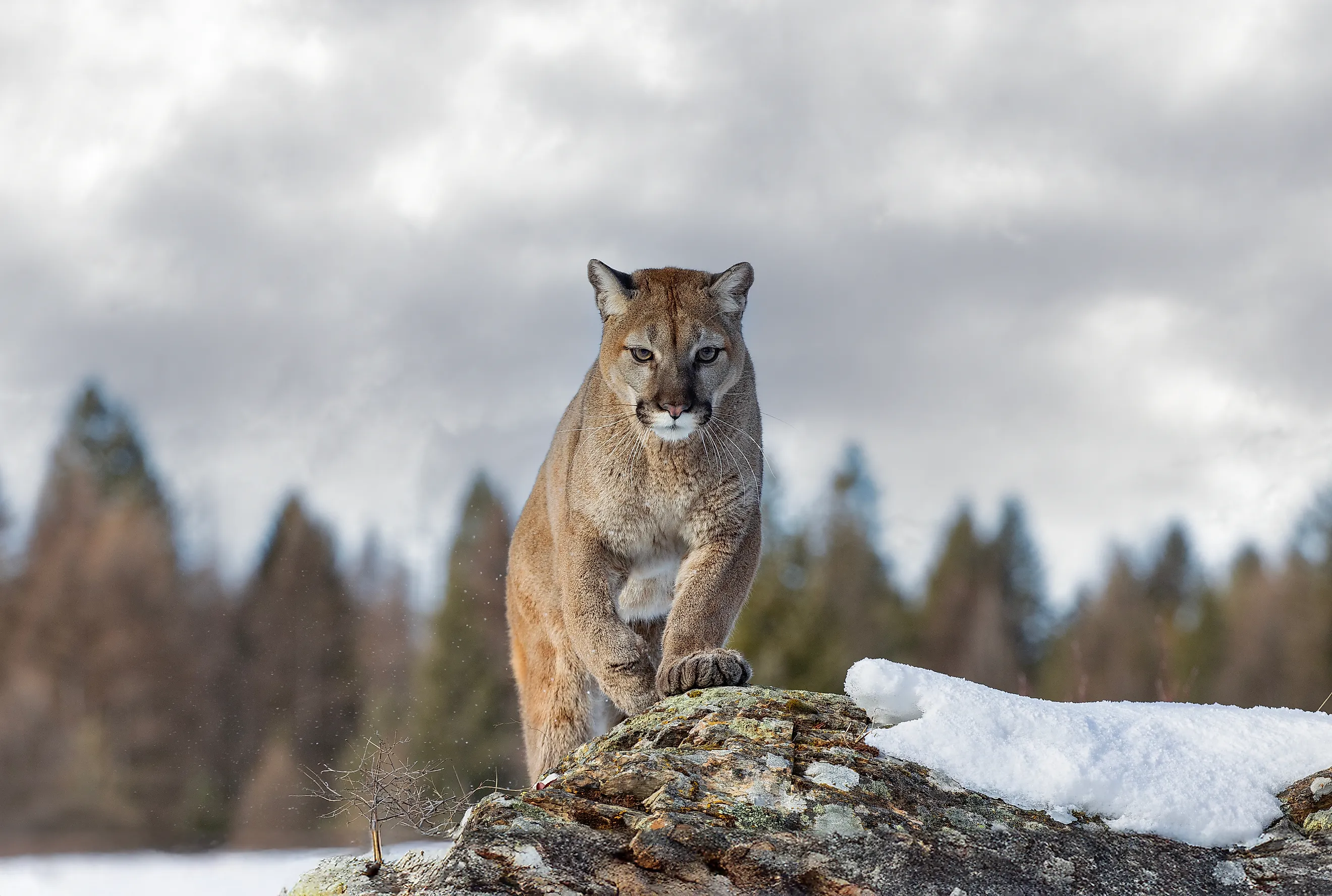
A single mountain lion can range across hundreds of square miles of backcountry. One young male tracked by biologists covered more than 1,500 miles, wandering from the Black Hills of South Dakota all the way to Connecticut. Territories that large, combined with the cat's talent for staying hidden, leave biologists with a real challenge in counting them. In a few national parks, resident populations are large and settled enough that researchers have managed to study them closely over the years. The parks that follow are where those numbers run highest, spread across the northern Rockies, the Sierra Nevada, and the Texas desert.
Yellowstone National Park

In the early 1900s, mountain lions and wolves were extensively hunted throughout the contiguous United States. While wolves were completely eradicated, the elusive nature of mountain lions combined with their preference for rocky and untraceable territory allowed them to survive in the West. In the early 1980s, mountain lions were able to reestablish themselves in Yellowstone National Park, potentially migrating from wilderness areas in central Idaho. Today, it is estimated that anywhere between 29 and 45 mountain lions of all ages and sexes inhabit the northern range in Yellowstone, while other individuals may occupy the park seasonally. The northern range of Yellowstone receives very light snowfall and has readily available prey. They will follow migrating deer and elk to higher elevations in the summer and lower elevations in the winter.
Glacier National Park

More mountain lions live in Glacier National Park than in Yellowstone. There is a high population of white-tailed deer for mountain lions to prey on in Glacier, without the wolf packs in Yellowstone that steal their kills. Montana has between two and four times as many mountain lions as wolves. Montana Fish, Wildlife and Parks estimate that in Glacier National Park alone, there are 4.9 adult lions per 100 square kilometers. They can be found in most habitat types in the park, although they have a preference for wooded areas where they can take advantage of cover when hunting deer, elk, moose, and bighorn sheep.
Yosemite National Park
As much as half of California is believed to be optimal mountain lion habitat, with an estimated population of 5,000 individuals across the state. Although Yosemite National Park covers an area close to 1,169 square miles, a 2003 study in the park (which also included areas outside of the park's boundaries) estimated that there was one mountain lion per 25 square miles. Today, it is suspected that density is much higher. They are a natural part of the Yosemite Valley, roaming at elevations of 10,000 feet. Encounters in the park, however, remain nonconfrontational. Sightings most consist of mountain lions roaming or sometimes chasing prey items like raccoons or coyotes.
Big Bend National Park

There are over 150 reported mountain lion sightings in Big Bend National Park each year. The majority of these sightings occur along roadways, however, encounters on the trail are not uncommon. While mountain lions generally prefer to avoid people, since 1984, several mountain lion encounters in Big Bend have involved attacks on humans. Attacks may occur for several reasons: a mother protecting cubs, a juvenile animal learning what is and is not prey, or an older or injured animal struggling for food. In the Big Bend region, mountain lions inhabit many different habitat types, including forested mountains, grasslands, and desert. Here, their diet consists mainly of deer, as well as javelina and rabbits.
Olympic National Park

Just like any other national park, cougars are very elusive in Olympic National Park. Although their population is uncertain, definitive evidence of their existence appears in the form of territorial scratch marks on trees and tracks on backcountry trails throughout the park. These areas within the park are often densely forested, mountainous, or rocky, allowing them to move through underbrush and stalk prey undetected. While attacks are rare, mountain lions have been known to pose a threat to small children who fall too far behind or stray too far ahead on trails. Attacks on children have happened twice in recent years in the park. In 2023, an eight-year-old child was attacked at Lake Angeles, while in 2025, a four-year-old child was attacked on Hurricane Ridge.
What Are the Chances of Seeing a Mountain Lion?
While mountain lions exist in many national parks, they are not confined to just the park boundaries. Although some parks have resident mountain lion populations, the chances of seeing one, much less having a negative encounter with one, are extremely unlikely. These solitary and elusive predators are most active at dawn and dusk, and hunt at night. Even seasoned hikers can frequent the backcountry for their entire lives without seeing a single glimpse of a mountain lion.