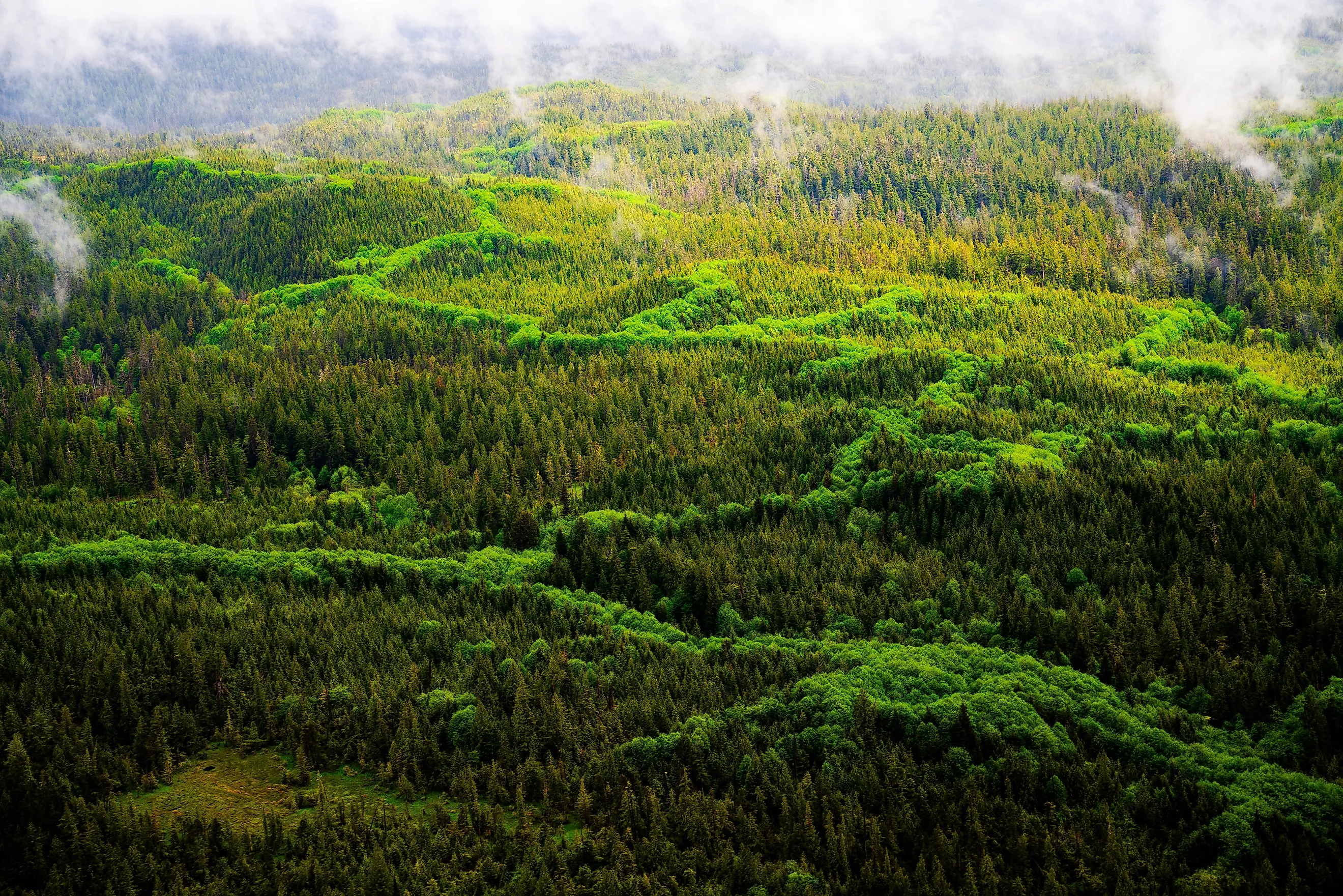
How Many Trees Are There In The United States?
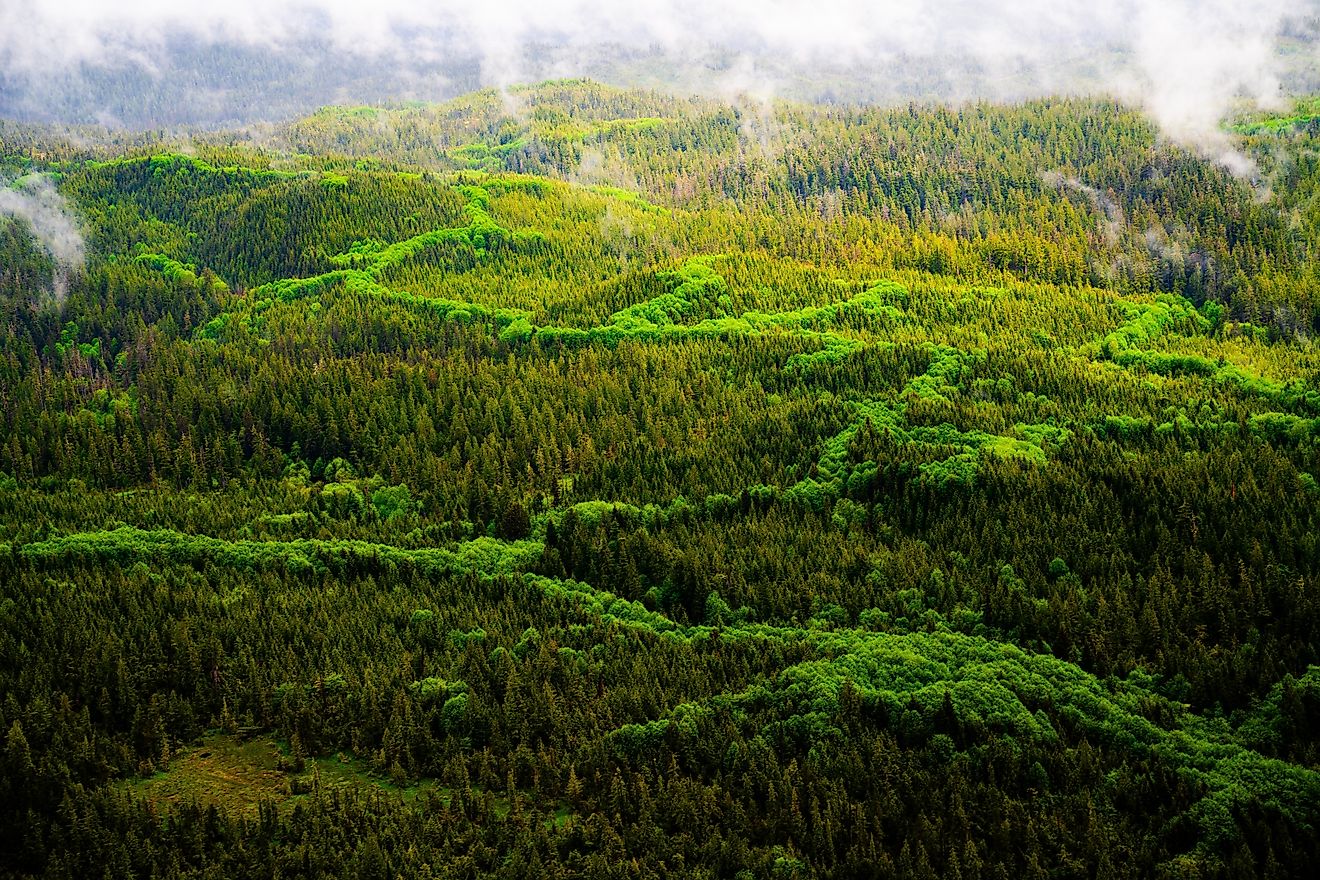
The United States accounts for nearly eight percent of the world's forest coverage. Nearly 1.4 trillion live trees and seedlings grow on forestland across the contiguous United States, according to an analysis by researchers with the USDA Forest Service. The estimate is based on measurements collected at more than 130,000 forest inventory plots and includes trees at nearly every stage of growth.
However, that number represents only the lower 48 states, as the study excluded Alaska, the country's most forested state, and Hawaii, which might bring the number up to an estimated 1.7 trillion. Further, many trees growing outside land officially classified as forest. Urban street trees, suburban yards, orchards, and isolated trees on agricultural land therefore may fall outside the estimate. The total also depends heavily on what qualifies as a tree. More than 1 trillion of the stems counted were seedlings with trunks less than 1 inch in diameter. Only about 90 billion were at least 5 inches in diameter. So, while the United States has nearly 1.4 trillion trees under the study’s broad definition, there are far fewer large trees.
How Scientists Count America’s Trees

No agency attempts to count every tree individually. Not even an army of Johnny Appleseed's would have the time. Instead, the Forest Service’s Forest Inventory and Analysis program maintains a nationwide network of permanent sample plots. Crews measure the trees growing within these plots, record their species and dimensions, and revisit the sites at regular intervals. Researchers then use the samples to estimate conditions across the country’s forestland.
The 2020 tree-count study used information from 130,250 plots containing forested conditions. The plots are distributed at a base intensity of approximately one for every 6,000 acres. Larger trees are measured on a series of fixed-radius subplots, while saplings and seedlings are recorded within smaller nested plots.
Most Of The 1.4 Trillion Are Seedlings

The Forest Service researchers divided the estimated 1.381 trillion live trees into three size classes. Approximately 1.033 trillion seedlings had trunks less than 1 inch in diameter. Realistically, it may be more insightful to disregard the seedlings and focus on saplings and larger trees. A forest floor can contain thousands of young seedlings, and only a fraction will survive long enough to enter the larger size classes. There are approximately 257 billion saplings measured between 1 and 5 inches in diameter in the contiguous US, and around 90.4 billion trees measured at least 5 inches in diameter.
These categories are based on trunk diameter rather than age or maturity. A tree more than 5 inches wide is not necessarily mature, particularly among species capable of reaching enormous dimensions.
How Much Of The United States Is Forested?

The 2020 study covered approximately 256.3 million hectares, or 633 million acres, of forestland in the contiguous United States. Unfortunately, no directly comparable official count currently covers all 50 states. When Alaska and Hawaii are included, the Forest Service reports more than 765 million acres of planted and natural forest, along with approximately 58 million acres classified as woodland. Together, these areas cover roughly one-third of the country.
Approximately 60 percent of American forest land is privately owned by families, corporations and other organizations, with the rest being controlled by various levels of government. For broad analysis, the Forest Service divides the country into four Resources Planning Act regions: the North, South, Rocky Mountain region, and Pacific Coast. Their forests differ sharply in density, dominant species, and average tree size.
The North

The North includes New England, the Great Lakes states, and much of the northern Appalachian region. Its forests are dominated by combinations of maple, beech, birch, and pine, among many others. Though its trees skew smaller than what you might encounter further west, the approximately 535 billion trees and seedlings account for 39 percent of the country's total.
Much of the region’s modern forest developed on land that had previously been cleared for agriculture. During the 19th and early 20th centuries, farms were abandoned as agriculture shifted westward and residents moved toward industrial centers. Trees gradually reclaimed many fields and pastures. That regrowth remains visible in regional statistics. Forest area in the North increased by approximately 11.6 million acres between 1977 and 2017, the largest gain among the four Forest Service regions during that period. Timber volume also rose substantially as recovering stands accumulated wood.
The South

The Forest Service’s Southern region extends from Virginia and Kentucky to Texas and Oklahoma. It contains extensive oak-hickory forests, pine plantations, bottomland hardwoods, and coastal wetlands. Common trees include loblolly, longleaf, and slash pine. The regional estimate places approximately 494 billion trees and seedlings in the South, or about 36% of the contiguous national total. That is slightly below the North’s estimated count despite the South having more forestland.
The South is the center of American timber production. In 2017, it contained approximately 71% of the country’s planted timberland, much of it dominated by commercially important pine species. Most national timber removals also occur in the region. Nevertheless, Southern forests are more than timber resources. They support wildlife, store carbon, and provide extensive opportunities for recreation.
The Rocky Mountain Region

The Forest Service’s Rocky Mountain region covers a vast area extending across the Great Plains, central and northern Rockies, Great Basin, and Desert Southwest. Approximately 240 billion trees and seedlings, or around 17% of the national estimate grow within the region. Ponderosa pine, Douglas-fir, spruce, and aspen are among its characteristic trees. Much of the West is naturally too dry to support closed forests.
Western forests also experience recurring wildfire, drought, and disease. Fire is a natural ecological process in many forest types, although its effects vary. Lodgepole pine forests, for example, can regenerate after fire when heat opens their resin-sealed cones. A long history of aggressive fire suppression has also contributed to heavy fuel accumulations in some forests, increasing the complexity of current management.
Between 1977 and 2017, total forest area in the Rocky Mountain region increased modestly, even as several individual forest types declined. Ponderosa pine, lodgepole pine, and western white pine forests experienced losses associated with interacting pressures that included insects, disease, wildfire, and changing environmental conditions.
The Pacific Coast

For purposes of the 1.4 trillion-tree estimate, the Pacific Coast section includes California, Oregon, and Washington. Alaska and Hawaii belong to the Forest Service’s broader Pacific Coast region but were not included in the study.
The submitted regional figures place approximately 113 billion trees and seedlings in the three-state area, or about 8% of the total. That is the smallest number among the four regions, but it does not mean these forests contain the least wood or carbon. Pacific forests include some of the largest trees on Earth. Coast redwoods grow primarily along the northern California and southern Oregon coast and hold the record for height. Giant sequoias grow naturally in scattered groves on the western slopes of California’s Sierra Nevada and include the world’s largest individual trees by volume. The two species occupy different ranges and hold different records.
Douglas-fir, Sitka spruce, and numerous oak species also contribute to the region’s forests. Many Pacific trees reach greater average dimensions than those in the East. As a result, an acre containing relatively few large trees may hold more wood and carbon than an acre containing many small stems. Forest area in the Pacific Coast region declined by approximately 2.3 million acres between 1977 and 2017, even as growing-stock volume increased.
Will The Number Of Trees Increase?
Trees are constantly growing and dying, like all living organisms. Estimates for annual planting totals fall around 1.165 billion, though these numbers are maps, more than territory. Given the inherent fallibility of trying to wrangle such an impossible number, the best we can conditionally say is that the contiguous United States has an estimated 1.38 trillion live trees and seedlings on forestland, with about 90.4 billion trees at least 5 inches in diameter. The broader total for all trees in all 50 states is not known, but presumably closer to 1.7 trillion. See them while you can!