Why Bison Vanished From Almost Every National Park
There was a time when buffalo, or bison, could have been found across what we know today as the United States. The animal became so emblematic of the American West that the Buffalo Bills of the National Football League still use one as their mascot. As we set aside more of those wide-open spaces as national parks, one might expect vast numbers of their kind still roaming them. Unfortunately that is not the case. Overhunting and habitat loss took a heavy toll long before the National Park Service existed to protect them. Conservation efforts have saved the herds that remain but have never made the work easy.
History

Before the onset of Europeans, bison numbered in the millions across North America. As these newcomers continued to move the line of settlement west, buffalo populations steadily declined. Much of this took place over the course of the nineteenth century, which is also the same period in which the first national park, Yellowstone, was established in 1872. By that point, though not all in state form, the United States' lower forty-eight all had some form of civilization. Those pioneers often killed herds as they moved, mostly for their lucrative pelts, leaving fields of carcasses to rot. The wars with Plains peoples exacerbated the problem. Bison were the most important food source of these native groups, and the United States army protecting these advancements typically sided with the Americans decimating the animal. This slaughter mostly preceded the establishment of the national parks, which is one of the reasons why by the time they came to be, there were no bison to be found.
Yellowstone

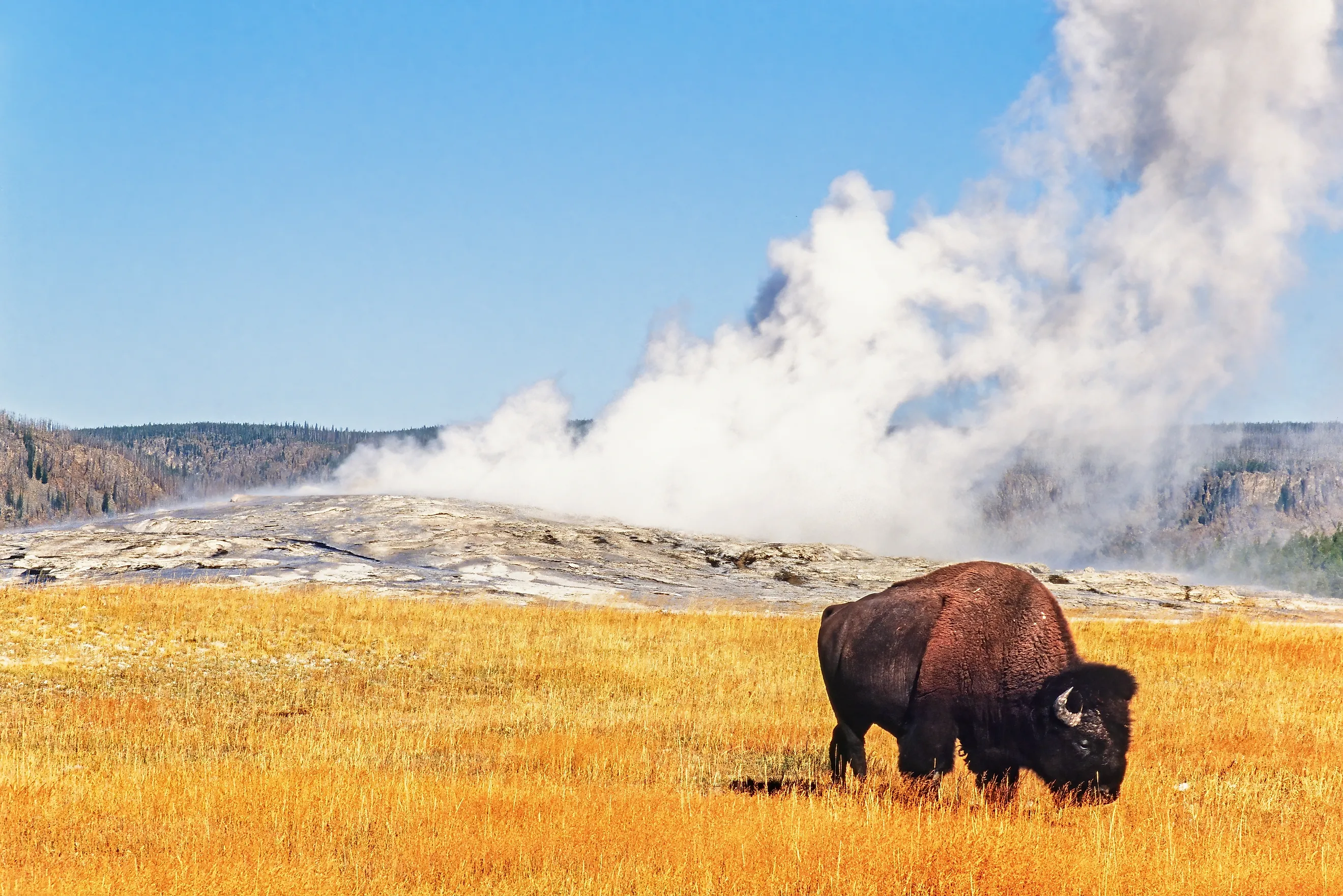
As mentioned in the last paragraph, Yellowstone became the first national park when President Ulysses S. Grant signed the Yellowstone National Park Protection Act in 1872. Covering parts of Wyoming, Montana, and Idaho, the preserve marked a shift from viewing land as simply something to be exploited to a natural resource worth protecting. This included the wildlife contained therein, along with the buffalo that remained within its borders. Indeed, there is an argument to be made that without these efforts, there might not be any bison left. This would have been a significant loss given that the herds found here are among the few in North America that have remained continuously wild and free-ranging. In turn, the conservation of the species here became a test case for the rest of the country. It is not solely about making sure they can reproduce, but how to integrate them into the park structure that also allows in visitors, not to mention balancing these needs against those of native peoples who can still legally hunt them.
Beyond Yellowstone

Yellowstone was one of a few national parks ideally situated for preserving buffalo. This was not the case with all subsequent additions to the system. A lot depends on the ecosystem, and not all of the United States are of the Plains variety where bison once thrived. Put differently, a preserve can be wild but not a habitat meant for these creatures. This means that the herds that we can view are found, other than Yellowstone, in places like the Badlands and Grand Teton National Parks, places with the kinds of grasslands on which these natural roamers graze over the landscape. Overall, it means that the fact that they are not in every preserve is less unusual than might be apparent.
The Comeback

Though there has been a concerted mission to keep and bolster buffalo herds, it has not been one that has seen them return to every national park. Much of the early conservation focused breeding in private locations, like zoos. From there, they took these out to newly created areas like Wind Cave National Park in South Dakota. From there, they branched into other reserves like Theodore Roosevelt National Park, where subsequent breeding led to their reintroduction into other places. What is important is the selectiveness of the breeding, which has been the result of refined scientific practices over the course of the twentieth century. Everything from foliage to water conditions had to be taken into consideration if the bison were to survive in any area, let alone a national park.
Cattle Herding
Getting back to historical factors for a moment, one of the biggest changes that settlement brought to buffalo ranges was livestock agriculture. Simply put, bison survive by roaming freely, whereas cattle production has traditionally been carefully managed. When dealing with an endangered species, it is not possible to turn reintroduced herds into the wild and let them migrate along once familiar paths. In order to monitor them more closely, they had to apply some of the same principles, while also doing their best to let the animals do what they do. This makes them ideal for places like Yellowstone, but a potential danger in other parks where they could damage property or injure visitors.
Limits
When you think about how close buffalo came to extinction and where they are at today, the conservation efforts are a bit of a success story. It is a shame that it had to come to this point, but we can be thankful for what has been done to correct this near ecological disaster. It has been a combined mission of the National Park Service and private enterprises that have managed and supported herds to this day. This also means that not all that remain are inside the bounds of national parks. Though it may seem like semantics, the Tallgrass Prairie National Preserve where bison can be found, for example, is not a national park. Others are on private lands. It amounts to scattered groups rather than the large herds that could once be so readily found.
Conclusion
When thinking about why we cannot see bison in every national park, the main culprit is the historical factors that led to their sharp decline in the first place. As has been discussed, much of this predated the founding of a single national park. Their establishment was a factor in helping them come back, but the fact that it has taken so long is a testament to the amount of damage that has been done. All the same, without them, we might not have the populations that do remain. Places like Yellowstone and its cousins have been instrumental in providing the places where they have been allowed to thrive once more. It will continue to take close management in these places, but it is a small price to pay for the sins of the past. Like the national parks themselves, the efforts underway there for the buffalo are among some of this country's best ideas and hopefully it will remain that way for years to come.