10 Pink Lakes From Around the World
Pink lakes are not the largest or deepest bodies of water on Earth, but they are among the most visually arresting. The color comes from chemistry and biology working together under extreme conditions: in hypersaline water that few organisms can tolerate, salt-loving microorganisms such as the green algae Dunaliella salina and bacteria like Salinibacter ruber produce carotenoid pigments (the same family responsible for the color of carrots and flamingos) as protection against intense ultraviolet light. When concentrations climb high enough, the pigments tint the water itself, in colors that range across pale pink, salmon, and deep magenta. A handful of lakes also turn red or pink because of soda chemistry rather than salt, as is the case at Tanzania's Lake Natron. Pink lakes are scattered across every inhabited continent, with the highest concentrations in Western Australia, southern Europe, and the soda lakes of the East African Rift. Below are ten of the most notable, ranked in ascending order of distinctiveness.
10. Lake Hillier, Australia

Lake Hillier sits on the edge of Middle Island, the largest island in the Recherche Archipelago, about 140 kilometers east of Esperance on the south coast of Western Australia. The lake is small (about 600 meters long, 250 meters wide, covering 15 hectares) and shallow, but it has been famous for its bubblegum-pink color since the English navigator Matthew Flinders first described it during his 1802 survey of the Australian coast. The color is unusual in being stable: water scooped into a container retains its pink hue rather than fading. Salinity at Lake Hillier sits around 28 percent, roughly eight times that of seawater, and a 2022 metagenomic study by the Extreme Microbiome Project found that the pink comes from a community of organisms rather than algae alone. The halophilic bacterium Salinibacter ruber dominates the water column, accounting for 20 to 33 percent of the DNA recovered, while Dunaliella salina, long credited as the lake's sole color agent, contributed only about 0.1 percent. Archaea such as Halorubrum round out the microbial cocktail. The lake sits inside the Recherche Archipelago Nature Reserve and is not accessible by boat for most visitors; scenic flights from Esperance are the standard way to see it. In early 2025, an unprecedented rainfall event diluted the lake's salinity below the threshold the extremophiles need, and Lake Hillier turned blue. National Geographic-cited researchers estimate it will take five to ten years for evaporation to restore the salinity and the color.
9. Lake Retba, Senegal

Lake Retba, known locally as Lac Rose ("Pink Lake"), lies about 30 kilometers northeast of Dakar on Senegal's Cap Vert peninsula, separated from the Atlantic Ocean by a thin dune barrier. Salinity reaches approximately 40 percent during the dry season, which actually exceeds the salinity of the Dead Sea (around 34 percent). The same buoyancy effect that allows easy floating at the Dead Sea applies at Retba, though the salt is corrosive enough that prolonged contact without skin protection causes irritation. The lake's color is most intense between November and June, when evaporation drives salinity up and the pigment-producing microbial population peaks; in the rainy season the pink fades toward a duller brown. Lake Retba is also a significant working salt lake. Several hundred Senegalese salt workers, mostly migrants from neighboring West African countries, harvest roughly 24,000 tonnes of salt per year by wading into the lake and breaking up the salt crust on the bottom by hand. They coat their skin with shea butter to protect against the brine. The lake served as the finish line of the original Paris-Dakar Rally from 1979 until the race was relocated to South America in 2009 for security reasons.
8. Hutt Lagoon, Australia

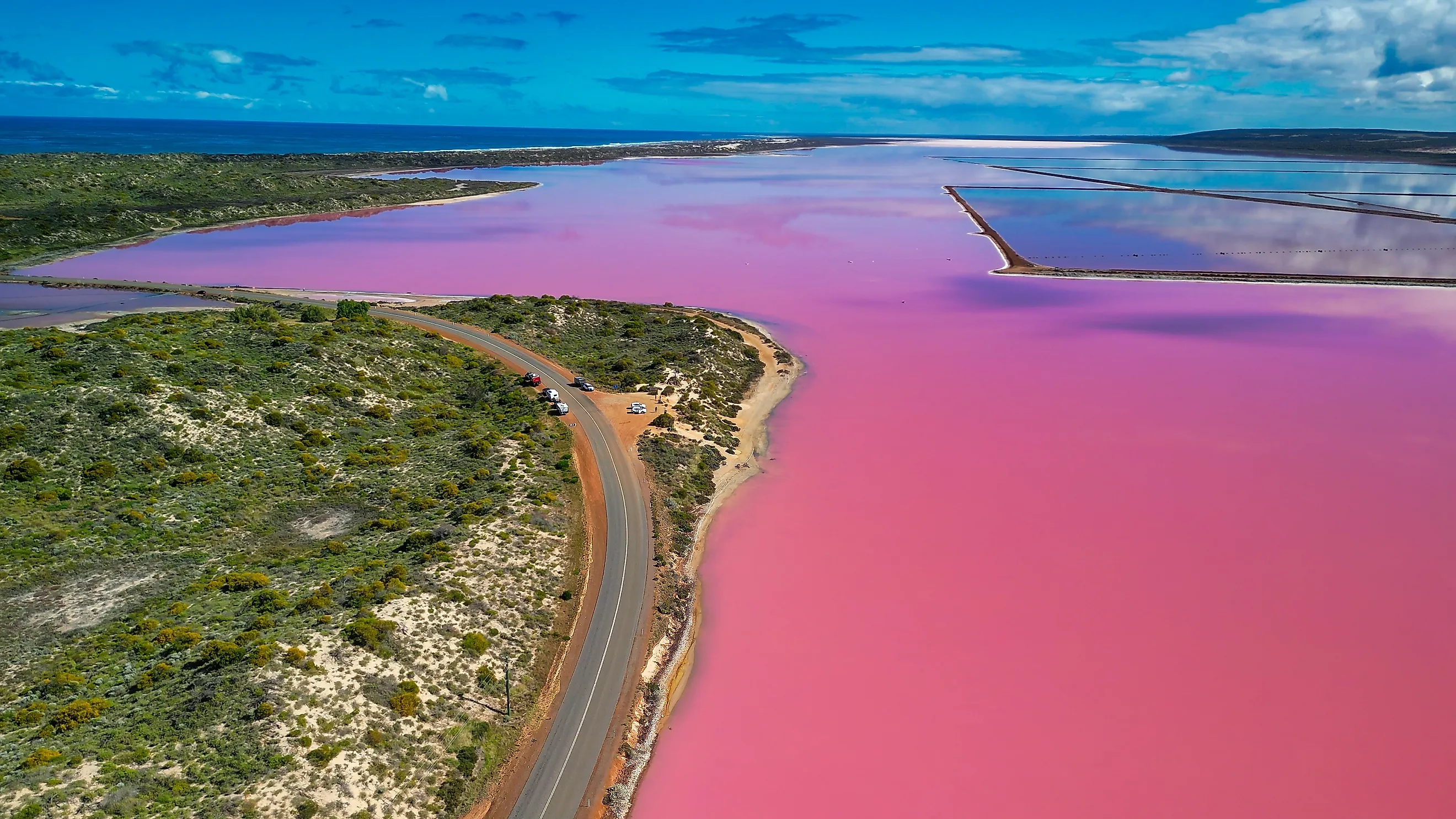
Hutt Lagoon stretches roughly 14 kilometers along the coast near Port Gregory in Western Australia, about 70 kilometers north of Geraldton. The English explorer George Grey named it during an 1839 expedition. The lagoon is fed by seawater seeping through the dunes from the Indian Ocean to the west, and intense evaporation pushes its salinity to between three and six times that of the ocean. The pink color comes from Dunaliella salina, which produces beta-carotene as a sunscreen against the strong Australian ultraviolet light. Hutt Lagoon is also a working industrial site: it contains what is widely cited as the world's largest microalgae production facility, a 250-hectare network of artificial ponds operated by the German chemical company BASF (previously known as Cognis and originally as Betatene). The ponds grow Dunaliella salina for commercial beta-carotene extraction, supplying the food coloring, dietary supplement, and cosmetics industries with a natural alternative to synthetic pigment. The color of the lagoon varies through the day and across seasons, shifting between pale pink, lilac, and deep magenta depending on cloud cover, time of day, and salinity. The most reliable color appears between mid-morning and mid-afternoon on clear days.
7. Quairading Pink Lake, Australia
Quairading Pink Lake lies about 167 kilometers east of Perth in Western Australia's Wheatbelt region, near the small town of Quairading. The unusual feature noted in older travel writing about the lake is real: a road, signposted as Pink Lake Road, bisects the lake almost exactly down the middle, and the two halves often display distinctly different colors at the same time. The northern half tends to be a pronounced pink, sometimes deepening to red, while the southern half is typically pale green or blue-gray. The cause is a difference in microbial communities and salinity on either side of the road embankment, which acts as a low dike and limits water exchange between the two sides. The lake is much smaller than the better-known Western Australian pink lakes, and it is not protected as a nature reserve, so visitors can pull over directly on Pink Lake Road. Like the other Wheatbelt salt lakes, Quairading's color is most reliable during the hotter months between November and March, when evaporation drives salinity high enough for the pigment-producing microbes to dominate.
6. Lake Natron, Tanzania

Lake Natron is a soda lake in the East African Rift Valley in northern Tanzania, close to the border with Kenya and immediately north of the active volcano Ol Doinyo Lengai. The lake is large but extremely shallow (a maximum length of about 56 kilometers and width of 22 kilometers, with a depth that rarely exceeds half a meter) and its color comes from soda chemistry rather than salt alone. Volcanic mineral inflow from the surrounding hills carries sodium carbonate and sodium bicarbonate, the same compound that gives the lake its name (natron is the historical Egyptian word for the mineral used in mummification). The water reaches a pH of 10 to 10.5, approaching that of household ammonia, and surface temperatures can climb to 60°C. Photographer Nick Brandt's 2013 book Across the Ravaged Land introduced the lake to a global audience through images of birds and bats whose bodies had been preserved by calcification in the alkaline water; a 2021 episode of the BBC nature series A Perfect Planet, narrated by David Attenborough, returned to the same subject. Despite the chemistry, Lake Natron is a critical habitat: it is the single most important breeding site in the world for the lesser flamingo (Phoeniconaias minor). Roughly 2.5 million birds, or about 75 percent of the global population of the species, hatch there. The flamingos feed on the cyanobacteria that bloom in the lake's red-pink waters during the dry season, and the harsh chemistry keeps most predators away from their nests.
5. Sasyk-Sivash and the Sivash Lagoons, Ukraine

The Sivash is a vast system of shallow lagoons covering roughly 2,560 square kilometers between mainland Ukraine and the Crimean Peninsula, bordered to the east by the Arabat Spit and separated from the Sea of Azov by the same narrow strip. The lagoons are exceptionally shallow, with an average depth of around 50 centimeters to 1 meter, and the bottom is coated by up to five meters of silt. Hydrogen sulfide given off by the warm, stagnant water in summer earned the system its Ukrainian nickname Hnyle More and the more widely known Russian translation, "Rotten Sea" or "Putrid Sea." The most photographed pink portion is Sasyk-Sivash, the largest lake on the Crimean Peninsula, located near the city of Yevpatoria. Dunaliella salina and halophilic bacteria color it bright pink in summer when evaporation concentrates the brine. Salt has been harvested at Sasyk-Sivash since at least classical antiquity; Greek traders mined it, and it was served at the table of the Russian imperial family in the 19th century. The Sivash's salt reserves are estimated at over 200 million tonnes. The central and eastern parts of the lagoon system were designated wetlands of international importance under the Ramsar Convention while administered by Ukraine. Since the 2022 Russian invasion of Ukraine, the entire Sivash has been under Russian military occupation, and the territorial status of the lagoons is contested.
4. Tuz Gölü, Turkey
Tuz Gölü, whose Turkish name translates as "Salt Lake," is the second-largest lake in Turkey and one of the largest hypersaline lakes in the world. It sits in Central Anatolia at an elevation of about 905 meters, at the meeting point of the Ankara, Konya, and Aksaray provinces, roughly 150 kilometers south of Ankara. The lake covers approximately 1,665 square kilometers when full, with a maximum length of around 80 kilometers and width of 60 kilometers, but it is exceptionally shallow (1 to 2 meters at most) and largely evaporates each summer, leaving a thick white salt crust across the bed. Roughly 63 to 70 percent of Turkey's table salt comes from saltworks around the lake, particularly the Kayacık and Kaldırım works near Şereflikoçhisar. The pink color is seasonal and develops in summer when residual brine concentrates enough for halophilic microorganisms to bloom, tinting the remaining water reddish-pink before it disappears entirely under the salt crust. Tuz Gölü was designated a Special Environment Protection Area in 2001 and is a major breeding ground for greater flamingos (Phoenicopterus roseus), with several thousand pairs nesting on islands that form during the dry-down period.
3. Kati Thanda-Lake Eyre, South Australia

Lake Eyre, officially renamed Kati Thanda-Lake Eyre in 2012 to incorporate the Arabana language name used by the lake's traditional owners, is Australia's largest lake when full but is dry for most of any given decade. The lake sits in the Lake Eyre Basin of northern South Australia and reaches 15 meters below sea level at its lowest point, making it the lowest land surface in Australia. The lake is divided into two main basins, Lake Eyre North and Lake Eyre South, connected by the narrow Goyder Channel. Major filling events depend on monsoon rains in Queensland flowing down through Cooper Creek and the Diamantina River, and the lake has filled completely only three times in the past century (1950, 1974, and 1989), with significant partial fills in 2010 and again in 2024. When water is present, it is initially fresh enough to support large bird populations including pelicans and banded stilts, but as the lake dries down it concentrates into a brine that supports Dunaliella salina and other halophiles, producing patches of pink and red across the shrinking water and the surrounding salt pan. The dominant impression for most visitors most of the time is the white salt crust rather than the pink water; the color is a brief stage in a long evaporation cycle.
2. Las Salinas de Torrevieja, Spain

Torrevieja, on the Mediterranean coast of Alicante province in southeastern Spain, is home to two coastal salt lagoons: the pink Laguna Rosa de Torrevieja and the larger, blue-green La Mata. Together they form a protected natural park, Parque Natural de las Lagunas de La Mata y Torrevieja, that has been actively producing salt since the late 13th century, with continuous industrial-scale production since 1759 under royal license from Ferdinand VI. The lagoon is anything but low-salinity; salinity routinely climbs above 30 percent during the summer evaporation cycle, comparable to Lake Retba, and Las Salinas de Torrevieja remains one of the largest salt producers in Europe, exporting on the order of 700,000 tonnes of salt per year. The pink color comes from Dunaliella salina and halophilic bacteria similar to those that color the Australian pink lakes. The World Health Organization has cited Torrevieja's local microclimate, created in part by evaporation off the lagoons, as one of the healthiest in Europe, with low humidity and a steady marine breeze. The two lagoons together host substantial flamingo populations and over a hundred other bird species, and they are a stopover on the East Atlantic migratory flyway.
1. Lake Bumbunga, South Australia

Lake Bumbunga is a small ephemeral salt lake on the edge of the tiny South Australian town of Lochiel, about 130 kilometers north of Adelaide along the Augusta Highway, roughly a one-and-a-half to two-hour drive from the city. Bumbunga changes appearance dramatically with the seasons. After winter rains, the lake holds a thin sheet of relatively fresh water and looks blue or gray. As summer progresses and the water evaporates, salinity climbs and Dunaliella salina blooms, turning the remaining water pink and red. By late summer, the lake often dries completely and becomes a salt pan of stark white crystals. Salt was commercially harvested at Bumbunga from the 1880s through the 1970s, and remnant levees and earthworks from the old saltworks remain visible from the highway. Lochiel itself is best known for a piece of local folk art on the lake's shoreline: a metal Loch Ness Monster sculpture installed by residents trading on the similarity between "Lochiel" and "Loch Ness." The combination of the playful sculpture, the regularly pink water, and the easy roadside access from a major highway have made Bumbunga the most-photographed of South Australia's small salt lakes, and arguably the most accessible pink lake on this list.