The World's Largest Whirlpools
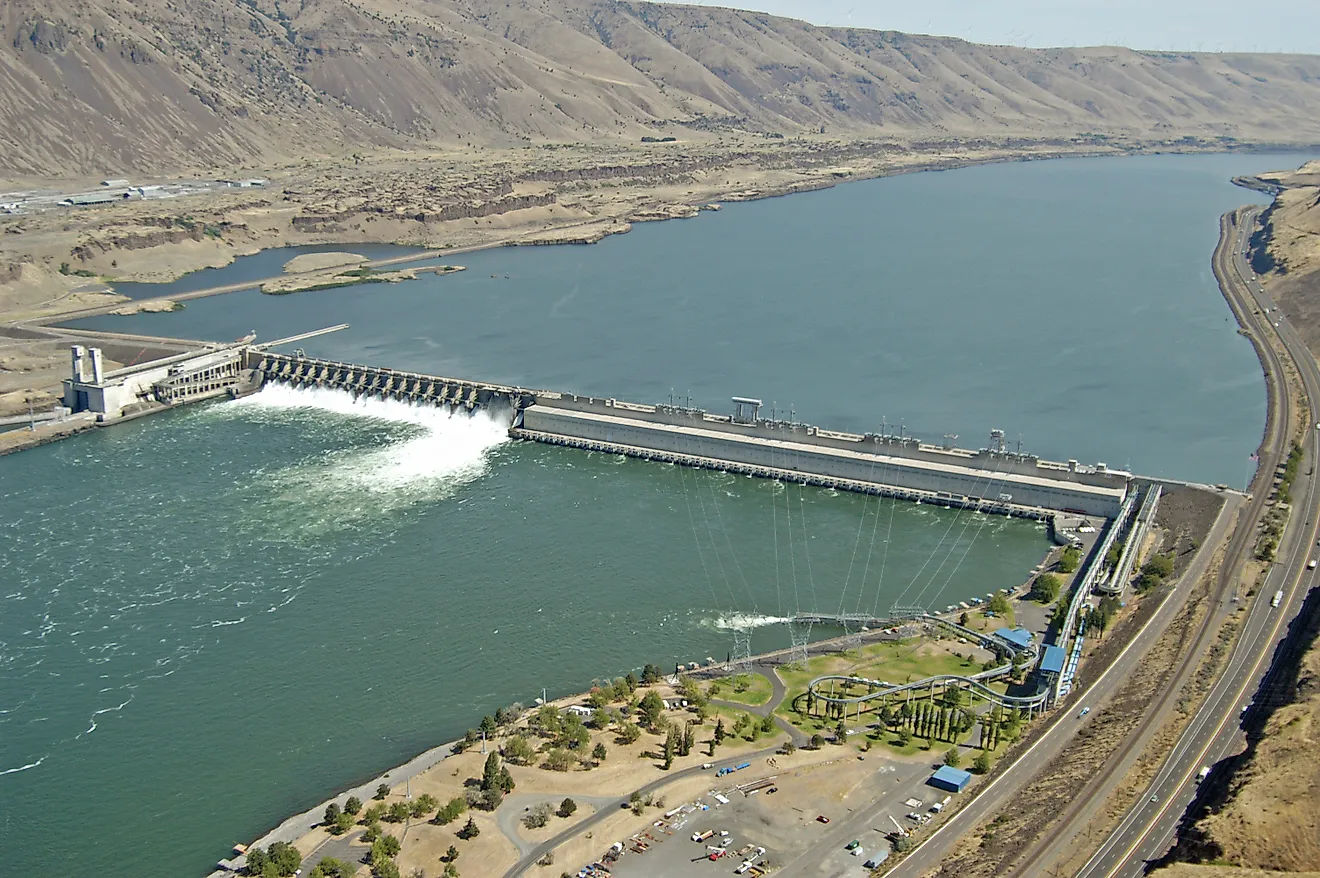
A whirlpool is a rotating body of water formed when two opposing currents meet, when a strong tidal race squeezes through a narrow strait, or when fast-flowing water passes over an irregular seabed. Small whirlpools form at the base of waterfalls and at dams and weirs. The most powerful ones, called maelstroms, occur in straits, narrows, and tidal channels where the periodic exchange of large volumes of seawater is constrained by geography.
How Is The "Size" Of A Whirlpool Even Measured?
There is no single standard measurement for whirlpool size. The two metrics most commonly used by scientists and mariners produce different rankings, and most popular lists silently mix them. The first is maximum current speed, the velocity of the tidal flow through the strait, recorded in knots or kilometers per hour. This is what most authoritative sources use when they call a whirlpool "the strongest" or "the largest" because current speed is consistently measurable and closely tracks the kinetic energy and power of the vortex. The second is maximum visible vortex diameter, the width of the rotating surface depression at the peak of tidal flow. Vortex diameter is more intuitive but less rigorous: the visible whirlpool changes width continuously through each tidal cycle, varies with weather, and at some sites is not a single fixed feature at all but a wandering set of vortices.
By max current speed, Saltstraumen in Norway is the most powerful tidal whirlpool in the world. By max diameter, Old Sow off the coast of New Brunswick is larger. The ranking below is ordered by maximum tidal current speed, the more rigorous metric. The table at the end shows both measurements for each whirlpool so readers can see how the order changes.
1. Saltstraumen (Norway)

Saltstraumen is a narrow strait in northern Norway about 33 kilometers southeast of the city of Bodø, in Nordland County, and is recognized as the strongest tidal current in the world. Its maximum current speed reaches 22 knots (40 km/h or 25 mph), faster than any other tidal current that has been reliably measured. Every six hours the strait carries an estimated 400 million cubic meters of water between the Saltfjord and the larger Skjerstadfjord, a volume equivalent to 105 billion US gallons, through a channel only 3 kilometers long and 150 meters wide. The whirlpools that form when the current is at its peak reach about 10 meters (33 feet) in diameter and 5 meters (16 feet) in depth. The strait is also one of the richest fishing grounds in Norway: cod, wolffish, and saithe are caught here in large numbers, including the world record saithe at over 22 kilograms.
2. Moskstraumen (Norway)
Moskstraumen is the second-fastest measured tidal current in the world, with peak speeds of about 27.8 km/h (17.3 mph or 15 knots). It is also the largest individual whirlpool by surface diameter on this list: its central vortex measures 40 to 50 meters (130 to 160 feet) across at peak flow. It forms in the open Norwegian Sea between the islands of Moskenes and Værøy in the Lofoten archipelago of northern Norway, where strong Atlantic tides meet the deep Vestfjorden over a sharply uneven seabed. Unlike most whirlpools, which form in confined straits, Moskstraumen forms in open water. It is the original "Maelstrom": the English word derives from the Dutch "maalstroom" and the Norwegian "Moskenstraumen." The whirlpool was labeled "Horrenda Caribdis" on Olaus Magnus's 1539 Carta Marina, inspired Edgar Allan Poe's 1841 short story "A Descent into the Maelström," is referenced in Jules Verne's "Twenty Thousand Leagues Under the Sea" and in Captain Ahab's dialogue in Melville's "Moby-Dick."
3. Old Sow (Canada-United States border)
Old Sow sits in Passamaquoddy Bay between Deer Island in New Brunswick, Canada and Moose Island in Eastport, Maine. It is the largest whirlpool in the Western Hemisphere by surface diameter, reaching up to 76 meters (250 feet) across at peak flow, and one of the strongest tidal currents in the world, recorded at peak speeds of about 27.6 km/h (17.1 mph), just behind Moskstraumen. The whirlpool forms during the extreme tidal exchanges between the Bay of Fundy (which has the largest tidal range in the world) and Passamaquoddy Bay, accelerated by the unusual seafloor topography in the area. The name comes from the pig-like noises the churning water produces; smaller surrounding eddies that swirl alongside the main vortex are nicknamed the "piglets." The best viewpoint is Deer Point on Deer Island or the Eastport waterfront on Moose Island.
4. Skookumchuck Narrows (British Columbia, Canada)

Skookumchuck Narrows forms the entrance to Sechelt Inlet on the Sunshine Coast in British Columbia, about 60 kilometers north of Vancouver. The tidal flow through the strait and the combined flows of Salmon Inlet and Narrows Inlet meet at the Sechelt Rapids, where peak current speeds have been recorded at over 30 km/h (about 16 knots or 19 mph), making this among the fastest tidal rapids in the world by some measurements. The water level difference on either side of the rapid can exceed 2 meters (6.6 feet). Skookumchuck is more accurately described as a tidal race that produces whirlpools rather than a single discrete whirlpool, which is why some authoritative rankings exclude it from the standard "fastest whirlpool" list even though its current speeds are substantial. The rapids are reached by a 4-kilometer hike to Roland Point or North Point and are popular with extreme kayakers and divers.
5. Naruto Whirlpools (Japan)

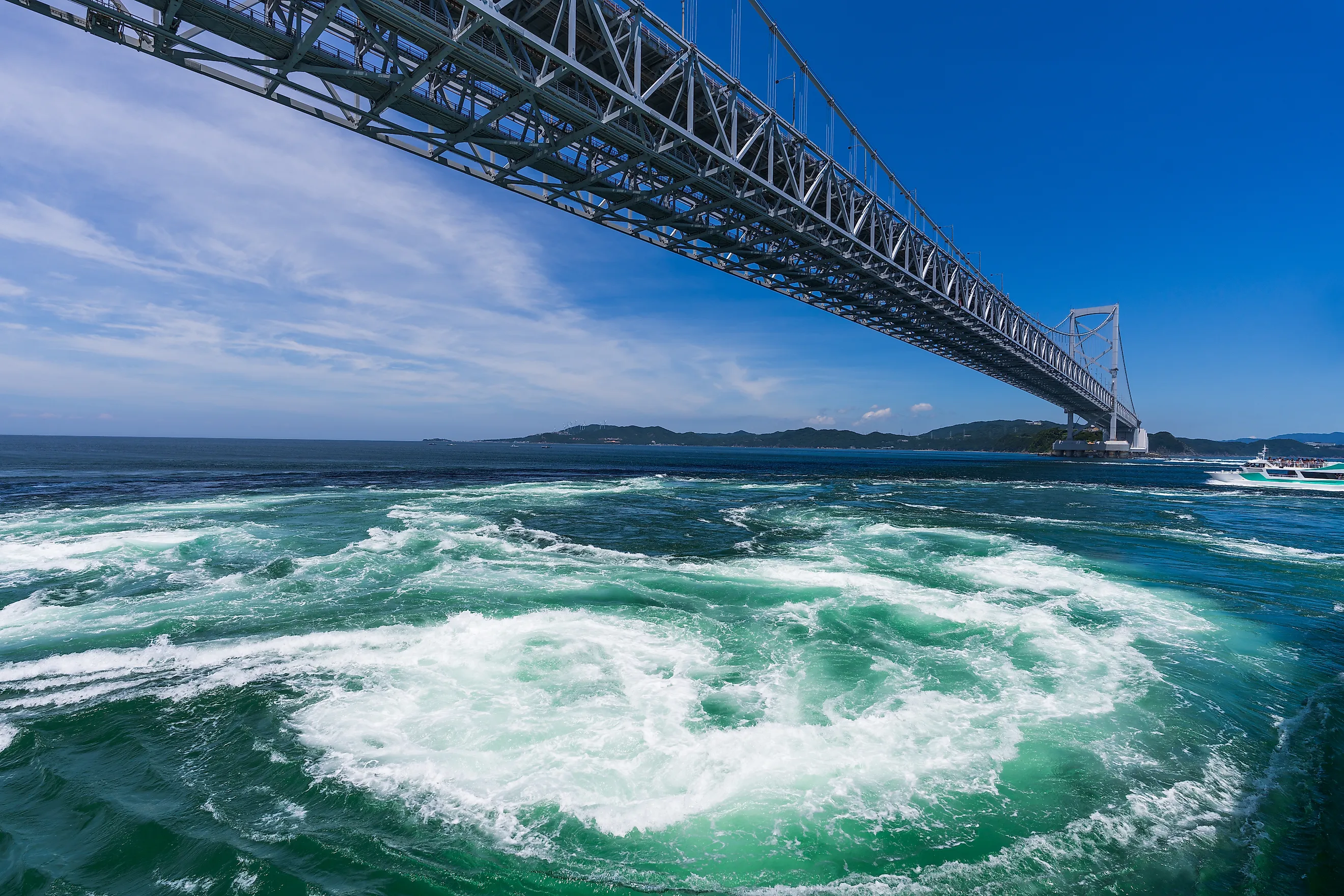
The Naruto whirlpools form in the Naruto Strait, the 1.3-kilometer-wide channel between Naruto in Tokushima Prefecture and Awaji Island in Hyōgo Prefecture, one of the connections between Japan's Inland Sea and the Pacific Ocean. The tidal range in the strait reaches up to 1.7 meters, creating a difference in water level between the two sides of up to 1.5 meters. The resulting current flows through the strait at about 13-15 km/h normally, accelerating to 20 km/h (about 11 knots) during spring tide, the world's fourth-fastest measured tidal current after Saltstraumen, Moskstraumen, and Old Sow. The whirlpools formed at peak flow can reach 20 meters (66 feet) in diameter. The best viewing point is the Uzunomichi Walkway on the 1985 Ōnaruto Bridge or from the Awaji-side shore. The whirlpools also gave their name to narutomaki, the steamed surimi fish cake with its distinctive pink spiral.
6. Corryvreckan (Scotland)

The Gulf of Corryvreckan is a narrow strait between the islands of Jura and Scarba in the Inner Hebrides off the west coast of Scotland. The Gaelic name, "Coire Bhreacain," means "cauldron of the speckled seas." On a full spring tide, the current through the gulf reaches 8.5 knots (16 km/h or 10 mph), slower than the other entries on this list, but unusual seabed geometry produces a particularly violent whirlpool: a 219-meter-deep hole on the eastern end is followed by a sharp rise to a basalt pinnacle (called the Old Hag) that comes within 29 meters of the surface, forcing water upward in pulses that dissipate into vortices and standing waves up to 9 meters tall. Corryvreckan has been described in older guidebooks as the world's third largest whirlpool, a claim that almost certainly refers to its violence rather than current speed. The roar can be heard 10 miles away. George Orwell, writing "Nineteen Eighty-Four" on Jura in 1947, nearly drowned in Corryvreckan that August when his boat got caught in the whirlpool with his young son aboard.
Notable Mention: Te Aumiti (French Pass), New Zealand
Te Aumiti, also known as French Pass, is the narrow strait separating D'Urville Island from the South Island of New Zealand at the northern tip of the Marlborough Sounds. Tidal flows through the pass reach approximately 8 knots (about 15 km/h), comparable to Corryvreckan, with whirlpools and standing waves. The pass was named for French explorer Dumont d'Urville's 1827 transit, considered one of the most dangerous attempted crossings of the era. It is not typically included in global top-five whirlpool rankings but is the most significant tidal whirlpool in the Southern Hemisphere.
Comparison Table: Six Whirlpools, Two Metrics
Ranked by max current speed (the body order). The bracketed number after each whirlpool indicates its rank by maximum visible diameter, showing how the order changes depending on which metric is used.
| Rank by current speed | Whirlpool | Location | Max current speed | Max diameter | Rank by diameter |
|---|---|---|---|---|---|
| 1 | Saltstraumen | Nordland County, Norway | 22 knots / 40 km/h | 10 m / 33 ft | 5 |
| 2 | Moskstraumen | Lofoten Islands, Norway | 15 knots / 27.8 km/h | 40-50 m / 130-160 ft | 2 |
| 3 | Old Sow | NB / Maine border | ~15 knots / 27.6 km/h | 76 m / 250 ft | 1 |
| 4 | Skookumchuck Narrows | British Columbia, Canada | ~16 knots / 30 km/h (peak) | Variable (tidal race) | n/a |
| 5 | Naruto | Tokushima / Awaji, Japan | 11 knots / 20 km/h | 20 m / 66 ft | 3 |
| 6 | Corryvreckan | Inner Hebrides, Scotland | 8.5 knots / 16 km/h | Variable | n/a |
Old Sow at 76 m diameter is the largest by visible vortex, although its current is the third-fastest. Saltstraumen is consistently the strongest current but produces individually smaller whirlpools because the water moves through a wider, shallower strait. The two rankings tell different stories about the same set of features, which is why nearly every general source describes Saltstraumen, Moskstraumen, and Old Sow as "the world's largest" without specifying which sense of "largest" is meant.