Why Great Lakes Freighters Are Shaped Differently Than Ocean Ships
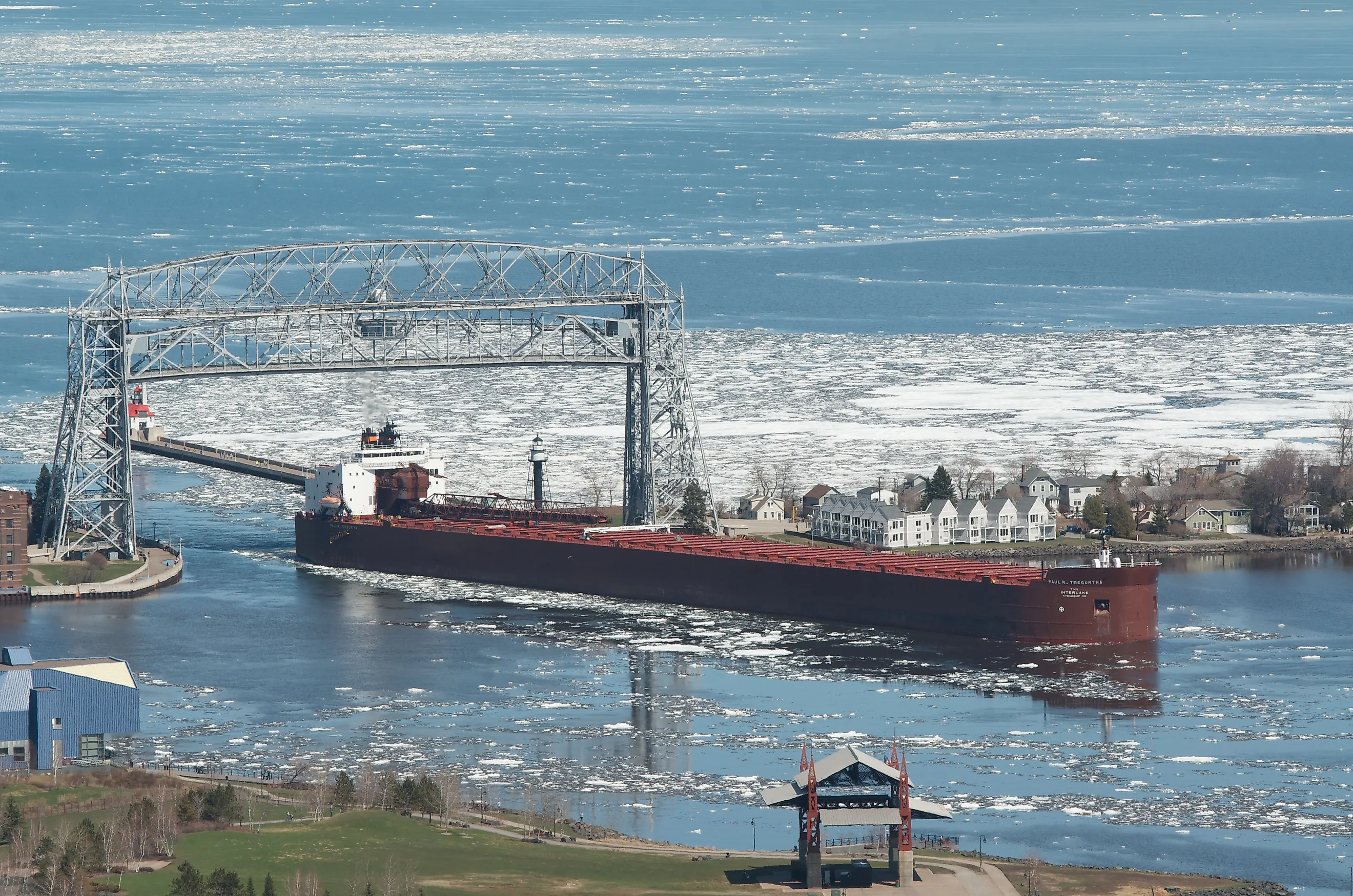
The longest ship on the Great Lakes cannot reach the Atlantic Ocean. The Paul R. Tregurtha runs 1,013.5 feet long, but the locks of the St. Lawrence Seaway are only 740 feet, so the biggest laker is stuck in fresh water for good. Stranger still, the limit cuts the other way. A 656-foot ocean freighter can carry cement out of Turkey and sail inland to Duluth, passing lakers far too big to ever reach the sea themselves.
Built for different water, the two end up looking almost nothing alike. A laker has blunt, straight sides like a powered barge, often with its wheelhouse set right at the bow and a long unloading boom folded down the deck. An ocean ship carries a sharper bow, with the crew quarters above the engines at the stern. The shape of each hull is really a record of the locks and shallow waters it has to work in.
The Locks Set the Ship's Outer Limits

Great Lakes ship design begins with concrete walls. The Poe Lock at Sault Ste. Marie is 1,200 feet long and 110 feet wide, large enough for the 1,000-foot freighters that move iron ore out of Lake Superior. The Paul R. Tregurtha uses 105 feet of that width. When centered, the vessel has only about 2.5 feet of space on either side before allowing for protective fenders and other operating clearances.
The route east is much tighter. The standard Seaway limit is 740 feet long, 78 feet wide, and normally 26 feet 6 inches in draft. Qualifying vessels with an approved Draft Information System can use three additional inches. Salties entering the lakes must remain inside this smaller envelope. The 1,000-foot U.S. lakers were built to use the Poe Lock but are too large for the Welland Canal and the route to the Atlantic. Their operating range covers the four upper Great Lakes and the connecting waterways above the canal. A freshwater freighter can therefore be substantially longer than an ocean ship sailing beside it, yet have no physical path to the sea.
Straight Sides Turn Lock Space Into Cargo Space

Within those fixed dimensions, carrying capacity depends on how much of the hull can be devoted to cargo. Typical lakers have vertical sides and a snub-nosed bow, preserving internal volume close to the ends. The upright sides also preserve width higher in the cargo holds, where sloping walls would reduce usable space. Seen from shore, the hull can look more like a powered barge than a deep-sea vessel. A salty commonly has a sharper bow and a more V-shaped forward hull suited to ocean passages. Lakers still have to withstand Great Lakes storms and seasonal ice. Their hull construction also accounts for contact at locks and docks. The fuller profile follows the economics of a fixed inland corridor. Shallow water and lock dimensions make every foot of the permitted hull valuable.
A Forward Pilothouse for Tight Spaces

That separation left most of the deck between the two structures open for cargo. Multiple hatches could line up with the chutes at ore docks, and the holds were not interrupted by a large central superstructure.
On a typical ocean bulker, the bridge and crew quarters sit above the stern machinery. Modern lakers sometimes do the same, so the forward wheelhouse is a Great Lakes hallmark instead of an absolute rule. It remains common on older vessels developed for close lock approaches and ore docks.
The Unloading Boom Replaces Dockside Machinery

The long steel boom folded above the deck lets many lakers unload without a dockside crane. Gates beneath the cargo holds release taconite pellets, limestone, coal, or salt onto conveyor belts inside the ship. Internal belts carry the material to the pivoting boom, which deposits it at a chosen spot ashore.
This system allows a vessel to serve terminals without large unloading equipment. Interlake reports discharge rates of 6,000 to 10,000 tons per hour for its self-unloaders. The Paul R. Tregurtha uses a 260-foot boom to empty five holds in about eight hours. Ocean bulk carriers can also be self-unloaders, but many visiting salties use deck cranes or rely on terminal machinery. Deck cranes suit ships calling at many kinds of ports. Shipboard conveyors are especially effective on repeated runs between Great Lakes bulk terminals.
A Salty Has to Work in Two Worlds

The 656-foot Federal Biscay shows why an ocean ship in the Great Lakes follows a different design brief. In 2021, it loaded about 21,000 metric tons of cement in Canakkale, Turkey, crossed the Mediterranean and Atlantic, and then traversed the Seaway to Duluth-Superior. A salty making that journey must fit every Seaway lock and remain capable at ports with different cargo systems. Many handysize bulkers carry deck cranes; those without them depend on shore equipment. A sharper bow suits ocean passages, while an aft superstructure leaves cargo holds along most of the deck. The Seaway envelope still fixes the ship's maximum length and beam. A lakebound 1,000-footer can be designed around familiar lock approaches and self-unloading terminals. Its smaller neighbor at Duluth is the vessel equipped for the longer geographic range.
The Mark W. Barker Borrows Ocean-Ship Features

Completed in 2022, the 639-foot Mark W. Barker is a Great Lakes vessel with several features borrowed from ocean ships. It was designed to negotiate the tight bends of Cleveland's Cuyahoga River. Its five large, stackable hatch covers are more commonly found on ocean-going vessels. The cargo hold is square and flat-bottomed, unlike the V-shaped holds that funnel loose material toward conveyor belts on many self-unloaders. The wider opening and flat floor allow it to handle project cargo and material that does not flow easily. Its unloading boom sits forward to work more easily at congested docks.
Older silhouettes remain common because freshwater slows corrosion and Great Lakes vessels can stay in service for decades with maintenance and modernization. Interlake's current fleet includes a ship originally built in 1942 and several launched in the 1950s. Because of that longevity, a World War II-era hull sails in the same fleet as the Mark W. Barker. Forward-pilothouse classics still share the lakes with all-aft 1,000-footers and newer river-class vessels.
What Determines Where a Freighter Can Sail
At Duluth-Superior Harbor, length alone does not reveal where a freighter can go. Passage depends on the locks a hull was designed to use and the terminals it was built to serve. The Mark W. Barker uses a newer arrangement. Ocean-style hatch covers and a square cargo floor widen its cargo options. The forward unloading boom serves Great Lakes docks. Freshwater longevity means older forward-pilothouse vessels still sail alongside that design. Those ships do not share one standard silhouette because they were built for different stages of the same inland trade. Lock dimensions still set the possible hull size, and cargo-handling needs determine the deck above it.