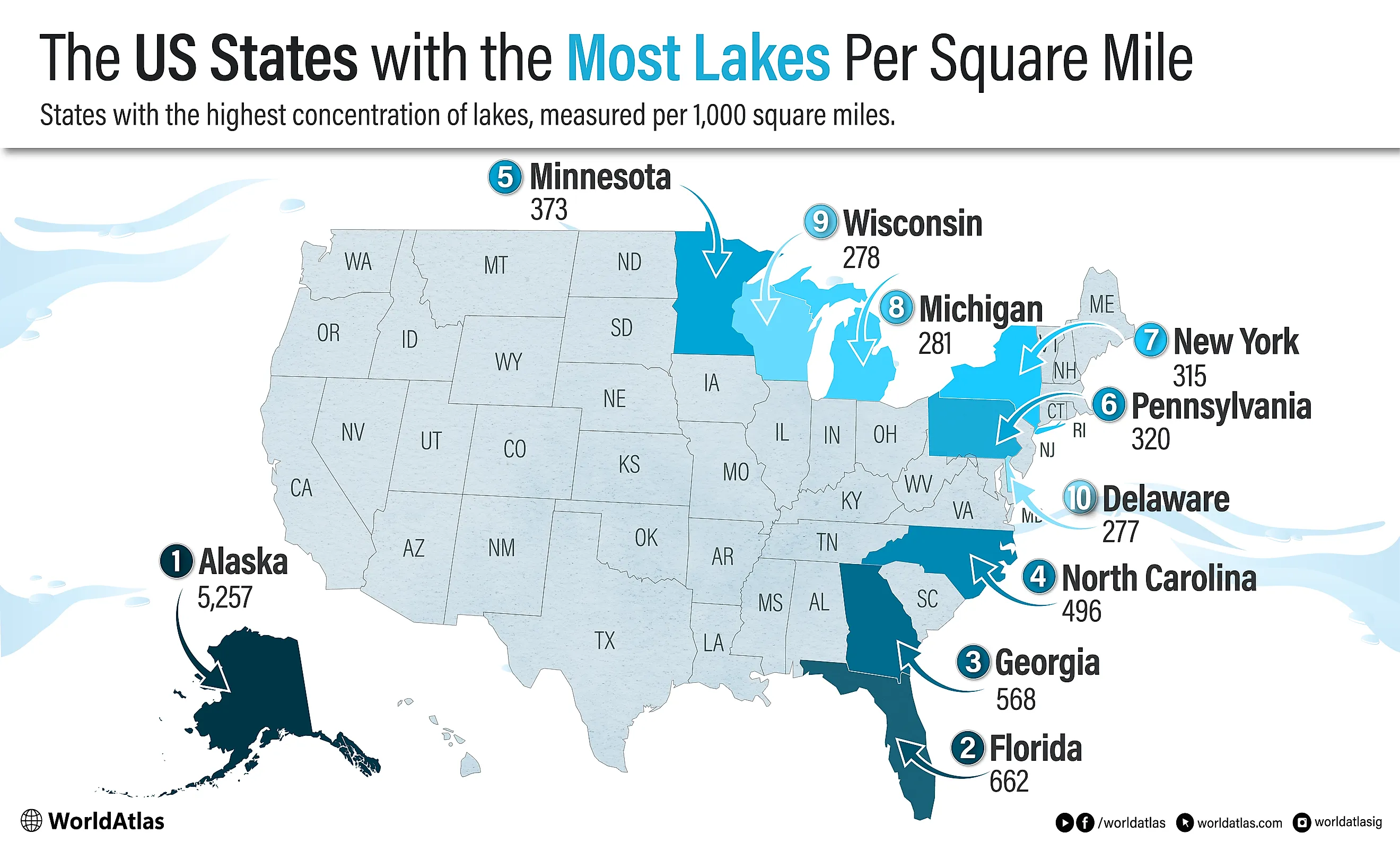
The US States With the Most Lakes Per Square Mile
Minnesota calls itself the Land of 10,000 Lakes, yet the state's own count is 11,842 lakes of at least 10 acres. Wisconsin claims about 15,000, using a smaller size threshold than some national databases. Alaska dwarfs both, with more than 3 million lakes by state and federal estimates. None of these numbers were measured the same way, so "which state has the most lakes" has no answer until you fix the definition. This article sets one: lake density, the number of lakes and reservoirs per 1,000 square miles of land.
The US States With the Most Lakes Per Square Mile
| Rank | State | Lakes/1,000 mi2 (approximate values) |
|---|---|---|
| 1 | Alaska | 5,257 |
| 2 | Florida | 662 |
| 3 | Georgia | 568 |
| 4 | North Carolina | 496 |
| 5 | Minnesota | 373 |
| 6 | Pennsylvania | 320 |
| 7 | New York | 315 |
| 8 | Michigan | 281 |
| 9 | Wisconsin | 278 |
| 10 | Delaware | 277 |
* the ranking above takes into account lakes and reservoirs
1. Alaska - about 5,257 lakes per 1,000 mi2

Alaska stands far above every other state for lake density. Government sources describe it as having more than 3 million lakes larger than 5 acres, along with more than 12,000 rivers. Spread across roughly 570,641 mi2 of land, that works out to about 5,257 lakes per 1,000 mi2.
That figure is not directly comparable to the lower-48 ranking below, which uses a 1-hectare (2.47-acre) threshold rather than Alaska's 5-acre cutoff. Mapped to the smaller cutoff, Alaska's count would be higher still. Either way, its density is so far beyond every other state's that first place is not in doubt.
Many of these lakes are unnamed, remote, and reachable only by floatplane, boat, or long overland travel. They support salmon, trout, grayling, waterfowl, and the subsistence fishing and hunting of rural and Alaska Native communities. Lake Iliamna, the state's largest, stretches some 77 miles across southwest Alaska and feeds the Bristol Bay sockeye runs through the Kvichak River. Nearby Becharof Lake, second-largest in the state, sits inside its own national wildlife refuge on the Alaska Peninsula. Beyond these giants lie countless tundra, glacial, and permafrost lakes across the lowlands, river valleys, and coastal plains.
2. Florida - 662 lakes and reservoirs per 1,000 mi2
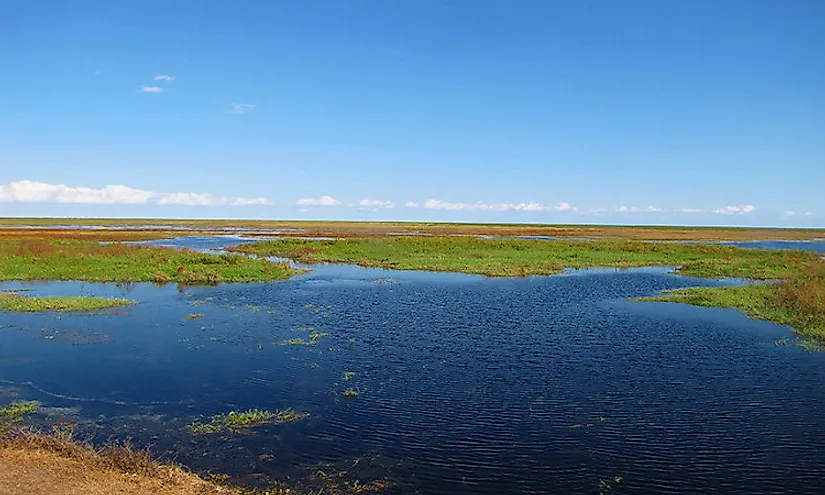
Florida has the highest lake density in the lower 48. LAGOS-US counts 35,508 lakes and reservoirs of at least 1 hectare in the state, which works out to about 662 per 1,000 mi2, ahead of the classic Upper Midwest lake states.
Geology explains most of it. Florida sits on a broad limestone platform, and its karst terrain forms where water dissolves limestone and dolomite over time. The result is a landscape of sinkholes, depressions, springs, and closed basins, many holding water. Reservoirs and managed waters add to the count, especially across central and south Florida.
Lake Okeechobee is the state's most visible inland-water landmark. At about 730 mi2, it is the largest lake in the southeastern United States. But Florida's density comes from thousands of smaller lakes, ponds, sinkhole basins, and reservoirs rather than one big lake. The Kissimmee Chain of Lakes, the St. Johns River basin, and the lake country of central Florida make the state a major freshwater-fishing region, and many of these waters also handle flood control, water supply, and wildlife habitat.
3. Georgia - 568 lakes and reservoirs per 1,000 mi2

Almost every famous body of water in Georgia has a dam at one end. Before the twentieth century the state had few natural lakes, so its biggest waters are the ones engineers built: Lake Lanier northeast of Atlanta, Lake Hartwell and J. Strom Thurmond Lake along the Savannah River on the South Carolina line, and a long roster of power and flood-control impoundments. LAGOS-US counts 32,664 lakes and reservoirs of at least 1 hectare statewide, about 568 per 1,000 mi2, most of them human-made.
Lanier is the one most Georgians picture first. The U.S. Army Corps of Engineers closed Buford Dam on the Chattahoochee in 1956, and the reservoir now supplies drinking water to much of metro Atlanta and draws millions of visitors a year to its marinas and islands. Hartwell and Thurmond, both shared with South Carolina, are larger by surface area; Thurmond, which many Georgians still call Clarks Hill, is the biggest lake touching the state. Smaller Corps and utility reservoirs such as Allatoona and West Point fill in the rest.
What makes Georgia dense is the mid-century push to dam its rivers for power, water, and flood protection. Those projects drowned river valleys and farm towns and left shoreline in their place. North of Atlanta especially, a lake address has become its own kind of suburb, built around boat ramps, fishing tournaments, and pontoon traffic on water that did not exist a lifetime ago.
4. North Carolina - 496 lakes and reservoirs per 1,000 mi2

North Carolina holds two different kinds of lake country, and both feed its density of about 496 lakes and reservoirs per 1,000 mi2 (24,104 in all, by LAGOS-US). In the Piedmont, the Catawba River has been dammed into a staircase of reservoirs: Lake Norman, the largest, sits above Mountain Island Lake and Lake Wylie, with Lake Hickory and Lookout Shoals upstream. The Yadkin-Pee Dee carries its own chain, including High Rock Lake and Badin Lake. On the coastal plain the water is natural: Lake Mattamuskeet, the state's largest natural lake, is a shallow sheet a few feet deep, ringed by the Carolina bays and pocosin wetlands.
Norman is the giant. Duke Power began Cowans Ford Dam in 1959 and brought the hydro station online in 1963, backing the Catawba up into the largest man-made lake in the state. Its shoreline now defines Cornelius, Davidson, Mooresville, and Huntersville, and Visit Lake Norman put the lake's FY2024 economic impact at about $23.7 million. Mattamuskeet, by contrast, draws not boaters but tens of thousands of migrating tundra swans and snow geese to its national wildlife refuge each winter.
Many of North Carolina's lakes are working reservoirs that generate power, hold back floods, and water the fast-growing Piedmont, while the coastal-plain lakes are shallow and bird-rich. Together, they give a state not usually grouped with Minnesota or Michigan a genuinely lake-shaped landscape.
5. Minnesota - 373 lakes and reservoirs per 1,000 mi2

Minnesota is one of America's great lake states, even if it does not lead by density. LAGOS-US counts 29,669 lakes and reservoirs of at least 1 hectare, about 373 per 1,000 mi2. The "Land of 10,000 Lakes" slogan comes from a different state definition: Minnesota officially counts 11,842 lakes of 10 acres or more.
Glaciation did the work. Retreating ice sheets scraped and blocked drainage across the Canadian Shield, the northern forests, and the prairie pothole region, and the depressions filled with meltwater and rain. In northern Minnesota, lakes mean cabins, canoe routes, walleye fishing, and loons in summer; in winter the same lakes become ice-fishing villages of shanties and plowed roads.
Some carry national weight. Lake Itasca, in Minnesota's oldest state park, is the headwaters of the Mississippi River, where you can walk across the young river before it begins its run to the Gulf of Mexico. Mille Lacs Lake, Lake of the Woods, Leech Lake, and Red Lake, the largest lake lying wholly within the state, round out a landscape that also includes the Boundary Waters canoe country on the Canadian border.
6. Pennsylvania - 320 lakes and reservoirs per 1,000 mi2

Few people rank Pennsylvania among the lake states, yet its 14,314 lakes and reservoirs work out to about 320 per 1,000 mi2, ahead of New York, Michigan, and Wisconsin by this measure. Two forces built the map. The last ice sheet left glacial lakes and wetlands across the northern tier, through the Poconos and the Endless Mountains. Twentieth-century engineers added reservoirs, mill ponds, and managed waters across the Appalachian Plateau and the interior valleys.
Lake Erie gives Pennsylvania a Great Lakes shoreline, but the inland waters carry the ranking. Lake Wallenpaupack, the state's signature recreation reservoir, was completed in 1926 with its hydroelectric plant and draws summer crowds into the Poconos. Raystown Lake, the largest lake lying entirely within Pennsylvania, fills a long valley in the south-central counties, while Pymatuning Reservoir straddles the Ohio line to the west. Both pull boaters, anglers, and campers through the warm months.
Pennsylvania's lakes are less about wilderness than about a heavily settled state adapting its rivers and valleys for industry, flood control, drinking water, and recreation. They are less famous than Minnesota's or Michigan's, but by density they are a major part of the state's landscape.
7. New York - 315 lakes and reservoirs per 1,000 mi2

New York follows close behind Pennsylvania, with 14,841 lakes and reservoirs and a density of about 315 per 1,000 mi2. Its lake geography is varied: wilderness ponds and mountain lakes in the Adirondacks, long glacial troughs in the Finger Lakes, reservoirs in the Hudson and Catskill watersheds, and border waters such as Lake Champlain, Lake Erie, and Lake Ontario.
The Adirondack Park is the centerpiece. Created in 1892, it is the largest publicly protected area in the contiguous United States, larger than Yellowstone, Everglades, Glacier, and Grand Canyon National Parks combined. Its forests, lakes, ponds, and rivers make northern New York one of the country's great paddling and lake-cabin regions.
The Finger Lakes give the state a different lake identity. These long, narrow glacial lakes cut through central New York and support boating, swimming, state parks, college towns, and one of the most recognizable wine regions in the eastern United States. Lake George, often called the Queen of American Lakes, carries a classic resort-lake tradition, while Lake Champlain links New York to Vermont and Quebec.
8. Michigan - 281 lakes and reservoirs per 1,000 mi2

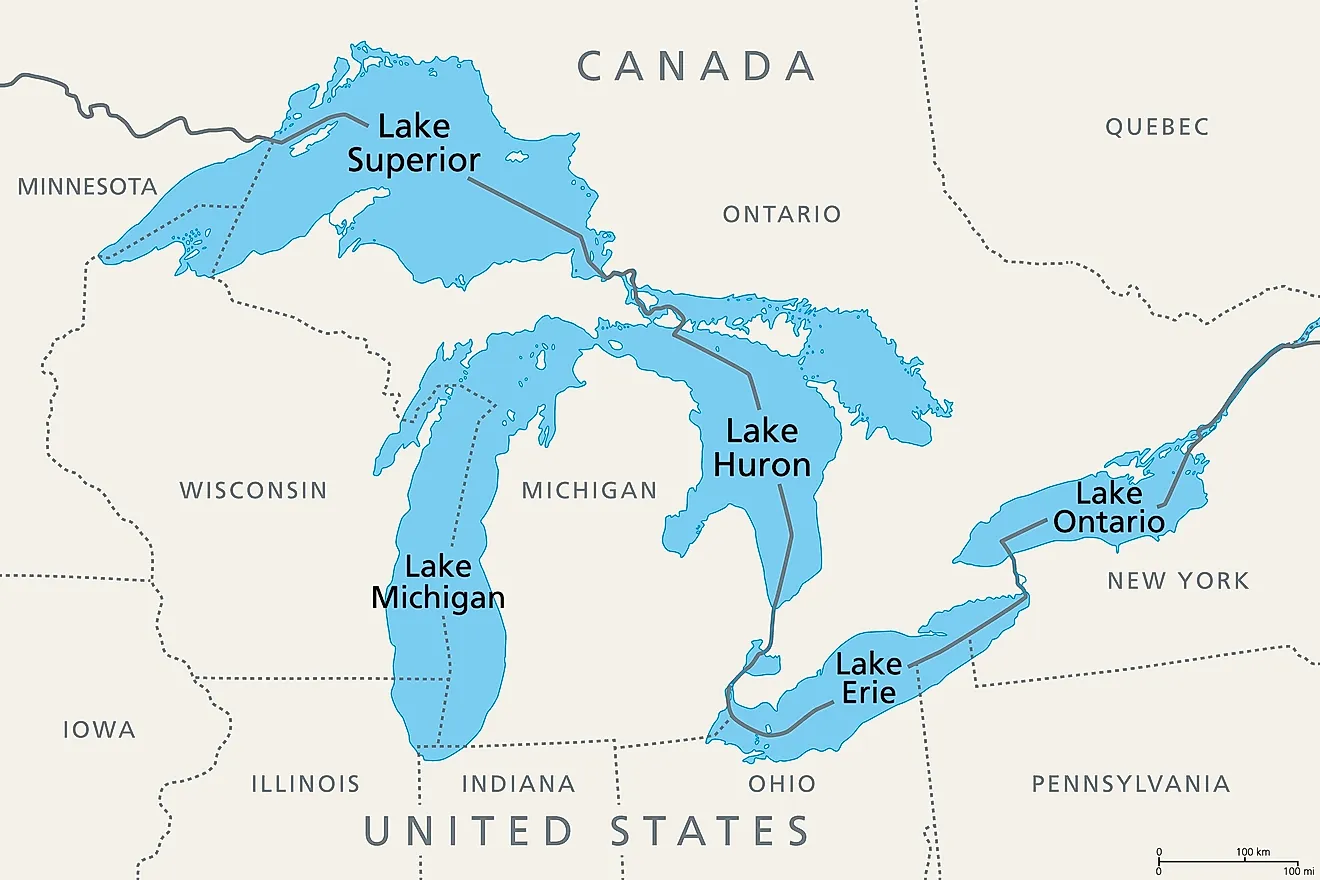
Michigan's identity is inseparable from water, but this ranking counts inland lakes and reservoirs, not the Great Lakes. LAGOS-US counts 15,905 qualifying inland lakes and reservoirs, a density of about 281 per 1,000 mi2. The Great Lakes define the state's outline, but they do not drive this figure.
Glaciation shaped Michigan's inland lakes across both peninsulas. Houghton Lake, at about 20,000 acres the largest inland lake in the state, leads a roster that includes Higgins Lake, Burt Lake, and Mullett Lake. Torch Lake runs more than 280 feet deep and is often singled out as one of the state's clearest waters. With thousands of smaller lakes, these support fishing, boating, cottages, and summer tourism, and the state describes itself as having more than 11,000 inland lakes.
The Inland Waterway, or Inland Route, shows how connected those waters can be. It runs through a chain of lakes and rivers in the northern Lower Peninsula, linking the Conway area near Petoskey with Cheboygan on Lake Huron. The route takes in Crooked Lake, Burt Lake, Mullett Lake, and connecting rivers, giving boaters a protected passage through one of the state's classic summer regions.
9. Wisconsin - about 278 lakes per 1,000 mi2, with a caveat

Wisconsin is one of America's classic lake states, with a familiar statewide count of about 15,000 lakes. Using the commonly cited figure of 15,074 lakes against the state's land area, the density is about 278 per 1,000 mi2. That places it just behind Michigan and just ahead of Delaware, whose 540 lakes and reservoirs yield roughly 277 per 1,000 mi2.
The caveat matters. Wisconsin's 15,000-lake claim uses a threshold of about 2.2 acres, slightly below the 1-hectare (2.47-acre) LAGOS-US cutoff used for the lower-48 comparison. Because Wisconsin and Delaware are separated by only about one lake per 1,000 mi2, the order of ninth and tenth depends on how a lake is defined. Under a strict one-hectare extraction, Wisconsin should be rechecked against LAGOS-US before its rank is treated as final.
Whatever the cutoff, Wisconsin is lake-rich. The densest lake country lies in the glaciated north, around Vilas, Oneida, Iron, and Sawyer counties. Lake Winnebago, Lake Mendota, the Eagle River Chain of Lakes, and the Minocqua area anchor a culture of boating, fishing, water skiing, cabins, supper clubs, and Friday fish fries. In winter, ice-fishing shanties spread across the frozen lakes, and the Ice Age Trail passes kettle lakes and other features left by the last ice sheet.
10. Delaware - about 277 lakes and reservoirs per 1,000 mi2

Delaware rounds out the top ten because density rewards small states. LAGOS-US counts 540 lakes and reservoirs of at least 1 hectare, which across Delaware's small land area equals about 277 per 1,000 mi2, just behind Wisconsin.
Delaware is not usually grouped with the classic lake states, and most of its waters are small ponds, reservoirs, millponds, and managed impoundments. The state sits on the Atlantic Coastal Plain, where low relief, wetlands, slow drainage, and water management have produced many small inland waters. In a large state that count would not stand out; in Delaware it is enough for the national top ten by density.
Lums Pond, in northern Delaware, anchors Lums Pond State Park and is one of the state's best-known inland waters. Farther south, Trap Pond holds bald cypress, wetlands, and paddling routes through swamp habitat. Delaware's lakes are small and closely spaced, serving recreation, wildlife, drainage, and water supply rather than forming any single famous lake.
Delaware also makes the ranking's main point: density is not the same as total lake abundance. Alaska, Florida, Minnesota, and Wisconsin have far larger lake identities, but Delaware's small size means even a modest number of qualifying lakes produces a high per-square-mile figure.
What the Ranking Shows
There is no permanent answer to "Which state has the most lakes?" until the definition of a lake is fixed. Change the size threshold, include or exclude reservoirs, or count only named lakes, and the ranking shifts. Under a density approach, lake country reaches well beyond the Upper Midwest, taking in Florida's limestone basins, Georgia's reservoirs, New York's glacial valleys, Pennsylvania's mountain waters, Delaware's compact coastal-plain ponds, and Alaska's vast, water-filled north. Alaska towers over everything, though its count sits outside the lower-48 LAGOS-US dataset and has to be handled separately. Florida leads the conterminous states on karst terrain, thousands of small basins, and managed waters. Georgia and North Carolina rank high on reservoirs and impoundments. Minnesota, Michigan, and Wisconsin remain the classic glacial lake states, while Pennsylvania and New York show how glaciation, reservoirs, and mountain waters combine into dense inland-water landscapes.