How Much Great Lakes Fishing Is Worth Every Year
Picture the average Great Lakes angler: a person in a boat, holding a rod in one hand and a beverage in the other, staring at the water with the patient optimism of someone who may catch nothing at all. It does not look like high finance. And yet, add up every one of those people across five enormous lakes, and you get one of the biggest outdoor economies in North America, a multi-billion-dollar machine built on the simple act of trying to trick a fish. So exactly how much is Great Lakes fishing worth every year? The answer is a genuinely big number, and getting to it involves a fun little detour through a figure that everyone has been quietly getting wrong for years.
The Big Number: About $5 Billion

Here is the headline. According to the Great Lakes Fishery Commission, the region's commercial, recreational, and tribal fisheries are collectively worth more than $5 billion a year and support over 75,000 jobs. That is billion, with a B, generated by people chasing walleye and salmon around some very large puddles. To put it in perspective, that is a bigger annual haul than plenty of things you would assume are far more serious industries. The fish themselves are, of course, blissfully unaware that they are propping up the economy of an eight-state region and a chunk of Ontario. They are just trying to live their lives, and failing, expensively, on our behalf. And the money is not spread evenly, either. Michigan, the state with the most Great Lakes coastline, pulls in roughly $2.7 billion in economic output from fishing in its Great Lakes waters and tributaries alone, which is to say a single state's fishing habit rivals the entire annual budget of some small countries. When people say the Great Lakes are an economic engine, the fishery is one of the pistons doing the actual work.
Wait, Isn't It $7 Billion?

Now for the detour, because you may have seen a bigger, rounder number floating around: $7 billion. That figure got calculated once, nearly two decades ago, and then everybody just kept repeating it. Politicians used it to justify projects. Agencies quoted it. News outlets printed it. It became the fishing equivalent of an urban legend, cited so confidently and so often that no one thought to check whether it was still true. Then a newer, more rigorous study came along and landed closer to $5 billion, at which point a lot of people had to sheepishly admit they had been using a number that was, in the memorable phrasing of one reporter, way past its sell-by date. The moral: even economic statistics need a use-by date, and $5 billion is still an absolutely enormous pile of money.
The Weekend Warriors, Not the Trawlers

Here is the part that surprises people. When you picture a fishing industry, you probably imagine big commercial boats hauling up nets. But on the Great Lakes today, the real economic muscle is recreational. The 2022 study found that Great Lakes sport fishing alone accounted for about $5.1 billion in total economic output, built on roughly $4.1 billion that anglers actually spent, supporting nearly 36,000 jobs. Commercial fishing, once king, is now a much smaller slice of the pie. In other words, the economic engine of the Great Lakes fishery is not a grizzled captain in a trawler. It is a dentist from Ohio who took a Friday off, and a few hundred thousand of his closest friends doing the exact same thing.
Where All That Money Actually Goes

The magic of fishing economics is that almost none of the money is spent on the fish. It is spent getting to the fish, which is a vastly more expensive proposition. Because here is a fundamental law of the sport: you cannot buy just a fishing rod. It is physically impossible. The rod requires a reel, which requires tackle, which requires a tackle box, which requires a boat, which requires a motor, which requires a truck to tow the boat, which requires gas, which requires a launch fee, a license, a cooler, bait, snacks, and a lakeside motel because you drove three hours to get there. Multiply that cascade of spending by millions of anglers and you understand the multiplier effect. A single yellow perch worth maybe a few dollars at the fish counter can easily be the centerpiece of a $60,000 boat's entire weekend.
The Charter Fleet and the Salmon Machine

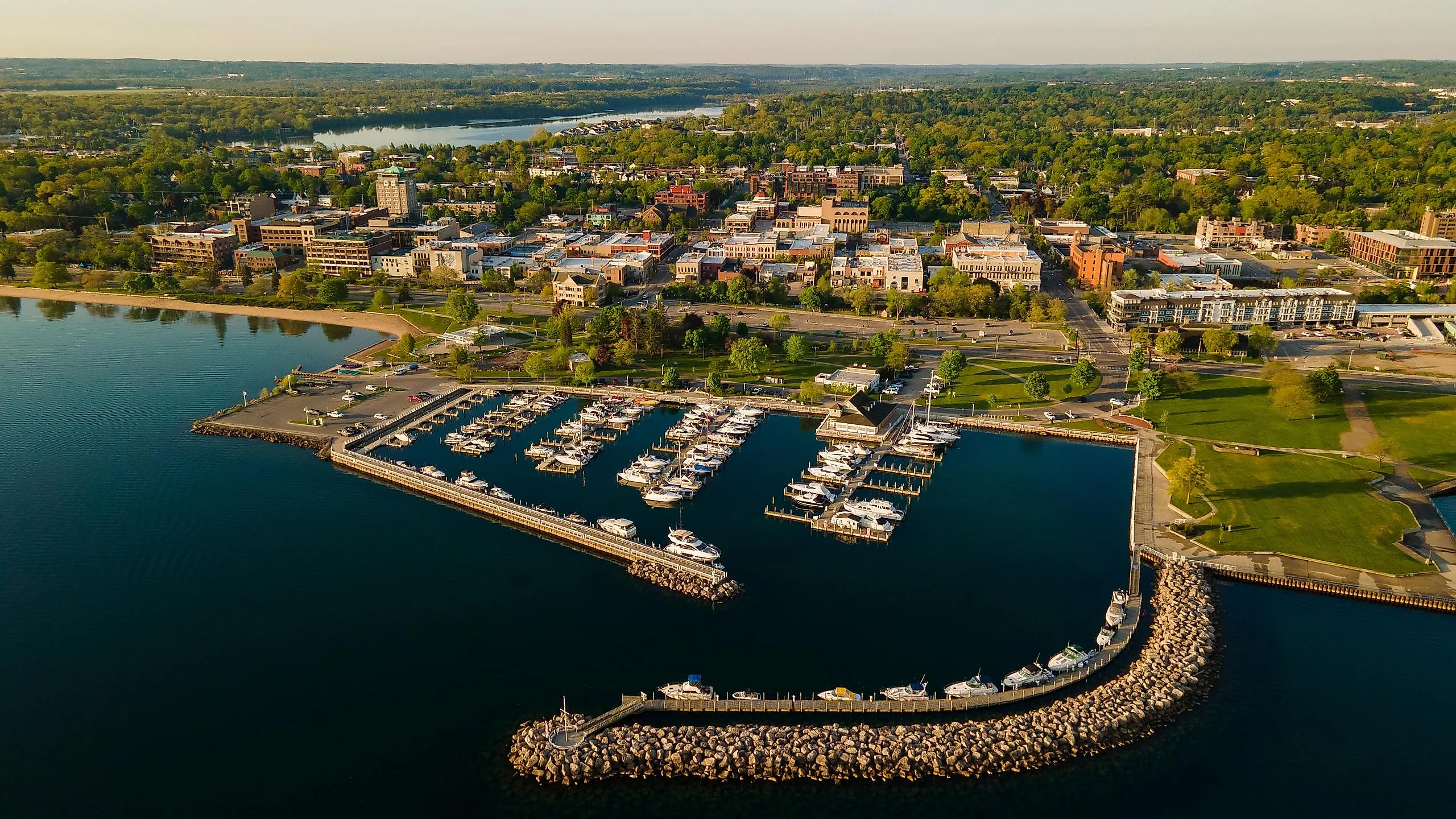
A huge chunk of that spending flows through the charter fleet, the professional captains who, for a fee, will take you out and dramatically improve your odds of not going home empty-handed. Ports like Grand Haven and Port Washington keep some of the largest charter fishing fleets on the lakes, and much of that industry rests on a wonderfully absurd origin story. Back in the 1960s, managers stocked the lakes with Pacific salmon, coho and Chinook, mostly to eat the exploding population of invasive alewives. It worked, and it accidentally created a world-class salmon fishery out of thin air. Today anglers travel from around the globe to chase those transplanted salmon, meaning a good slice of this multi-billion-dollar economy is built on fish that were only invited to the party as pest control.
The Fish That Pay the Bills

Not every fish carries equal economic weight. On the recreational side, the megastars are salmon, trout, muskellunge, and above all the mighty walleye, a fish so beloved and so delicious that entire regional identities are built around frying it. Yellow perch are the unsung workhorses, the fish that quietly keep every Friday fish fry in business. On the commercial side, the foundation species are lake whitefish, walleye, yellow perch, and ciscoes. Notice the overlap: walleye and perch are stars in both columns, which is exactly why Lake Erie, the walleye and perch capital of the whole system, is sometimes called the walleye capital of the world. When those two are biting, cash registers ring from Toledo to Buffalo.
It's Worth Even More Than the Receipts

Now for the genuinely fun part. Economists went and asked anglers how much a fishing trip was actually worth to them, versus how much it cost, and the answer was that people value their trips far above what they pay. Fishermen reported being willing to spend somewhere between $54 and $101 more per trip than they actually did, a gap that adds up to a "surplus value" of around $611 million a year. In plain English, all that fishing generates hundreds of millions of dollars in pure joy that never even shows up on a receipt. It is the rare case where an economist confirms what every angler already knew: the value of a day on the water is not really about the fish at all. Which is fortunate, given how often the fish decline to show up.
Which Is Why We Spend Millions Protecting It

When something is worth $5 billion a year, it is worth defending, and the Great Lakes fishery is under constant assault. The invasive sea lamprey nearly destroyed it once already, so agencies now spend tens of millions of dollars every single year keeping the parasite in check, which is one of the great bargains in government: spend millions, protect billions. On top of that, invasive quagga and zebra mussels keep quietly rewiring the food web, alewife populations boom and crash and drag the salmon along with them, and warming water shuffles the deck further. The fishery is enormous and valuable, but it is not indestructible. Every dollar it generates depends on a lot of unglamorous, behind-the-scenes work to keep the whole thing swimming.
The Takeaway
So the next time you see someone dozing in a lawn chair on a pier, line in the water, apparently doing nothing of any economic consequence whatsoever, know that you are looking at a tiny piece of a $5-billion-a-year colossus. Great Lakes fishing is a genuine economic pillar for an entire region, one built not on some giant industrial operation but on millions of people voluntarily spending real money for the privilege of maybe catching dinner. It is, when you think about it, the most expensive free food in America, and one of the best deals going. The fish may not appreciate the arrangement, but the rest of us clearly do.