The Invasive Plants Taking Over US Lakes
A handful of non-native water plants have reshaped lakes and reservoirs across the United States, blanketing the surface in dense mats, filling the water column with underwater canopies, and crowding out native vegetation until managers spend years and millions of dollars pushing them back. The picture varies by water body. Eurasian watermilfoil can dominate one lake while staying sparse in the next. The scale is still substantial. A 2024 study of 30,375 lakes in the Upper Mississippi River Basin predicted that another 665 were already invaded by or at high risk from Eurasian watermilfoil, and another 771 from curly-leaf pondweed.
Hydrilla (Hydrilla verticillata)

Hydrilla sits at the top of the national list. It is a submerged perennial capable of building thick underwater canopies that reach the surface, shade other vegetation, interfere with boating, and persist through several reproductive mechanisms. A USGS review identified hydrilla alongside Eurasian watermilfoil as the invasive aquatic plants of greatest national concern to aquatic-resource managers.
The problem is active rather than historical. Texas Parks and Wildlife Department's 2026 vegetation-control records include hydrilla treatments at Bonham State Park, Buescher State Park, Inks Lake, Lake Nacogdoches, and Canyon Lake, among other waters. Lake Raven holds hydrilla alongside giant salvinia, water hyacinth, and water lettuce.
Hydrilla also shows why aquatic weeds are so difficult to eradicate. Fragmentation drives vegetative spread, and underground tubers can bring a population back after the visible vegetation has been controlled.
Eurasian Watermilfoil (Myriophyllum spicatum)

Few invasive plants are as closely associated with recreational lakes in the northern United States as Eurasian watermilfoil. Stem fragments can establish new populations, which makes boats and other movement between lakes an important pathway. At high densities, the plant produces floating surface mats that block light from reaching native vegetation and obstruct navigation. Dense populations can also replace more diverse native plant beds with relatively uniform milfoil habitat.
Its geographic reach is substantial, but the scientific caveat matters. Wisconsin DNR records Eurasian watermilfoil in almost every county in the state, yet in fewer than 10% of Wisconsin water bodies, and notes that relatively few invaded lakes currently develop extremely dense populations. The 2024 Upper Mississippi Basin analysis, meanwhile, predicted 665 additional lakes invaded or at high risk.
That gap separates widespread invasion from outright ecological dominance, and milfoil sits between the two.
Giant Salvinia (Salvinia molesta)

Giant salvinia produces some of the most visually dramatic aquatic-plant invasions in the country. This free-floating fern spreads across the water surface instead of rooting in the lakebed. The U.S. Fish and Wildlife Service reports that it can double its biomass in roughly seven to ten days under favorable conditions. Thick mats block sunlight, reduce oxygen beneath them, and can make sections of a lake difficult to use for swimming, paddling, fishing, or boating.
Recent control work in East Texas is strong contemporary evidence. In 2026, approved proposals targeted giant salvinia in B.A. Steinhagen Lake, Caddo Lake, Lake O' the Pines, Sam Rayburn Reservoir, Lake Texana, Martin Creek Reservoir, Lake Nacogdoches, and several other water bodies. The Caddo Lake proposal allowed for chemical treatment across areas of up to 13,000 acres, though TPWD explicitly warns that proposed treatment acreage is not the same as the acreage ultimately treated or infested.
At Lake Raven, giant salvinia became serious enough to prompt an integrated management program combining herbicides and biological control.
Water Hyacinth (Pontederia crassipes)

Water hyacinth is another free-floating species capable of covering the water surface with tightly packed vegetation. Long known as Eichhornia crassipes, it was reclassified into the genus Pontederia in a 2018 revision of the family Pontederiaceae, and many U.S. agencies still list the older name. Native to South America, it lives in lakes as well as ponds, canals, rivers, and other slow-moving waters. California's Division of Boating and Waterways controls it through herbicide treatments, mechanical removal, and hand removal.
Management in Texas shows how extensive the effort can become. The state's 2026 proposals include water-hyacinth control at B.A. Steinhagen Lake, Caddo Lake, Sam Rayburn Reservoir, Lake Texana, Lake Fork, Granger Lake, and other public waters. The approved Caddo Lake proposal covers potential treatment areas extending to thousands of acres.
Dense floating growth matters ecologically because it changes conditions beneath the mat. Less light reaches submerged plants, and oxygen levels can drop as accumulated plant material dies and decomposes. The mats also physically close off shallow water and shoreline access.
Curly-Leaf Pondweed (Potamogeton crispus)

Curly-leaf pondweed behaves differently from many summer-dominant aquatic weeds. Its specialized buds, called turions, let it begin growing early, which gives it a head start before many native plants reach peak growth. It can then form dense surface mats that interfere with recreation and compete for space and light. Minnesota DNR specifically identifies dense mat formation and displacement of native aquatic vegetation among its impacts.
Its regional spread is already extensive enough to stand out in predictive research. The 2024 Upper Mississippi River Basin study estimated that 771 additional lakes among the 30,375 analyzed were either invaded by curly-leaf pondweed or at high risk of invasion. That was the highest predicted number among the five invasive species modeled in the study.
Curly-leaf pondweed also carries an unusual water-quality dimension. Heavy stands can die back during summer, creating a large pulse of decomposing vegetation and recycling nutrients that may worsen water quality under the right conditions.
Water Chestnut (Trapa natans)

Water chestnut is one of the clearest examples of an invasive plant physically transforming the surface of a lake. Long stems rise from the sediment and terminate in floating leaf rosettes. When populations grow dense, those rosettes join into mats that shade native plants, reduce dissolved oxygen as vegetation decomposes, and make boating, kayaking, and swimming difficult. The hard fruits carry sharp barbed spines.
New York DEC records the species in more than 40 New York counties. Lake Champlain has the longest record of any of them. Water chestnut reached the lake in the 1940s, and Vermont authorities have run a harvesting program since the early 1980s. New York later funded mechanical harvesting in the lake's South Bay beginning in 2000.
Control must continue for years because viable seeds can persist in sediments for up to 12 years. That long-lived seed bank is why pulling the visible plants does not end the invasion.
Flowering Rush (Butomus umbellatus)

Flowering rush matters most in the northern Rocky Mountain and Columbia Basin region. It grows along shallow shorelines and can develop extensive stands from a network of underground rhizomes. In Montana, populations reproduce even when sterile, because disturbance breaks rhizomes into fragments capable of producing new plants. Waves, boats, and waterfowl all contribute to that vegetative spread.
Flathead Lake, Montana, is one of the best specific lake examples available. Montana State University Extension estimates roughly 2,000 acres of Flathead Lake infested with flowering rush. The plant is also established in the Upper and Lower Flathead River system, with additional infestations in Noxon and Thompson Falls reservoirs.
Unlike many aquatic weeds, which appear on state lists without a measured footprint, flowering rush has a quantified infestation and an active management program behind it.
Brazilian Waterweed (Egeria densa)

Brazilian waterweed is a submerged South American species sold historically for aquariums and water gardens. Once established, broken pieces generate new plants. Dense growth can clog waterways, crowd native vegetation, reduce fish habitat, and form floating mats that obstruct boats and other recreation.
Washington has several well-documented named examples. Snohomish County reports the species as widespread in neighboring King County, including Lake Washington, Lake Sammamish, and Lake Union. The state classifies it as a noxious weed, and California has also run an aquatic invasive plant program targeting Egeria densa.
Egeria can change a lake without producing an obvious blanket of floating leaves, because much of the biomass develops underwater before stems reach the surface.
Crested Floating-Heart (Nymphoides hydrophylla)

Crested floating-heart, historically reported as Nymphoides cristata, is a relatively newer U.S. invader that has already shown a capacity for rapid lake-scale expansion. A recent U.S. Fish and Wildlife Service ecological risk assessment rates the species High Risk. It was detected in Lake Marion, South Carolina, in 2006, and by 2009 roughly 2,000 surface acres were reported infested. It later became established in nearby Lake Moultrie and elsewhere in the Southeast.
The plant forms rooted colonies with floating leaves that interfere with navigation, recreation, and water management. Currents and recreational equipment move the fragments between sites. Its U.S. distribution now includes several southeastern states.
The threat is current. Texas's 2026 vegetation-management records include an approved proposal targeting crested floating-heart in Lake Conroe.
European Frog-Bit (Hydrocharis morsus-ranae)

European frog-bit is an increasingly important floating invader around the Great Lakes. Native to Europe, Asia, and Africa, it has spread into Michigan, New York, Ohio, Pennsylvania, Vermont, and Washington. Michigan records it widely along coastal portions of Lake Erie and Lake Huron, extending into the eastern Upper Peninsula, with additional populations in inland lakes and ponds.
Its small floating leaves can accumulate into continuous mats in protected bays, backwaters, and other quiet water. Michigan authorities warn that those mats obstruct boats, alter fish and waterfowl habitat, and reduce oxygen and light within the water column.
Its Great Lakes distribution is still expanding, which sets it apart from long-established invaders such as Eurasian watermilfoil.
Alligatorweed (Alternanthera philoxeroides)

Alligatorweed is a South American perennial that grows both in water and on wet land. In aquatic settings it creates intertwined floating mats. Federal invasive-species sources identify crowding of native plants and obstruction of boating, swimming, and fishing as its major impacts. The species was first reported in the United States in Alabama in the late nineteenth century.
It remains an active management problem in southern reservoirs. Texas's 2026 control proposals include alligatorweed in B.A. Steinhagen Lake and Sam Rayburn Reservoir, where management can combine herbicides with alligatorweed flea beetles used as biological-control agents.
Alligatorweed is one of the few cases where managers can turn a plant's natural enemies against it rather than relying on herbicide alone.
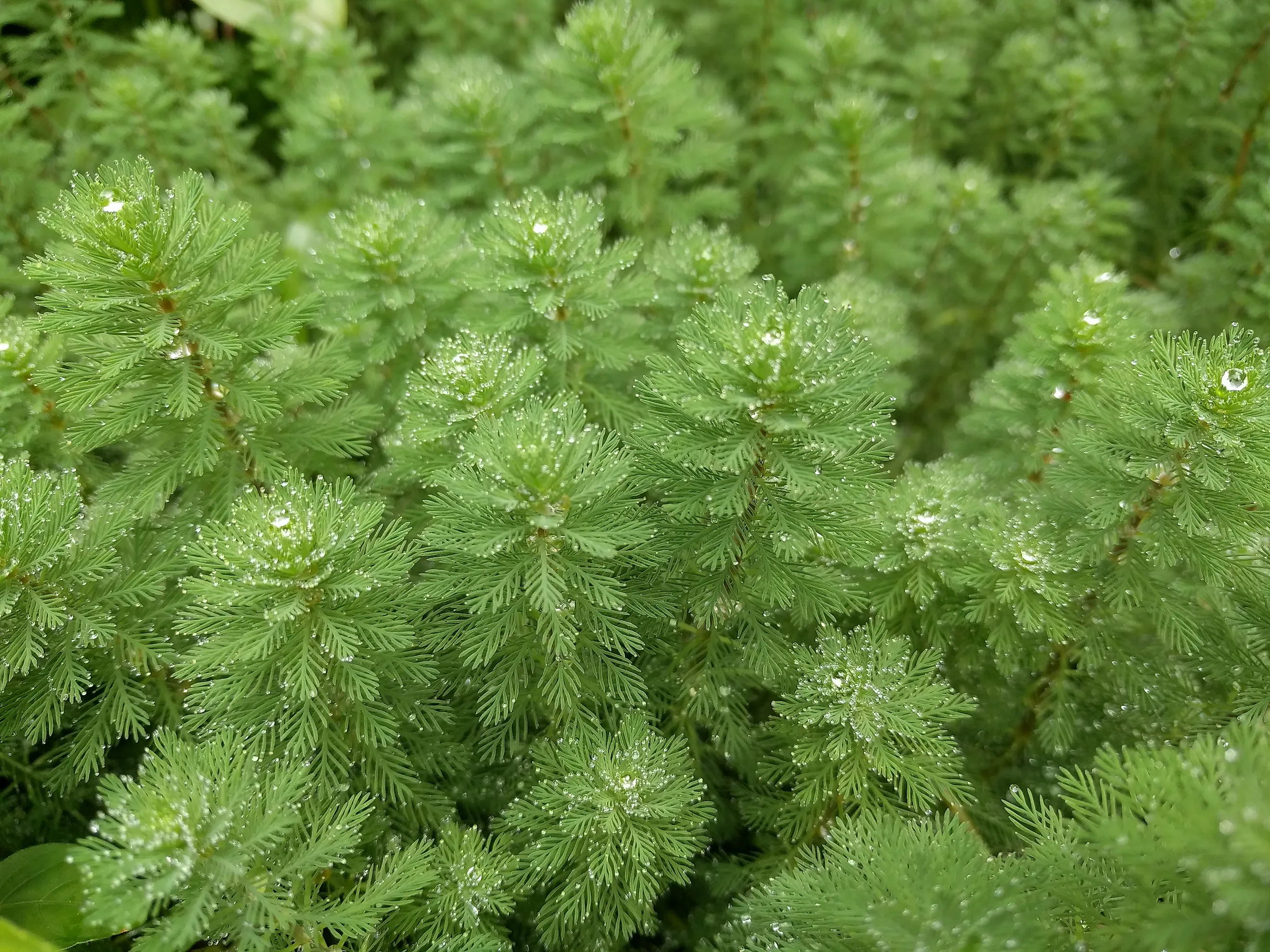
Parrotfeather (Myriophyllum aquaticum)

Parrotfeather is a serious regional invader, though its U.S. lake footprint is smaller than that of hydrilla or Eurasian watermilfoil. Washington's Invasive Species Council states that the species can take over shallow lakes by rapidly producing dense mats. It is established across western Washington and has been documented to a more limited extent in the eastern part of the state.
The resulting vegetation can cover the surface completely, obstruct recreation, alter water quality, impede fish passage, and provide habitat for mosquito larvae. Fragmentation is again critical, since pieces adhering to boats can regenerate after reaching another water body.
The result is high impact within a limited range, rather than the nationwide reach of hydrilla or Eurasian watermilfoil.
The Takeaway
The plants on this list share a few mechanical traits that explain their staying power. Most spread from fragments, so a single boat trailer or bird can start a new population miles away. Several build seed banks or tubers that outlast the visible vegetation by years, which is why control programs run for a decade or more rather than a single season. Managers at agencies like Texas Parks and Wildlife and Minnesota DNR repeat treatments on the same waters year after year, and the 2026 Texas records show many of these species turning up together in lakes such as Caddo Lake and B.A. Steinhagen Lake.