The US Lakes With The Highest PFAS Levels
Health regulators start worrying about PFAS (persistent "forever chemicals") in drinking water at a few nanograms per liter. One quiet lake in northern Maine returned almost 79,000. That 2024 reading came from Malabeam Lake, downhill from the shuttered Loring Air Force Base, and the rest of this list follows the same trail. Onondaga Lake carries the legacy of a century of industry outside Syracuse. Bde Maka Ska sits in the middle of Minneapolis, and the readings at Lake Mead spike where the Las Vegas Wash pours in treated wastewater. The figures come from government monitoring and peer-reviewed research, where one nanogram per liter equals about one part per trillion, roughly a single drop in an Olympic swimming pool. A reading taken at one shoreline can run far higher than the water a mile out, so each entry carries the context behind its number.
Malabeam Lake, Maine

Malabeam Lake sits near the former Loring Air Force Base in northern Maine, where a 2024 study found an exceptional concentration of PFAS in surface water. Laboratory analysis measured 78,840.91 nanograms per liter of PFOA and 47,920.45 ng/L of PFHxS. PFOS reached another 1,379.55 ng/L. The six quantified PFAS added up to 129,222.73 ng/L.
Loring operated as a military installation for decades before closing in 1994, and the property later became an EPA Superfund site. Firefighting foam has been investigated as one source of PFAS around former military bases, and researchers noted extensive PFAS contamination previously identified in soils around Loring. The Malabeam result came from a specific surface-water sampling location, so it cannot be treated as an average for every corner of the lake. Even within that narrow definition, its PFOA concentration dwarfs the figures reported from the other lakes here.
Onondaga Lake, New York

Onondaga Lake has a long industrial history beside Syracuse, and PFOS appeared there at concentrations rarely documented in American lake water. A New York study analyzed three samples and found 198, 981, and 1,090 nanograms per liter of PFOS. The median was 756 ng/L. PFOA ranged from 39 to 64 ng/L in the same samples. Those figures were later compiled by the Agency for Toxic Substances and Disease Registry and reviewed by EPA. They also stood apart from measurements elsewhere in New York. PFOS in the Finger Lakes reached only 1.3 to 2.6 ng/L in that study, while Lake Champlain ranged from 0.8 to 7.7 ng/L. Onondaga was already a federal Superfund site after generations of chemical and municipal pollution, and researchers associated its unusually high PFOS concentrations with industries around the lake. The 1,090 ng/L result remains one of the highest published PFOS measurements for a named US lake.
Van Etten Lake, Michigan

Van Etten Lake borders the former Wurtsmith Air Force Base near Oscoda, another military property where firefighting foam became central to a major PFAS investigation. Surface-water testing in December 2018 found as much as 531 nanograms per liter of PFHxS, 497 ng/L of PFOS, and 131 ng/L of PFOA. One sample contained 1,855 ng/L when the measured PFAS compounds were added together.
Results elsewhere around the lake varied sharply. Additional samples collected during the same December survey had total PFAS concentrations between 314 and 574 ng/L. Michigan agencies have since continued sampling surface water, groundwater, foam, fish, and other environmental media around Wurtsmith.
More recent lake-water measurements have been lower at several monitored locations. That longer record makes Van Etten unusual among PFAS hotspots because the historic peaks can be followed through years of investigation and cleanup work. The lake remains closely tied to one of Michigan's most extensive military PFAS cases.
Lake Mead, Nevada and Arizona
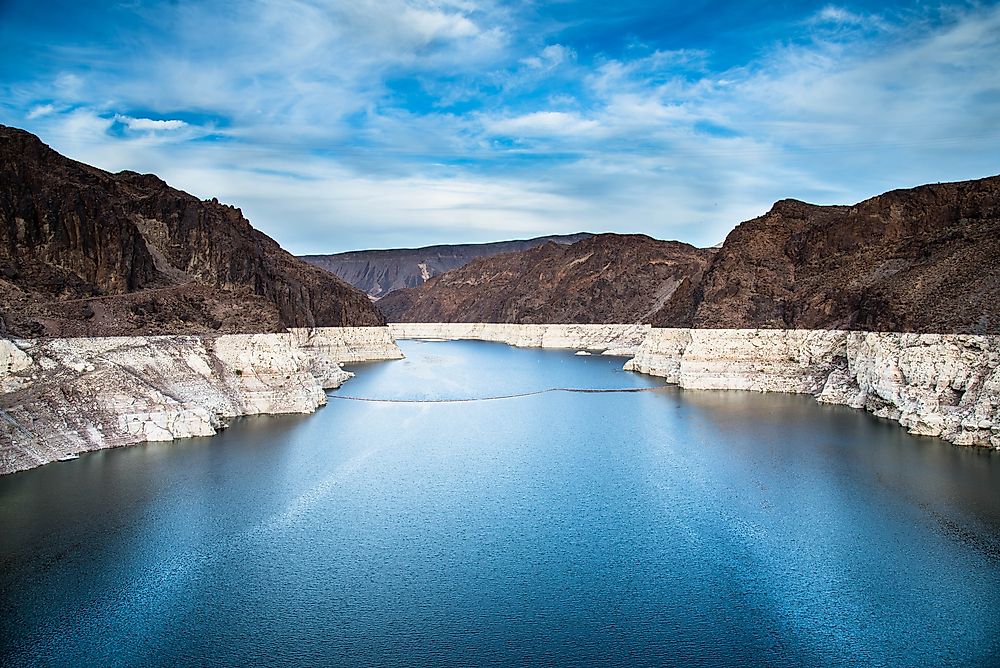
Lake Mead's highest published figure comes from Las Vegas Bay, where the Las Vegas Wash empties into the reservoir. Researchers sampling Nevada watersheds measured 271.9 nanograms per liter of total PFAS there during winter. When they returned in summer, the concentration at the same downstream site was 14.8 ng/L. Farther into Lake Mead, water from the Lake Mead Marina contained just 3.8 ng/L. The enormous winter-to-summer difference makes the location of the sample as interesting as the headline figure. Upstream, Las Vegas Wash receives treated wastewater from the metropolitan area, and the study found its highest PFAS concentration immediately below a wastewater treatment plant. By the time that water reached the marina, dilution and movement through the system had reduced the measured concentration dramatically. The 271.9 ng/L result therefore belongs specifically to Las Vegas Bay at the wash's entrance into Lake Mead, a well-defined pollution pathway inside one of America's largest reservoirs.
Lake St. Clair, Michigan

A shoreline sample turned Lake St. Clair into another important Michigan PFAS case in August 2017. Testing at the Selfridge Public Boat Launch found 180 nanograms per liter of PFOS near Selfridge Air National Guard Base. Michigan's later investigation recorded 211.2 ng/L of total measured PFAS at that station. Heavy rainfall had occurred before the sampling, and the boat launch sits near drainage entering the lake.
The rest of the survey looked very different. When officials sampled the boat launch again in February 2018, total PFAS fell to 6.1 ng/L. November 2017 stations at St. Clair Shores, Metropark, Cottrell Road, New Baltimore, and the Selfridge area generally contained about 8 to 16 ng/L total PFAS. Lake St. Clair therefore contributes one of the clearest examples in the dataset of a concentrated shoreline pulse surrounded by much lower open-water measurements.
Lake Ontario

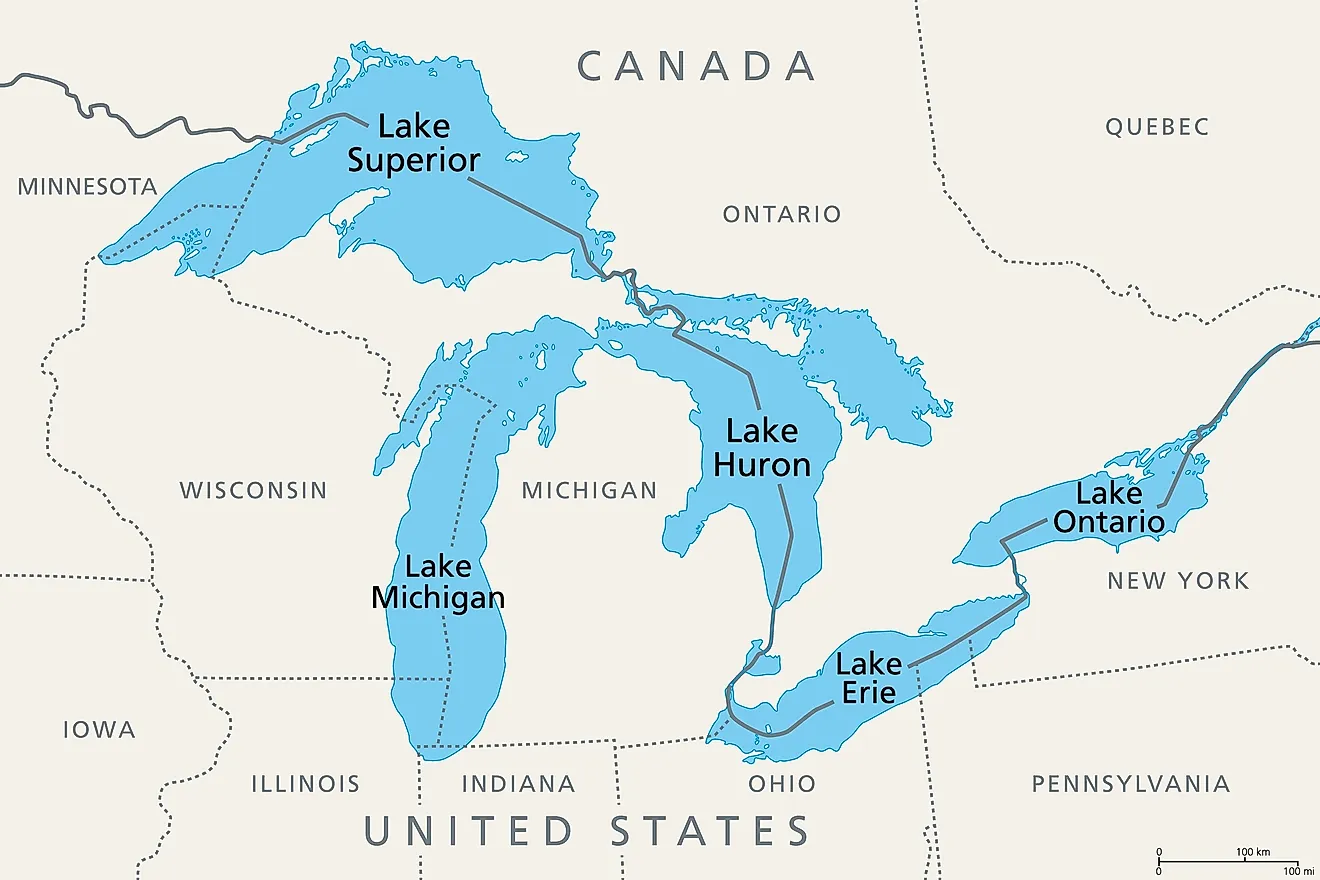
Eight Lake Ontario samples collected during early Great Lakes research in 2003 contained PFOS concentrations between 6 and 121 nanograms per liter. PFOA ranged from 15 to 70 ng/L. ATSDR later incorporated those measurements into its national toxicological profile for perfluoroalkyl compounds, preserving one of the earliest snapshots of PFAS in the Great Lakes.
Later research has sampled the system on a much broader scale. A 2021 to 2023 investigation analyzed dozens of locations across all five Great Lakes and found far smaller typical concentrations than the old Lake Ontario maximum. Lake Ontario still recorded the highest median total PFAS concentration among the five, at about 11 ng/L.
That history gives the lake two useful datasets separated by roughly twenty years. The 121 ng/L PFOS measurement captures an early high point at an individual station, while the newer survey describes conditions across a much wider section of the lake.
Bde Maka Ska, Minnesota

Bde Maka Ska sits among the neighborhoods of Minneapolis, and its PFAS record can be followed through more than a decade of surface-water measurements. Mean PFOS reached 108 nanograms per liter in 2006, according to data reported by the Minneapolis Park and Recreation Board from Minnesota Pollution Control Agency records. PFOA averaged 19.77 ng/L that year. PFOS then fell to 53 ng/L in 2007, 35.3 ng/L in 2013, 24.3 ng/L in 2016, and 12 ng/L in 2018. Minnesota's investigation eventually traced PFOS moving through the local stormwater system to a chrome-plating facility in nearby St. Louis Park that had used the chemical. The facility stopped using PFOS in 2010 and undertook measures to prevent PFAS from leaving the property. Minnesota continues to monitor the lake, which remains on the state's impaired-waters list because of PFOS accumulated in fish.
Lake Elmo, Minnesota

Lake Elmo lies east of St. Paul inside Minnesota's heavily studied East Metro PFAS area. Water data used by the Minnesota Pollution Control Agency to develop human-health criteria included a 2020 PFOA concentration of 83.5 nanograms per liter for Lake Elmo. Another paired dataset used a water concentration of 76.3 ng/L. The agency has since established site-specific PFAS water-quality criteria for Lake Elmo and connected waters.
The surrounding area has a complicated contamination history. Minnesota officials identify the 3M Oakdale disposal site and Washington County Landfill among known PFAS sources near parts of Lake Elmo, while extensive sampling has also found affected groundwater across the East Metro. That regional investigation has involved private wells, municipal water, lakes, streams, and fish. Lake Elmo's 2020 PFOA measurement places the lake well above the concentrations typically reported from remote surface waters and adds a different source story to a list otherwise dominated by military installations.
Lake Erie

Early Great Lakes sampling found PFOA concentrations between 21 and 47 nanograms per liter in eight Lake Erie water samples collected in 2003. PFOS ranged from 11 to 39 ng/L. Those results came from the same research program that recorded Lake Ontario's 121 ng/L PFOS maximum and were later compiled by ATSDR. A modern Great Lakes survey paints a broader picture. Samples collected between 2021 and 2023 gave Lake Erie a median total PFAS concentration of about 7.3 ng/L, placing it below Lake Ontario and Lake Michigan in that study. Lake Erie receives water from a vast urban and industrial watershed that includes Detroit, Cleveland, Toledo, Buffalo, and numerous river systems, so individual sampling locations can capture very different influences. The historic 47 ng/L PFOA measurement remains among the higher open-water lake values in the published record, while recent monitoring puts typical concentrations much lower.
Lake Champlain, New York and Vermont
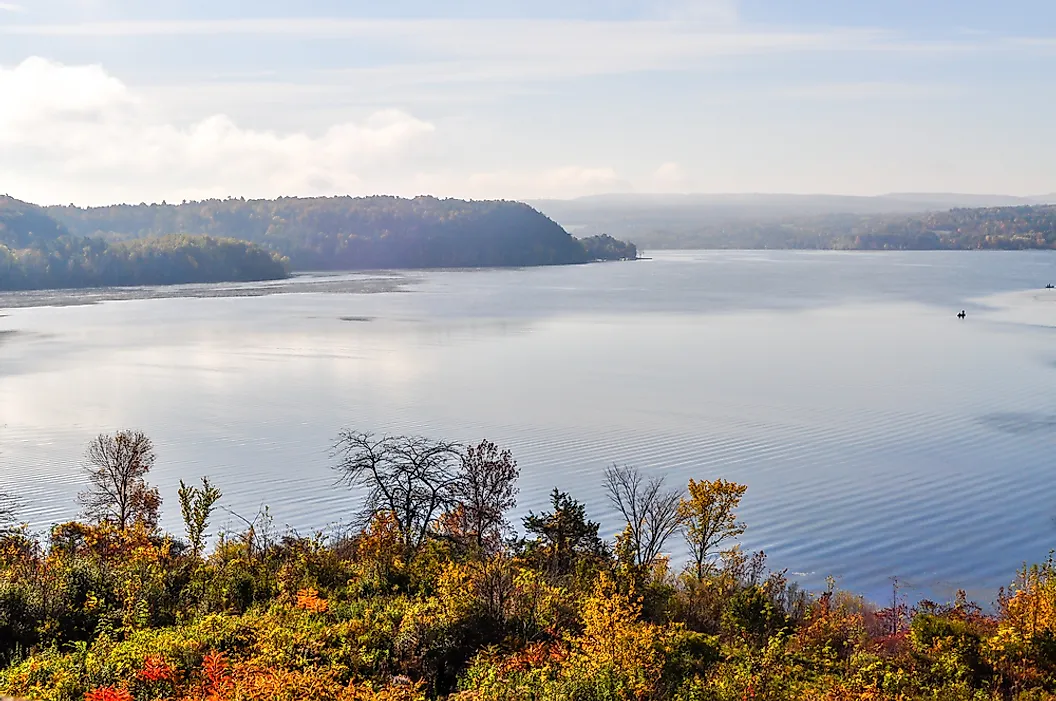
Lake Champlain rounds out the group with a PFOA maximum of 46 nanograms per liter in New York State surface-water research. Four samples contained 10 to 46 ng/L of PFOA, while PFOS ranged from only 0.8 to 7.7 ng/L. The contrast between the two compounds is especially pronounced when Champlain is compared with Onondaga Lake, where PFOS exceeded 1,000 ng/L in the same wider New York investigation.
The lake stretches between New York and Vermont and drains a large watershed reaching into Quebec. Its inclusion comes from the published PFOA measurement rather than a broad lake-wide PFAS crisis. The four samples are also a reminder of how uneven the national evidence remains. Some famous lakes have years of monitoring, while others appear in one research campaign that tested only a small number of sites. For Lake Champlain, that early dataset still supplies a documented PFOA result comparable to Lake Erie's 47 ng/L historical maximum.