The US Lakes Where Swans Have Taken Over
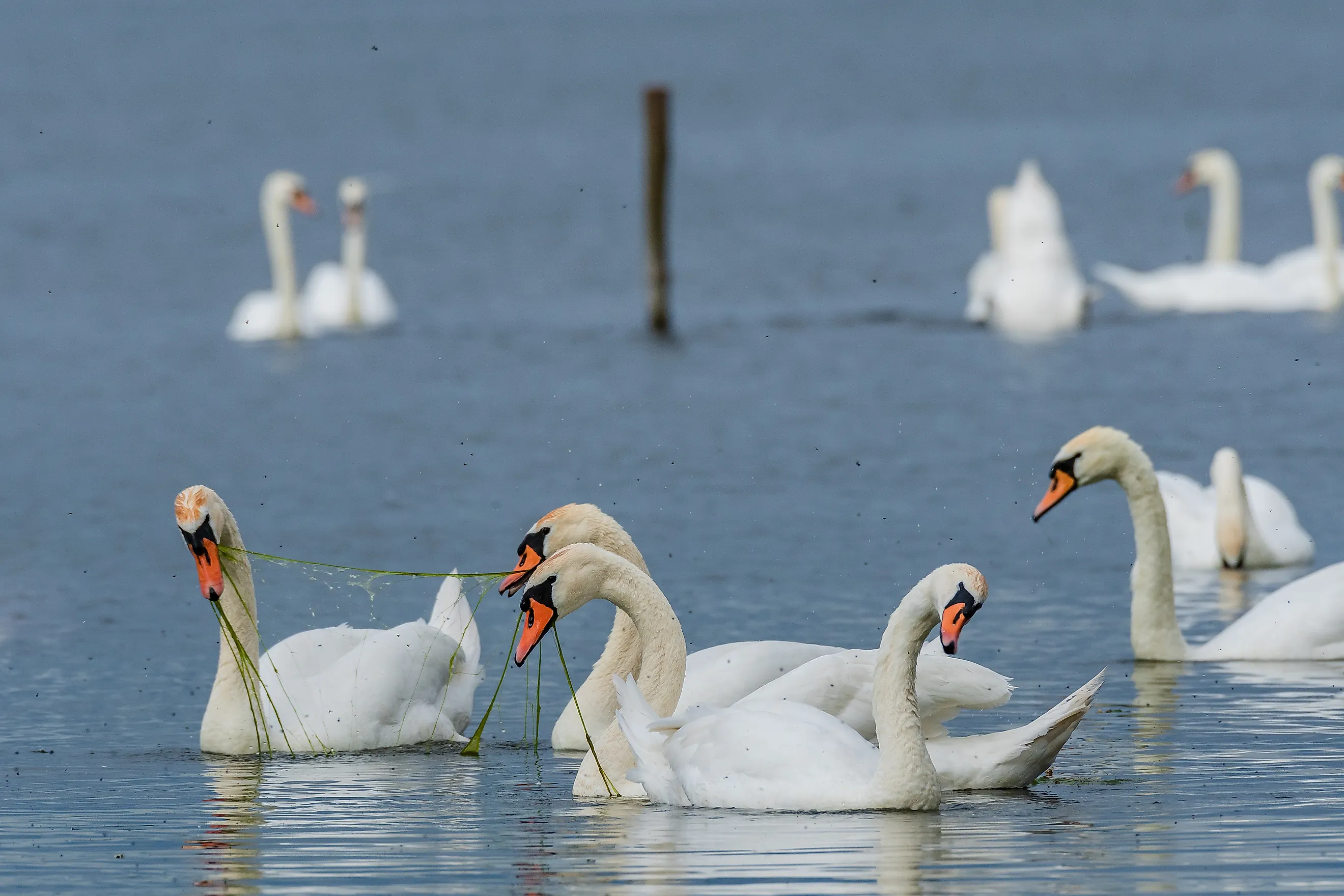
A single mute swan can strip four to eight pounds of underwater plants from a lake bed in a day. The huge white birds look almost too elegant to cause trouble, but across the Great Lakes their numbers have climbed far past the ornamental flocks that first escaped into the wild. Feeding swans uproot the vegetation that the native fish and waterbirds depend on. On the eight waters below, that takeover shows up not as a few stray sightings but as documented breeding, large survey counts, and years of active control.
Lake Ontario, New York

Few places show the climb in hard numbers as plainly as the New York shore of Lake Ontario. Crews with the state Department of Environmental Conservation counted 234 mute swans there in the 2017 midsummer survey, 341 in 2019, and 533 in 2021. The 2023 count eased to 428, though that still included 286 adults and 142 cygnets. DEC has described the Lake Ontario population as one that took hold quickly, and the survey line explains the worry: in just four years, the shoreline count more than doubled before the recent dip.
Feeding swans spend much of the day reaching into shallow water for submerged plants. DEC records show them pulling vegetation from water as deep as about four feet, and in dense flocks they strip the same plant beds that fish and native waterfowl depend on. New York now lists the mute swan as a prohibited invasive species. The birds here are no longer the odd individual drifting past a beach or marina; this stretch of shoreline has become one of the state's main expansion zones.
Western Lake Erie, Ohio

During Ohio's aerial waterfowl survey on December 17, 2024, observers counted 4,867 mute swans at Ottawa National Wildlife Refuge, and none at any other site on that day's sheet. That put the entire tally inside Ottawa's Lake Erie marshes, a refuge of roughly 6,900 acres of wetland, grassland, and woods along one of the busiest waterbird corridors on the Great Lakes.
The crowding carries ecological consequences. Ohio's swan management plan records repeated competition between mute swans and native trumpeter swans across the Lake Erie marshes. State crews eventually began removing mute swans from public wildlife areas to ease the pressure on native birds and wetland plants. A handful of white birds on open water looks calm enough. Nearly 5,000 packed into one marsh complex is a very different picture.
Muskegon Lake, Michigan

One of Michigan's most vivid recent snapshots of the boom came off Muskegon Lake in February 2023. Gale-force winds pushed the local flock together near the mouth of the North Branch of the Muskegon River, where it enters the lake. A briefing prepared for the Muskegon City Commission put that single gathering at 150 to 200 mute swans. That many birds on the winter water was hard to miss, and harder for the city to set aside.
Muskegon did more than watch. The city signed on to a five-year management and control program covering 2023 through 2028. The plan allows work on nests and eggs and the removal of birds where Michigan Department of Natural Resources policy permits it. City documents name the destruction of native plants and competition for food and nesting space among the reasons.
The flock also sits inside a much larger Michigan pattern. The statewide mute-swan population reached an estimated 17,520 in 2013, according to research on Great Lakes populations. Intensive control has since cut that figure well down, but Michigan remains one of the species' North American strongholds. On Muskegon Lake, that statewide total turns concrete: a flock hundreds strong beside a working urban waterfront.
White Lake, Michigan

Whitehall, on the eastern shore of White Lake, had already run an annual mute-swan cull for more than a decade by the time neighboring Muskegon weighed its own expanded program in 2023. A Muskegon-area management briefing judged those efforts only minimally effective, because birds from the wider watershed kept moving back into the lake.
That is what makes White Lake such a revealing case. Removing swans from one body of water did not stop replacements from arriving through the surrounding network of wetlands and lakes. Michigan's wildlife managers classify the mute swan as an established invasive species and permit control of adults, nests, and eggs. White Lake has no spectacular one-day tally like Lake Erie's, but the record of repeated intervention is just as telling. The population held on long enough that swan control became a standing job rather than a one-time response.
Lake Michigan, Michigan

On Lake Michigan, the longest-rooted mute swans are the ones around Grand Traverse Bay, where the birds have nested for generations. University of Michigan records identify the Traverse Bay area as one of the Lower Peninsula's historic breeding centers. The local population started with introduced birds in the early 20th century and spread through northwestern Lower Michigan from there. By 1981, the statewide count had reached an estimated 1,440 mute swans, with much of the northern population wintering around Grand Traverse Bay.
Michigan's numbers later climbed steeply. Great Lakes researchers estimated 17,520 mute swans statewide in 2013 before heavier control brought the population down to roughly 8,133 by 2019. The same research documents why managers act: mute swans feeding in Great Lakes coastal wetlands can clear out submerged vegetation and shut native wildlife out of feeding and breeding habitat. Grand Traverse Bay is more than a scenic spot where swans gather against one of the country's biggest lakes. It is part of the ground where Michigan's century-old feral population first took hold.
Houghton Lake, Michigan

The University of Michigan's distribution records name Houghton Lake specifically, which is more than most inland lakes get. Biologists have long described the species as a locally common breeder in parts of Michigan's Lower Peninsula, Houghton Lake and the Traverse Bay region in particular. That marks the lake as an established breeding center rather than a spot with a handful of stray sightings.
The birds took hold in Michigan in the early 20th century and stayed relatively limited for decades before their numbers accelerated, reaching an estimated 17,520 statewide by 2013. Michigan still classifies mute swans as established invasive birds and permits their control on lakes and wetlands under license.
No recent lakewide count pins a current total to Houghton Lake the way New York's surveys do for Lake Ontario. Its standing rests on longevity instead. Michigan's largest inland lake became one of the state's recognized breeding strongholds while the mute-swan population was still climbing.
Platte Lake, Michigan

The Platte Lake Improvement Association has been unusually blunt about its swans. In its published materials, the group describes a significant swan population on the lake and names the non-native mute swan as the predominant species for most of the year, with native trumpeter swans showing up mainly as seasonal visitors. Few inland lakes come with such a plain local statement about which swan holds the water.
The concern goes past which bird is easiest to photograph. Great Lakes research has shown that mute swans can clear submerged aquatic vegetation and push native wildlife off important habitat, and local guidance around Platte Lake has warned people to keep their distance, especially near nesting territories. No recent government census assigns a hard number to the lake's swans, but the local evidence is unusually strong: an organization devoted to monitoring Platte Lake calls the population significant and names the mute swan as the species residents are most likely to meet through much of the year.
Geist Reservoir, Indiana

South of Michigan, the clearest official backing comes from Indiana. The state's Department of Natural Resources says mute swans have established themselves in high numbers on many waters across the state and points to the area around Geist Reservoir as a place the birds turn up year-round. The agency calls the mute swan Indiana's most abundant swan. A full-grown bird can put away large amounts of aquatic and wetland vegetation in a day and uproots still more as it feeds. Those plants steady shorelines, shelter fish, and support the small animals other wildlife eat, which is why Indiana lets lake associations and managers apply for permits to control the population. Geist has no published flock count to rival western Lake Erie's survey totals, but Indiana's own wildlife agency identifies the reservoir as a place where mute swans stay common the year round, which is evidence enough.
The Common Thread
The evidence looks different on each of these waters. On Lake Ontario and western Lake Erie, the case is in the survey numbers: a steady shoreline climb in one, a single marsh holding nearly 5,000 birds in the other. On Muskegon and White lakes, it is in years of management paperwork. On Grand Traverse Bay and Houghton Lake, it is in a feral population more than a century old. On Platte Lake and Geist Reservoir, it is in the plain testimony of the people who watch the water closest. Running through all of them is the same problem wildlife managers keep naming: a beautiful bird, brought over for looks, that feeds hard on the plants native fish and waterfowl need and crowds out the trumpeter swans slowly working their way back. Michigan's stated goal of fewer than 2,000 mute swans statewide by 2030 is a measure of how far the balance has tipped.