The Pink Lakes of the World and Why They Are Pink
A handful of lakes around the world glow bright pink instead of blue. That color comes from life thriving in extreme salt. Microbes called Dunaliella salina and Salinibacter ruber flood hypersaline water with red pigment. The pigment pushes whole lakes toward rose bubblegum and deep crimson. Lake Hillier and Hutt Lagoon in Australia rank among the brightest on Earth. Senegal's Lake Retba grew so saturated that divers once raked pink salt from its floor. One lake in Canada takes its blush from glacial rock dust rather than microbes. The six pink lakes below still hold their color today.
Most pink lakes shift color through the year. During rainy months, the pink fades as fresh water dilutes the salt. In hotter months, evaporation concentrates the salt again and the pink deepens.
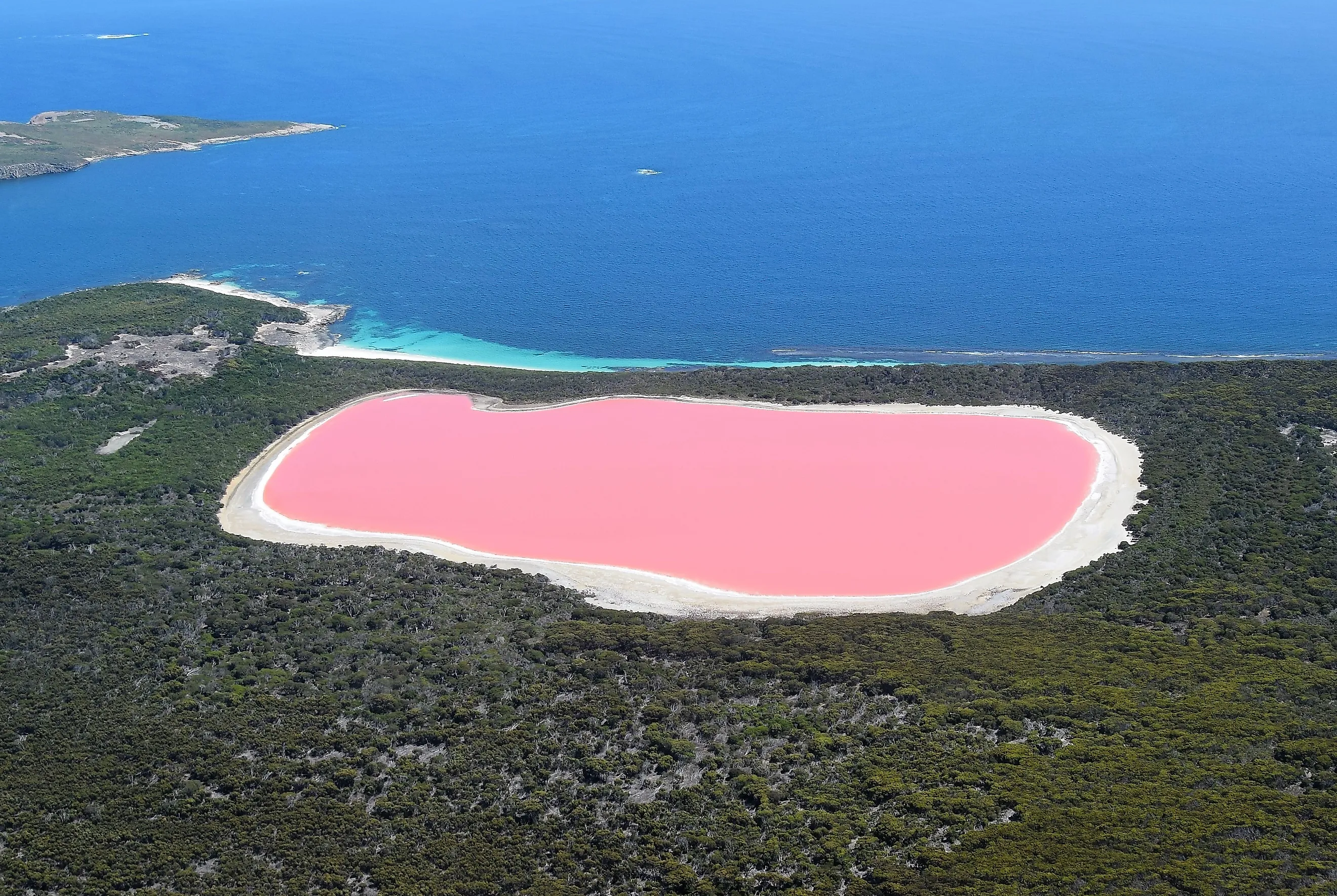
Lake Hillier, Australia

Matthew Flinders recorded Lake Hillier in 1802, one of several pink lakes in Australia. It sits on the south coast of Western Australia, with a thin strip of land separating it from the Southern Ocean. The lake runs only about 2,000 feet long and 820 feet across at its widest, yet it is one of the most vivid pink lakes anywhere. Its color holds even when the water is scooped into a container. Researchers attribute the hue to Dunaliella salina and Salinibacter ruber living in the brine. The water carries a salt concentration near 28%, and crews mined it for salt in the late 19th and early 20th centuries. They abandoned the work because the salt tasted bitter.
In recent years, the famous pink has almost completely faded. Heavy rainfall has diluted the salt that drives the color. Scientists expect the change to be temporary, with the pink returning as water levels drop.
Hutt Lagoon, Australia

Hutt Lagoon lies roughly 1.2 miles north of the mouth of the Hutt River. The explorer George Grey camped on its eastern edge in 1839 and named it after the British politician William Hutt. The lagoon stretches about 9 miles long and 1.4 miles wide at its broadest point. George Grey Drive runs along the eastern shore and gives a clear view across the pink water. Most of the lagoon sits below sea level, with only a dune system separating it from the Indian Ocean.
The color changes with the time of day and the weather. The best viewing window falls between 10 a.m. and 2 p.m. on days with little cloud cover. The lagoon runs highly saline, so the edges often turn white as water evaporates over the year. The salt crust reaches its whitest in summer, and the shards grow sharp enough that walking barefoot is a bad idea.
Dusty Rose Lake, Canada

Dusty Rose Lake gets its color a different way than the others here. It is a freshwater lake rather than a salt one. The pink comes from pigment in the surrounding environment. Glacial meltwater feeds the lake and picks up its hue from particles of the pink and purple rock around it. The lake sits in a remote part of Tweedsmuir Park, Canada, well away from any trail. Scenic flights are the most practical way to see it.
Dusty Rose Lake holds no life at all, not even microorganisms, because its water is anoxic. The water contains essentially no oxygen. It stays still year-round, which leaves the site eerily silent out in the wilderness.
Lake Retba (Lac Rose), Senegal

Lake Retba, also called Lac Rose, sits in Senegal about 22 miles northeast of the capital, Dakar. It covers a surface area of roughly 1.2 square miles. The lake is known for a high salt content that reaches up to 40% in some areas, driven by seawater seeping in and then evaporating. Before 2022, salt workers harvested about 38,000 tonnes here each year, part of the salt trade that makes Senegal the top salt producer in Africa. Then, in September 2022, a major flood devastated the lake and turned its pink hue green.
The pink shows best during the dry season between November and May. As of 2026, the water has recovered some of its color. Many workers have gone back to harvesting salt, rubbing shea butter on their skin to protect it from the high salinity.
Torrevieja Pink Lagoon, Spain

This bubblegum-pink lake anchors a nature reserve called Las Salinas de Torrevieja, alongside a green-tinted neighbor. Seen from above, it looks like a melted strawberry milkshake pooled just outside the city. The best months to visit fall between June and October, when the weather stays mostly sunny. When the wind picks up and clouds roll in, the water shifts from bright pink to a brownish tone. The pink lagoon covers around 1,400 hectares, close to half of the wider natural park.
Torrevieja also draws flamingos, which come to eat the brine shrimp in the water. The birds arrive for their breeding season between March and May. The lake sits at the center of the salt industry in Spain, and much of Torrevieja's salt ships to markets around the world.
Maharloo Lake, Iran

Maharloo Lake sits in Iran, ringed by mountains about 16.8 miles southeast of Shiraz in Fars province. Its size swings widely with the season. Like most lakes here, it carries very high salt content, which supports the growth of Dunaliella salina. By mid-summer the lake has usually evaporated, leaving behind a white salt bed.
Maharloo draws flamingos and other migratory birds that feed on the brine shrimp in its water, much as Torrevieja does. Spring and early autumn offer the best conditions for a visit. The weather stays mild, and the pink runs far more vivid in spring.
Pretty in Pink
These six lakes share one trait above all: their color. The salt-driven lakes in Australia, Senegal, Spain, and Iran turn pink through the same partnership of algae and bacteria in extreme brine. Dusty Rose Lake reaches nearly the same shade with no life in it at all, colored instead by glacial rock. Together they show how much the water we expect to be blue depends on the chemistry and biology underneath it.