The Lakes Heated By Geothermal Activity
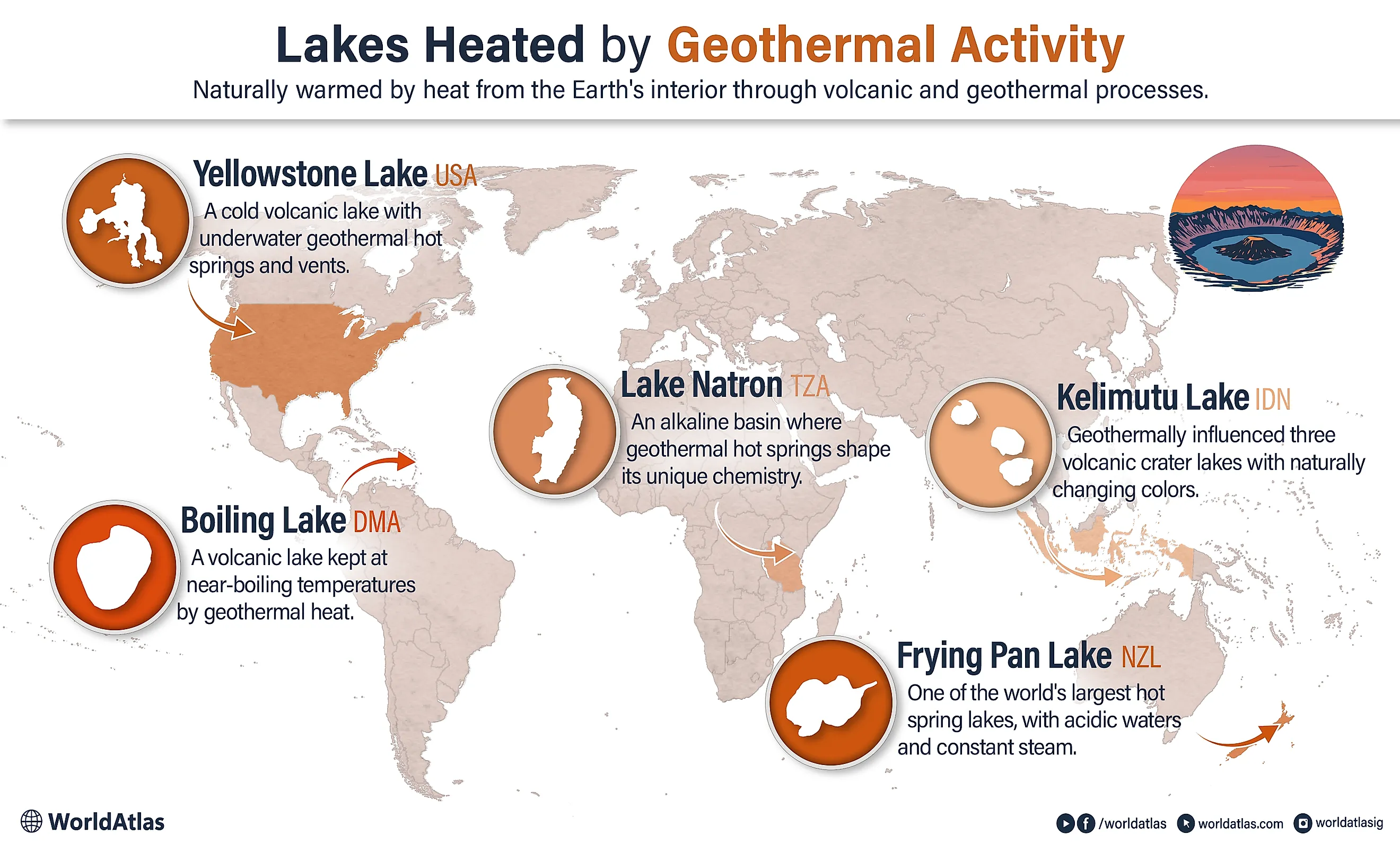
Most lakes take their temperature from the sun. A handful get it from the magma below instead. Heat rising through vents and fumaroles can push a lake past 100°F while the air stays cool. At Kelimutu the same volcanic chemistry tints three neighboring crater lakes three different colors. Lake Natron bakes down to a pH above 12. Dominica's Boiling Lake churns hot enough to cook an egg at the surface.
Kelimutu Lakes, Indonesia

The Kelimutu Lakes in Indonesia comprise three lakes: Lake Tiwu Ata Mbupu, Lake Tiwu Nua Muri Kooh Tai, and Lake Tiwu Ata Polo. These lakes sit deep inside a volcanic crater, which gives them their unusual colors and warm waters. The volcano Kelimutu is near the small town of Moni on the island of Flores. These three lakes are all different colors, and their exact hues change throughout the year as minerals and gases rise from their volcanic floors.
Tiwu Ata Mbupu is usually blue, Tiwu Nua Muri Kooh Tai is usually green, and Tiwu Ata Polo is usually red. Recent PVMBG field observations have measured the three crater lakes at about 61-91°F (16-33°C), with temperatures varying by lake and hydrothermal activity. These distinct colors and changing water conditions result from volcanic activity, which drives fluid flux through the vents at the bottoms of the three lakes. The lakes' colors are brightest in the early morning.
Lake Natron, Tanzania

Lake Natron is primarily alkaline and part of the Lake Natron Basin. The lake sits in Northern Tanzania and is fed by the Southern Ewaso Ng'iro River and by mineral-rich hot springs. These hot springs, along with the lake's arid basin conditions and high evaporation rates, help raise the water's temperature and concentrate its dissolved minerals. Water in the lake can frequently reach temperatures above 104°F (40°C). Lake Natron is 35 miles (57 km) long and 14 miles (22 km) wide, and its evaporation leaves behind high concentrations of sodium carbonate decahydrate and sodium sesquicarbonate dihydrate.
Along with the hot springs, these minerals drive the lake's extreme alkalinity, at times pushing the water's pH above 12.
Yellowstone Lake, USA

Yellowstone Lake in the USA is not warm overall, with an average temperature of only 41°F (5°C), but parts of the lake are strongly affected by geothermal activity. The highest temperature ever recorded in the lake, 252°F (122°C), was in Mary Bay. The lake is heated by underwater geothermal vents, and hot springs warm other parts, leaving some areas hotter than others.
The lake sits 7,733 feet (2,357 m) above sea level and has an area of about 132 square miles (342 km²). It also has around 141 miles (227 km) of shoreline and an average depth of 139 ft (42 m). The lake lies partly within the Yellowstone Caldera, and its underwater hot spots are tied to hydrothermal vents, hot springs, and fumaroles. That caldera formed about 631,000-640,000 years ago.
Frying Pan Lake (Waimangu Cauldron), New Zealand
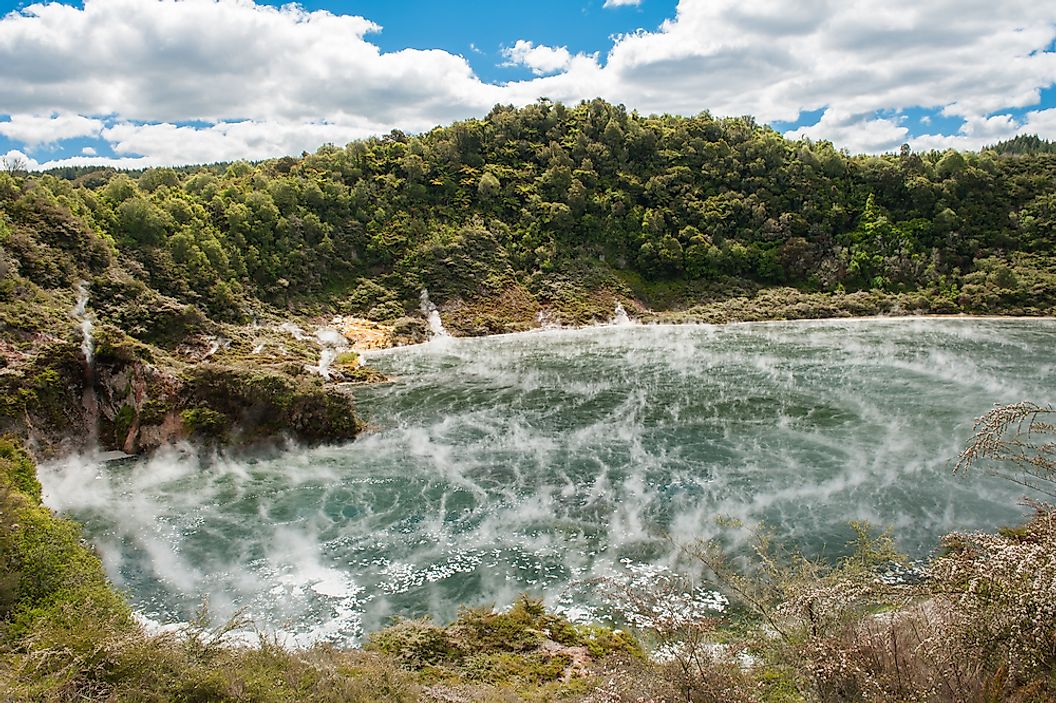
Frying Pan Lake, also called Waimangu Cauldron, sits in the Waimangu Volcanic Rift Valley in New Zealand. This lake is considered one of the world's largest hot pools. It is generally heated to about 113-140°F (45-60°C) by underground geothermal activity tied to its location within a volcanic crater. Several underground vents beneath the crater release hot air, gases, and other chemicals that warm the water. They also make the water highly acidic.
The lake covers 409,028.60 square feet (38,000 m²) and has a shallow depth of only 18 feet (5.5 m). Its vents, however, go much deeper, reaching as far down as 60 feet (18.3 m).
The name Frying Pan Lake comes from the lake's appearance, which is said to resemble a "frying pan" because of its bubbling surface and rising steam. Carbon dioxide and hydrogen sulfide gases released by the vents gradually rise to the surface, creating that effect.
Boiling Lake, Dominica

The Boiling Lake is located in Morne Trois Pitons National Park, Dominica. Temperatures along the lake's edges have been measured at 180-197°F (82-91.6°C), while the center is too active to measure directly. The lake is about 200 to 250 feet (60 to 75 m) in diameter and is the second-largest hot lake in the world. It is a flooded fumarole heated by volcanic steam and gases from below, with water replenished by rainfall and small streams. This activity keeps the water far too hot for any swimming.
The lake is named for its hot temperatures and its bubbling, boiling surface. Its water is an almost grayish-blue, and it always appears to be in a rolling boil, like a pot on the stove about to boil over. That constant churn comes from extreme heat and from volcanic steam and gases rising through the flooded fumarole. The surrounding air also carries a strong sulfur smell from the gases released by the bubbling.
Where Volcanic Heat Meets Water
Geothermal activity turns up all over the planet, usually as hot springs, geysers, or small pools. Only rarely does it heat an entire lake, and the results are strange: crater water that shifts between blue, green, and red at Kelimutu, a pH above 12 at Lake Natron, a spot in Yellowstone's Mary Bay that has reached 252°F (122°C). At the Boiling Lake in Dominica, the water never stops churning, like a pot left on the stove.