The Lakes Where The Most Vehicles Fall Through The Ice
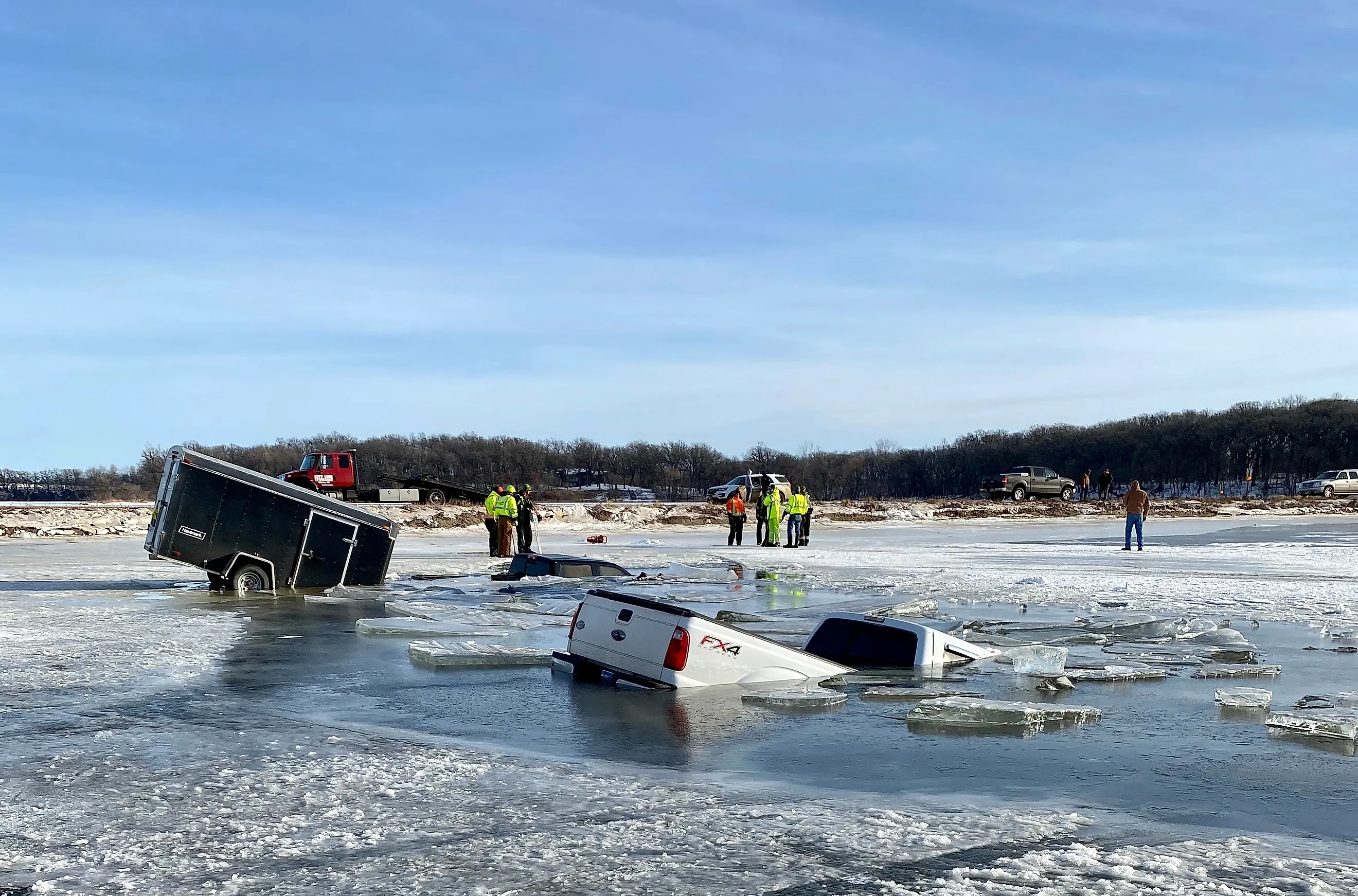
At an ice fishing tournament on Lake Winnebago, 36 anglers came back to the parking area and found their vehicles in the water. Eighteen went all the way under.
Nobody keeps a national tally of this, which is itself telling. In the states where ice fishing is a serious pursuit, dozens of vehicles go through in an ordinary winter, and a handful of lakes account for most of them.
Mille Lacs Lake, Minnesota

If one lake owns this category, it is Mille Lacs. It covers 207 square miles, is only about 42 feet deep at its maximum, and in a normal winter carries plowed ice roads, wheelhouses, pickups, and road graders.
The scale of the recovery business tells the story. One towing operator in nearby Isle, Minnesota, whose shop specialises in pulling vehicles off the bottom, reported hauling up eight in a single winter, six of them from Mille Lacs alone. In another recent season, four vehicles went in before the ice had properly finished forming.
The ice roads are a commercial operation. One resort plows roughly 25 miles of them and charges about $15 for access, and in a thin year the operator simply refuses to let vehicles on at all. Minnesota's fatality records list Mille Lacs repeatedly, including an 80-year-old man who died in January 2024 when his truck went through.
Lake Winnebago, Wisconsin

Winnebago has a problem the others do not: sturgeon spearing season puts an enormous number of vehicles onto the ice over a short, fixed window, and the lake has a river channel running through it that never freezes reliably.

In February 2026 two spearers lost both their pickups in a single morning near Menasha. Their account is instructive: their GPS routed them a different way, fog made the surface unreadable, and they ended up near the channel on the northwest side. One of them put it plainly afterwards, saying the ice was good but they were where they should not have been.
In another season a major crack opened south of Faro Springs Road, running east to west across the lake, and the county sheriff reported multiple vehicles going in. The Wisconsin DNR noted four drownings involving UTVs through the ice on area lakes including Winnebago, and the advice from fish biologists has settled into a single sentence: no ice is ever completely safe.
Lake Of The Woods, Minnesota

Lake of the Woods usually has the thickest ice of any of these, commonly a couple of feet by mid-January, and draws tens of thousands of anglers for walleye and sauger. That reputation for reliability is exactly what makes a bad year dangerous.
In one recent winter two pickups broke through early on a Sunday morning, about a mile apart, in the dark. One was heading to shore and the other was driving further out. One sank in roughly 33 feet of water; the second was pulled free before it went under, with its front end held up on a floating chunk of ice.
Recovering the second one took three trucks from two different resorts chained together. A resort operator there said he could not remember a truck ever going through at that point in the season.
Lake Pepin And The Mississippi

River ice behaves differently from lake ice, and the worst single incident in recent Minnesota memory happened on it. Near Frontenac, anglers parked two rows of vehicles close to shore before heading out onto Lake Pepin on foot and by ATV.
Thirteen pickups and other vehicles went through the ice in one day.
Current is the reason. Moving water erodes ice from underneath continuously, so a river or a flowage can carry a respectable measurement at the surface while being substantially thinner than it reads. The shore edge, where the parking happens, is often the weakest part of the whole system.
Lake Erie

Lake Erie presents a different failure mode. It is the shallowest Great Lake, so it freezes readily and attracts crowds, but it is also big enough that an offshore wind can detach an entire sheet.
In February 2009, more than 130 anglers were spread across two feet of ice off Oak Harbor, Ohio, when the sheet sheared loose and drifted out. Airboats and helicopters worked the floe for hours. Nearly everyone came off, but one man went into the water and did not survive.
Two feet of ice held every one of those people and their gear. Thickness was never the problem. Attachment was.
Why These Lakes And Not Others

Three things recur. Volume of traffic comes first: these are the lakes with established ice roads and organised seasons, so there are simply more vehicles out there to lose. Shallow, wind-exposed basins come second, because they freeze early enough to tempt people and flex enough to crack.
The third is pressure ridges. These form along cracks as the sheet contracts in deep cold and then cannot expand again when it warms. They can rise over ten feet and, critically, they can appear within hours, which means a route that was clear on the way out can be blocked or broken on the way back in the dark.
Fog, GPS routing, and darkness turn up in account after account. Most of these failures are navigational rather than structural. The ice was fine fifty yards away.
What It Costs To Get It Back

The vehicle is the owner's problem. Minnesota requires removal, and leaving a vehicle on the bottom brings penalties on top of the recovery bill, which is why specialist operators exist at all in towns of a few hundred people.
Insurance is not a safe assumption either. Comprehensive cover may handle it, liability-only generally will not, and some policies treat driving onto a frozen lake as a decision rather than an accident.
Minnesota has tracked ice fatalities since 1976, and 49 of those deaths have involved vehicles going through. The trucks are recoverable. That number is the reason the state keeps publishing the list.