Why Clear Lake Ice Holds Twice As Much As White Ice
The folk rule says white ice is half as strong as clear ice, and a study published in Nature Communications puts an actual number on it. Flexural strength is reduced by 51 percent for white ice compared with black ice at the same temperature. The reason is not that the two look different. It is that one of them is full of air, and air does not hold anything up.
Clear Ice Grows Downward From Below

The two ice types form by completely different processes, which is where the strength difference originates.
Clear ice, properly called congelation ice, forms when lake water freezes onto the underside of the existing sheet. It grows downward into still water under calm, steadily cold conditions.
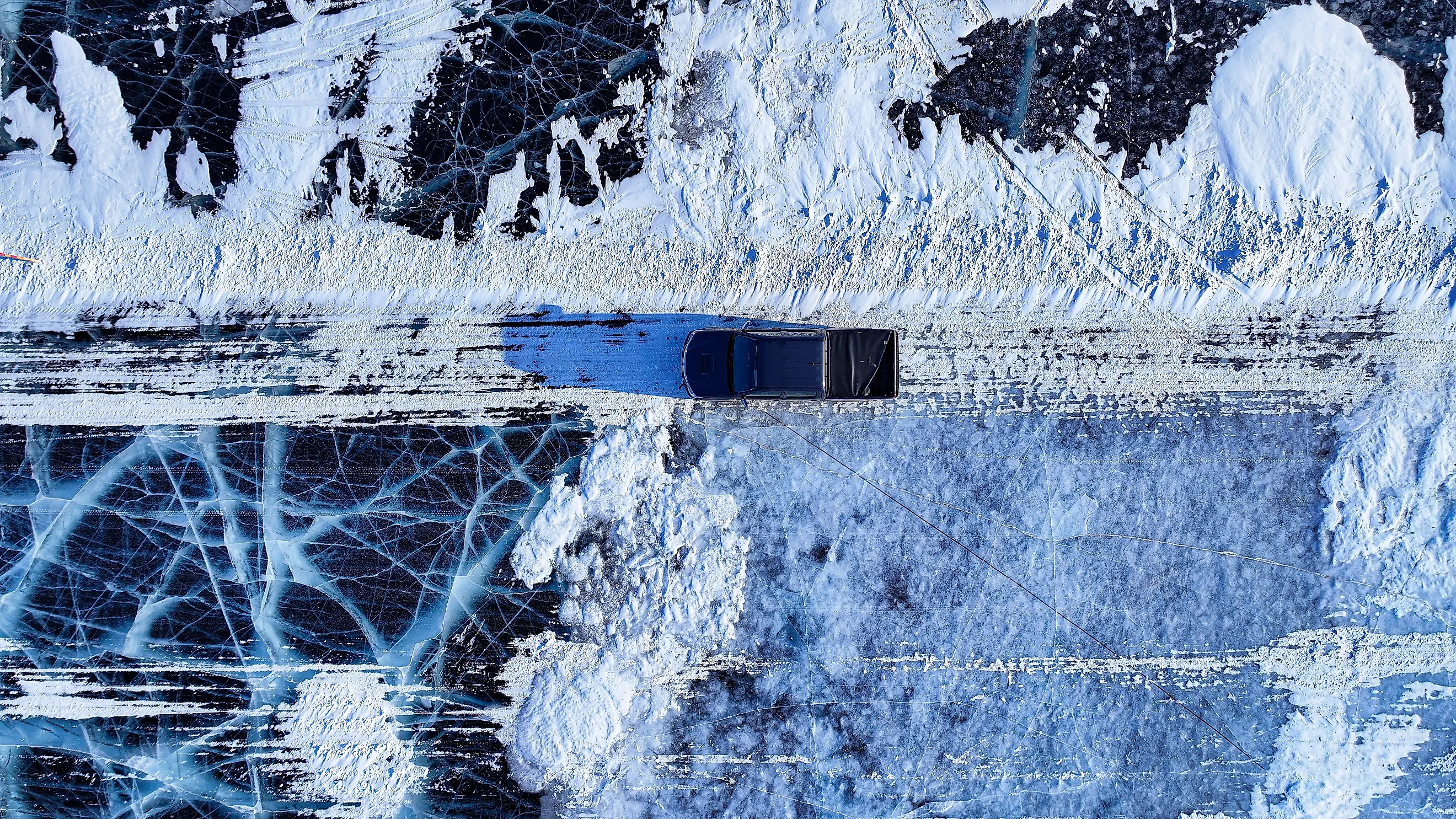
It is called black ice because it is transparent, so what you see through it is the dark water underneath. The ice itself has no color at all.
Air Cannot Join The Crystal

The central fact is a piece of chemistry that most ice safety guidance never mentions.
Air dissolved in water cannot be incorporated into the ice crystal lattice. As water freezes, the dissolved gas is excluded and either stays in solution in the water below or forms a bubble.
Which of those two happens depends entirely on speed. The structure of the ice is decided by how fast it is made.
Slow Freezing Pushes The Air Away

This is the mechanism that produces strong ice, and it depends on patience.
Bubble concentration is higher when freezing proceeds rapidly, because the thin boundary layer of water at the ice face becomes saturated with the rejected air more readily. Freeze slowly and the excluded gas has time to diffuse away into the lake.
Congelation ice forming at the bottom of a sheet therefore contains very few bubbles. The air has somewhere to go and the time to get there.
Slow Also Means Bigger Crystals

The second half of the structural advantage comes from crystal size, and the comparison is geological.
Slower cooling produces larger crystals in almost any material. Magma that cools quickly makes fine-grained rock while magma that cools slowly makes coarse-grained rock, and ice behaves the same way.
York University researchers describe black ice as clear and dense with few air pockets and larger ice crystals. Fewer, bigger, interlocking crystals make a more continuous solid than many small ones.
White Ice Is Made Two Ways

Snow ice forms from above rather than below, by either of two routes.
Snow lying on the surface becomes saturated with water and refreezes as a slushy mass. Or the weight of accumulated snow pushes the sheet down until lake water floods up through cracks and soaks it.
Either way the water freezes fast, around snow that was already mostly air. The result is opaque, porous and full of trapped bubbles.
Snow Is Mostly Air To Begin With

The raw material explains why the product is so poor.
Fresh snow is roughly 65 percent air by volume between the grains. Freezing water around that does not eliminate the voids, it locks them in place.
Every bubble is a space where there is no ice. A sheet that is substantially void carries load across whatever solid remains between the holes.
Fifty-One Percent Is The Measured Figure

Researchers have quantified the difference rather than leaving it as a rule of thumb.
The Nature Communications work records flexural strength reduced by 51 percent for white ice compared with black ice at a given temperature, with flexural strength being proportional to bearing strength.
York University adds that near zero degrees Celsius the gap can exceed 50 percent, making the ice closer to a snow cone than an ice cube. The doubling rule in safety guidance is a rounded version of a measured result.
The Thresholds Scale Accordingly

Agencies translate the strength difference directly into thickness numbers.
York University gives the unsafe thresholds as less than 10 centimeters of black ice, less than 15 centimeters of equal parts black and white, and less than 20 centimeters of white ice.
Ten, fifteen, twenty. The all-white figure is exactly double the all-black one, and a mixed sheet sits halfway between, which is the strength ratio restated as depth.
Snow Makes Less Ice And Worse Ice

Snow cover works against ice twice over, which compounds the problem.
Snow is an excellent insulator, so it slows the growth of clear ice beneath it. A lake with less snow on it may develop thicker, stronger ice than one buried in drifts.
Then the same snow becomes the raw material for the weak layer on top. It reduces the good ice and supplies the bad.
Warming Will Produce More Of It

The balance between the two types is not fixed, and researchers expect it to shift.
York University modeled Northern Hemisphere lake ice from 1850 to 2100 and concluded that white ice conditions are expected to increase as the climate heats, lengthening the unsafe transition periods at the start and end of winter.
Steady cold is what makes black ice. Fluctuating temperatures, thaws and wet snow make the other kind.
The Short Answer

Clear ice holds roughly twice as much because it forms slowly from below, which gives dissolved air time to escape into the water rather than being trapped as bubbles, and gives the crystals time to grow large and interlock. White ice forms fast from saturated snow that was already two-thirds air, and locks those voids into the sheet.
The measured difference is a 51 percent reduction in flexural strength. Safety tables round that to half, which is why the thickness required for white ice is double, and why the only number that matters on a frozen lake is how much of it is clear.