How Thick Lake Ice Has To Be To Hold A Truck
The Minnesota Department of Natural Resources publishes the figures most of North America works from, and for a medium truck the number is 12 to 15 inches. That applies to new clear ice only. On white or snow ice, which the agency rates at roughly half the strength, the same truck needs the guideline doubled to 24 to 30 inches. The heading printed across the top of the DNR's own poster is the part worth memorizing before any of the numbers: ice is never 100 percent safe.
The Full Scale

The guidelines run in steps, and each one assumes the ice beneath is new and clear.
Under 4 inches, stay off entirely. At 4 inches, ice fishing and other activities on foot. At 5 to 7 inches, a snowmobile or ATV. At 8 to 12 inches, a car or small pickup. At 12 to 15 inches, a medium truck.
So a truck needs three to four times what a person on foot needs. Weight does not scale with thickness in a straight line.
White Ice Halves Everything

The single largest adjustment to those numbers has nothing to do with the vehicle.
White ice, also called snow ice, forms when water seeps up through cracks or saturated snow refreezes. The DNR describes it as approximately half as strong as new clear ice and instructs people to double the thickness guidelines when traveling on it.
That turns 12 to 15 inches into 24 to 30. A foot of white ice is not a foot of ice in any meaningful sense.
Most Holes Show Both Kinds

Real ice is usually layered, which complicates the measurement considerably.
The DNR's own example photograph shows 10 inches of clear ice underneath 5 inches of white ice. Fifteen inches total, but not 15 inches of equivalent strength.
Clear ice with a bluish tint is the strongest. Ice formed from melted and refrozen snow appears milky and is porous and weak. Slush ice is half strength and signals that the ice has stopped freezing from the bottom.
Thickness Varies Enormously Across One Lake

This is the factor that makes a single measurement close to worthless.
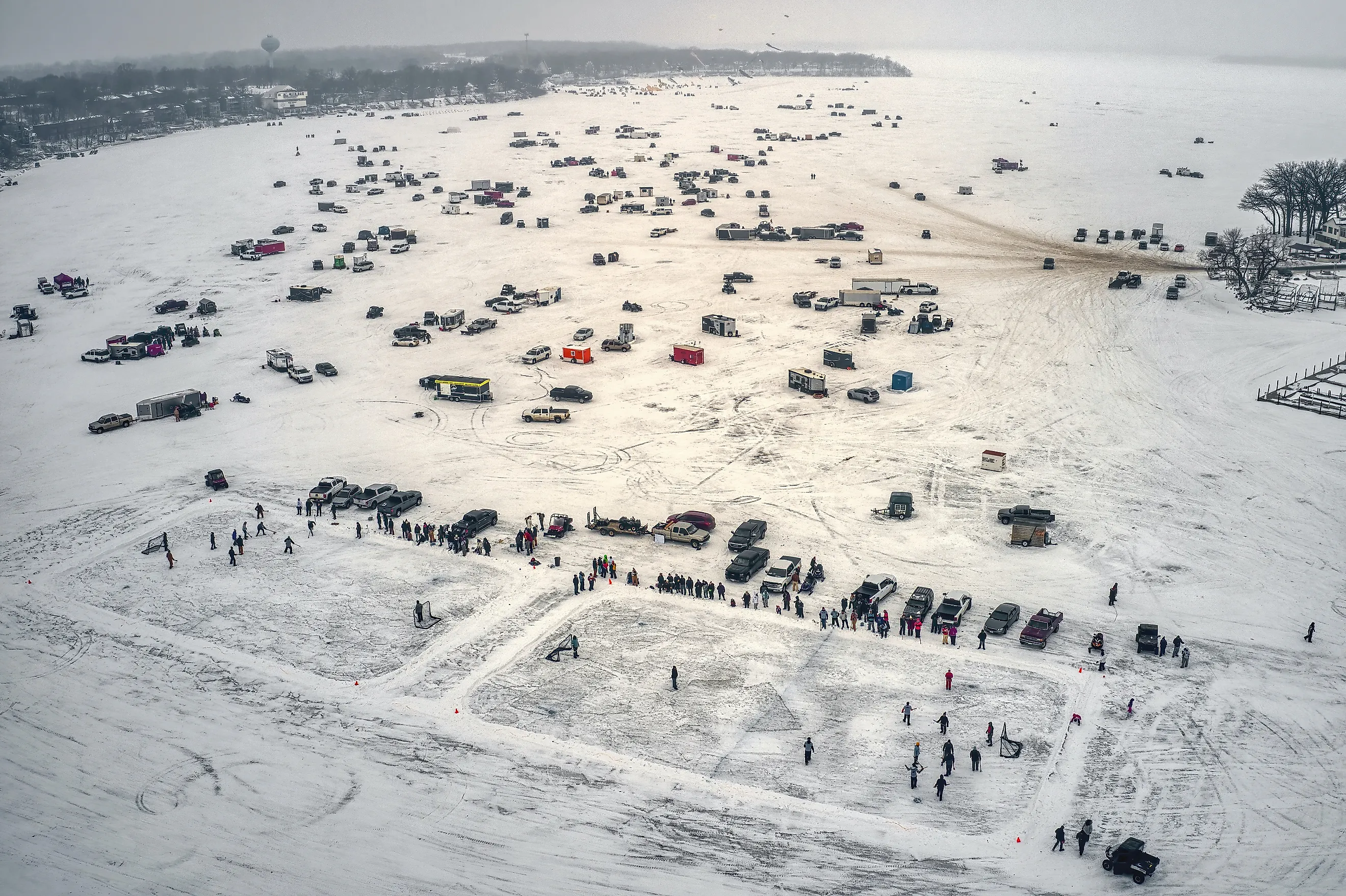
The DNR states that ice seldom freezes uniformly, and that a lake can be two feet thick in one place and one inch thick a few yards away. The recommendation is to check thickness at least every 150 feet along a route.
Ice near shore can be weaker than ice further out. Ice over flowing water, springs and currents is weaker again, and the outside bends of rivers are weakest of all.
Snow On Top Means Thinner Ice Below

Snow cover works against ice formation in a way that catches people out.
Snow acts as an insulating blanket and slows freezing, so ice under snow will be thinner and weaker than exposed ice nearby. The DNR advises that snow-covered ice should always be presumed unsafe.
Snow also hides the surface entirely, which means you cannot assess color, cracks or pressure ridges without clearing it first.
Nobody Is Measuring It For You

One sentence in the Minnesota guidance deserves more attention than it gets.
The DNR does not measure the thickness of ice on Minnesota lakes. No agency does. Local resorts and bait shops often know where the thin areas are, and that is the extent of the information network.
Testing is done with an ice chisel, an auger, or a cordless drill with a long bit. If nobody has drilled your route, nobody knows what is under it.
New Ice Beats Old Ice

Age changes ice strength as much as thickness does, and in the direction most people would not guess.
New ice is usually stronger than old ice. Several inches of newly formed clear ice may hold a load that a much greater depth of old, partially thawed ice will not.
Which means late-season ice at the same measured thickness as early-season ice is a different proposition entirely. The number on the tape does not capture it.
If You Do Drive, Plan To Get Out

The agency's advice for anybody who decides to take a vehicle onto ice is uncompromising.
Refrain from driving on ice whenever possible. If you must, be prepared to leave in a hurry: keep the windows down, unbuckle the seatbelt, and have an escape plan agreed with passengers before you start.
That is official guidance from a state agency, which tells you how the people who write the thickness tables regard the activity the tables describe.
Ice Roads Use Far More

Commercial operations that move heavy loads over ice work to standards far beyond the recreational table.
Northern ice roads carrying loaded trucks are built, monitored and thickness-tested continuously through a season, with speed limits and spacing rules because a moving vehicle generates a pressure wave under the ice.
The recreational guidelines assume one vehicle crossing carefully. They are not a specification for repeated heavy haulage.
The Short Answer

A medium truck needs 12 to 15 inches of new clear ice by Minnesota DNR guidelines, a car or small pickup 8 to 12, a snowmobile 5 to 7, and a person on foot 4. On white ice every one of those figures doubles, so a truck needs 24 to 30 inches.
The thickness is the easy part. Ice varies by feet across a single lake, snow cover hides and weakens it, old ice is weaker than new at the same depth, and no agency is measuring any of it for you. The guidelines are minimums for ideal conditions, and the agency that publishes them heads the page with a reminder that there is no such thing as safe ice.