The Lakes Where Native Fish Are Making A Comeback
Native fish are returning to some of North America's most prominent lakes after decades of overharvest, pollution, and pressure from introduced species. The results are not uniform: Lake Superior's lake trout are considered restored, while Pyramid Lake's Lahontan cutthroat trout still depend heavily on hatcheries and intensive management. In every example, managers have documented a meaningful improvement: more wild fish, renewed natural reproduction, or reduced reliance on stocking.
These recoveries have required more than simply "cleaning up" a lake. Harvest restrictions, invasive-species control, and cooperation among government and community partners have all played roles. The work is also not finished. A recovering fish population does not mean that every ecological problem in its lake has been solved. See how lake trout, walleye, cutthroat trout, and river herring are making measurable comebacks across North American lakes.
Lake Superior - Lake Trout

Lake Superior holds the clearest example of a restored native fish among the Great Lakes. Lake trout were once the dominant cold-water predator throughout the Great Lakes, but commercial overharvest drove their numbers down, and invasive sea lampreys accelerated their collapse during the mid-20th century.
Superior never lost all of its wild lake trout. Remnant populations survived, giving managers a native foundation on which to rebuild. Sea lamprey control, strict harvest regulations, and decades of stocking protected those survivors while natural reproduction recovered. By the mid-1990s, agencies were able to reduce stocking substantially because wild-born fish had become more abundant.
Today, the Lake Superior Committee, coordinated by the Great Lakes Fishery Commission, considers lake trout restored across most of the lake. Naturally produced trout are estimated to be at or above the best estimates of abundance from before the sea lamprey invasion, and the lake retains several native lake-trout forms. The recovery still requires continued lamprey control and careful harvest management, but Lake Superior has moved beyond reintroduction: its lake trout once again sustain themselves in the wild.
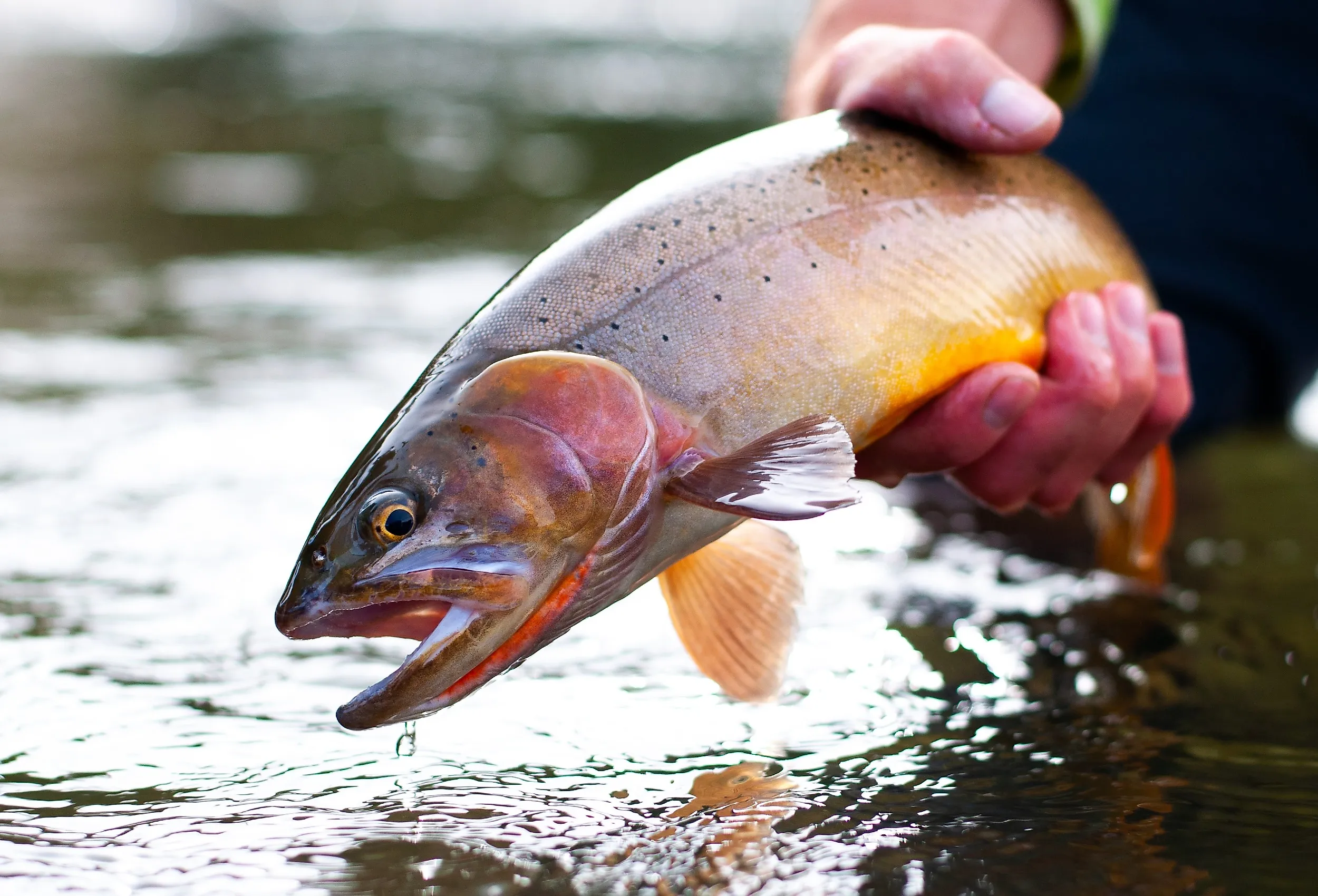
Yellowstone Lake - Yellowstone Cutthroat Trout

Yellowstone Lake supports one of the most important populations of Yellowstone cutthroat trout, a native fish that feeds grizzly bears, bald eagles, ospreys, river otters, and other wildlife. The lake's food web was disrupted after non-native lake trout were discovered there in 1994, almost certainly following an illegal introduction.
Lake trout live and spawn in deep water, beyond the reach of many animals that catch cutthroat trout in shallow water and tributary streams. They are also efficient predators: a mature lake trout can consume dozens of cutthroat trout in a year. By the mid-to-late 2000s, the number of spawning cutthroat trout had fallen to roughly 5% to 10% of levels recorded in the late 1970s.
The National Park Service responded with one of the largest non-native-fish suppression programs in the country. Crews have used extensive gillnetting, along with methods that kill lake trout embryos on spawning grounds, to reduce the predator population. Through 2024, they had removed more than 4.9 million lake trout. According to the National Park Service, the abundance of older predatory lake trout fell by about 90%, and cutthroat trout began returning to spawning streams in greater numbers.
The comeback is real but conditional. Hundreds of thousands of lake trout are still removed in some years, and the invasive fish cannot presently be eradicated. Continued suppression is therefore necessary to protect the recovering cutthroat population and the wildlife that depends on it.
Mystic Lakes - River Herring

Upper and Lower Mystic Lakes, northwest of Boston, are freshwater spawning habitats for two native migratory fish: alewife and blueback herring, collectively known as river herring. The fish spend most of their lives at sea before traveling up the Mystic River to reproduce. Dams once made that journey so difficult that volunteers carried thousands of herring over the Mystic Lakes Dam in buckets.
A permanent fish ladder installed at the dam in 2012 allowed herring to reach the lakes without human assistance. Improved passage at the Center Falls Dam in 2018 opened additional habitat farther upstream. Together, the projects expanded accessible spawning habitat by more than 200 acres.
The response has been measurable. The Mystic River Watershed Association estimated a run of about 199,000 herring when monitoring began in 2012. The estimate reached 815,000 in 2025, the largest recorded during the program. Annual numbers still fluctuate with drought, survival at sea, and other conditions, but the long-term increase makes the Mystic Lakes one of the clearest fish-passage success stories in an intensely urban watershed.
River herring also move energy between marine and freshwater food webs. Their return provides prey for striped bass, herons, ospreys, bald eagles, river otters, and numerous other animals.
Pyramid Lake - Lahontan Cutthroat Trout

Pyramid Lake once supported enormous Lahontan cutthroat trout, the world's largest cutthroat-trout subspecies, and an animal of deep cultural importance to the Pyramid Lake Paiute Tribe. Derby Dam, completed on the Truckee River in 1905, diverted water and blocked access to upstream spawning habitat. Combined with commercial overfishing and habitat change, those effects extirpated the original lake-form trout from Pyramid Lake by the early 1940s.
The lineage was not genetically extinct. Trout transplanted decades earlier to a remote stream near Pilot Peak survived in isolation. Genetic comparisons with museum specimens later showed that these fish were descendants of the historic Truckee River-Pyramid Lake population. The US Fish and Wildlife Service secured the strain in a hatchery broodstock and, in partnership with the Pyramid Lake Paiute Tribe, began releasing Pilot Peak fish into Pyramid Lake in 2006.
The reintroduced trout grew to the large sizes for which the lake was historically known, and adults began migrating from Pyramid Lake into the Truckee River again in 2011. The Marble Bluff Fish Passage and Research Facility, built in the 1970s, assists and monitors those migrations using a fish lock and an alternative three-mile fishway.
Pyramid Lake is therefore a managed comeback, not yet a fully self-sustaining recovery. Hatchery releases, adequate Truckee River flows, fish passage, and coordinated water management remain essential. Even so, a native trout extirpated from the lake for more than half a century is once again growing, migrating, and attempting to reproduce in its ancestral waters.
Upper Red Lake - Walleye

Upper and Lower Red Lakes in northern Minnesota once supported a highly productive native walleye fishery. Decades of excessive harvest, including illegal harvest, drove the population to historic lows by the late 1990s. Mature female biomass fell below the level managers believed was needed to produce a reliable new generation.
Red Lake Nation, the Minnesota Department of Natural Resources, the US Fish and Wildlife Service, and the Bureau of Indian Affairs developed a joint recovery plan. It closed the walleye harvest, strengthened enforcement, and used intensive but temporary fry stocking to rebuild the depleted spawning population. Stocked fish made up much of the strong 1999, 2001, and 2003 year classes.
By 2004, managers concluded that stocking was no longer needed because natural reproduction could again produce strong year classes. A Minnesota DNR assessment found that the short-term stocking program had rebuilt enough spawning biomass for wild recruitment to take over.
The fishery subsequently reopened under conservative, jointly managed harvest limits. Recent year-class strength has been strong enough that Minnesota has retained a five-walleye possession limit for the 2026 open-water season in state-managed portions of Upper Red Lake. The current management system still protects spawning abundance and coordinates harvest with the Red Lake Nation, showing how a recovered fishery can remain productive without repeating the overuse that caused its collapse.
Lake Champlain - Lake Trout

Lake trout disappeared from Lake Champlain in the 19th century after overfishing and habitat degradation. Restoration agencies began stocking hatchery-raised trout in the 1950s, but heavy sea lamprey parasitism prevented the population from becoming self-sustaining. A coordinated lamprey-control program started in 1990, using targeted lampricides, barriers, and traps to reduce attacks on trout and other native fish.
For decades, the lake continued to depend on hatchery fish even as wild reproduction slowly increased. That changed in 2025, when the Lake Champlain Fish and Wildlife Management Cooperative determined that naturally produced lake trout were abundant enough to sustain the population. New York, Vermont, and the US Fish and Wildlife Service announced that routine lake-trout stocking would end after one final release in spring 2025.
The decision marked the completion of a recovery effort spanning more than 70 years, and New York's Department of Environmental Conservation called the result a successful restoration. The agencies will continue to monitor the population and control sea lampreys, with benchmarks for restarting stocking if wild trout decline. Lake Champlain's Atlantic salmon are also returning to tributaries and reproducing naturally, but they still receive hatchery support.
Lake Huron - Walleye

Walleye were once abundant in Lake Huron's Saginaw Bay, but the population collapsed beginning in the 1940s. Pollution, sedimentation of spawning reefs, unrestrained fishing, barriers on tributaries, and predation on young walleye by invasive alewives all hindered recovery. Water-quality improvements and stocking helped rebuild the fishery, but for years the population remained dependent on hatchery releases.
A major ecological change created an unexpected opening. Invasive alewives collapsed in Lake Huron in 2003, sharply reducing predation on newly hatched walleye. Wild reproductive success surged. Stocking ended in 2006, and by 2009, Saginaw Bay walleye had reached recovery targets.

The recovered fish now disperse widely from Saginaw Bay into Lake Huron. Monitoring in 2025 recorded the second-highest catch rate of yearling walleye in the Saginaw Bay gillnet survey, while total walleye catch remained within the range observed since the population recovered in the late 2000s. Michigan fisheries managers continue to protect river spawning habitat and are restoring rocky reefs to diversify reproduction.
Walleye have recovered while yellow perch and several native prey fishes continue to struggle, demonstrating that one species can rebound inside a food web that remains profoundly altered.
Lake Erie - Walleye

Lake Erie's walleye demonstrate how quickly a naturally reproducing fish population can grow when several strong year classes survive. Walleye numbers have varied dramatically over time with fishing pressure, water conditions, prey availability, and the success of each spring hatch. The present population is sustained entirely by natural reproduction rather than stocking.
Record-setting hatches during the late 2010s and early 2020s produced one of the largest concentrations of adult walleye seen in decades. The estimated number of fish aged two or older reached 93.6 million in 2023. It has since declined as those unusually large year classes have aged, but the population remains substantial: fisheries managers projected approximately 57.6 million walleye aged 2 or older for 2026. Pennsylvania retained its standard six-fish daily limit, while jurisdictions around the lake continued to coordinate annual harvest levels. Pennsylvania's Fish and Boat Commission described recent hatches as record-setting.
The walleye boom, however, does not mean a complete ecological recovery of Lake Erie. Excess phosphorus still fuels harmful algal blooms and low-oxygen conditions, and yellow perch have not shared the same reproductive success.
Comebacks That Still Need Protection
These lakes illustrate several forms of recovery. Lake Superior and Lake Champlain now support self-sustaining lake-trout populations. Yellowstone Lake and the Mystic Lakes show that native fish respond directly to invasive predator suppression and restored passage. Upper Red Lake and Saginaw Bay demonstrate that temporary stocking can end once wild reproduction takes over. Pyramid Lake shows an earlier, more management-dependent stage in which a lost native lineage has returned but still needs hatchery and water-management support. Lake Erie shows the opportunity (and volatility) created by exceptionally strong natural year classes.
None of these outcomes means restoration is complete. Sea lamprey control, harvest limits, fish passage, habitat work, water-quality programs, and invasive-species suppression must continue. Climate change adds a further challenge by warming water, changing runoff and river flows, and altering food webs. The reason for optimism is not that these lakes have returned to an untouched past; rather, targeted, sustained conservation has given native fish a measurable path back.