The Great Lakes Species Found Nowhere Else On Earth
A fish that survives only in Lake Superior. A grasshopper restricted to Great Lakes dunes. A wildflower known from a single population on Isle Royale. These are not just species associated with the Great Lakes. They exist naturally nowhere else on Earth.
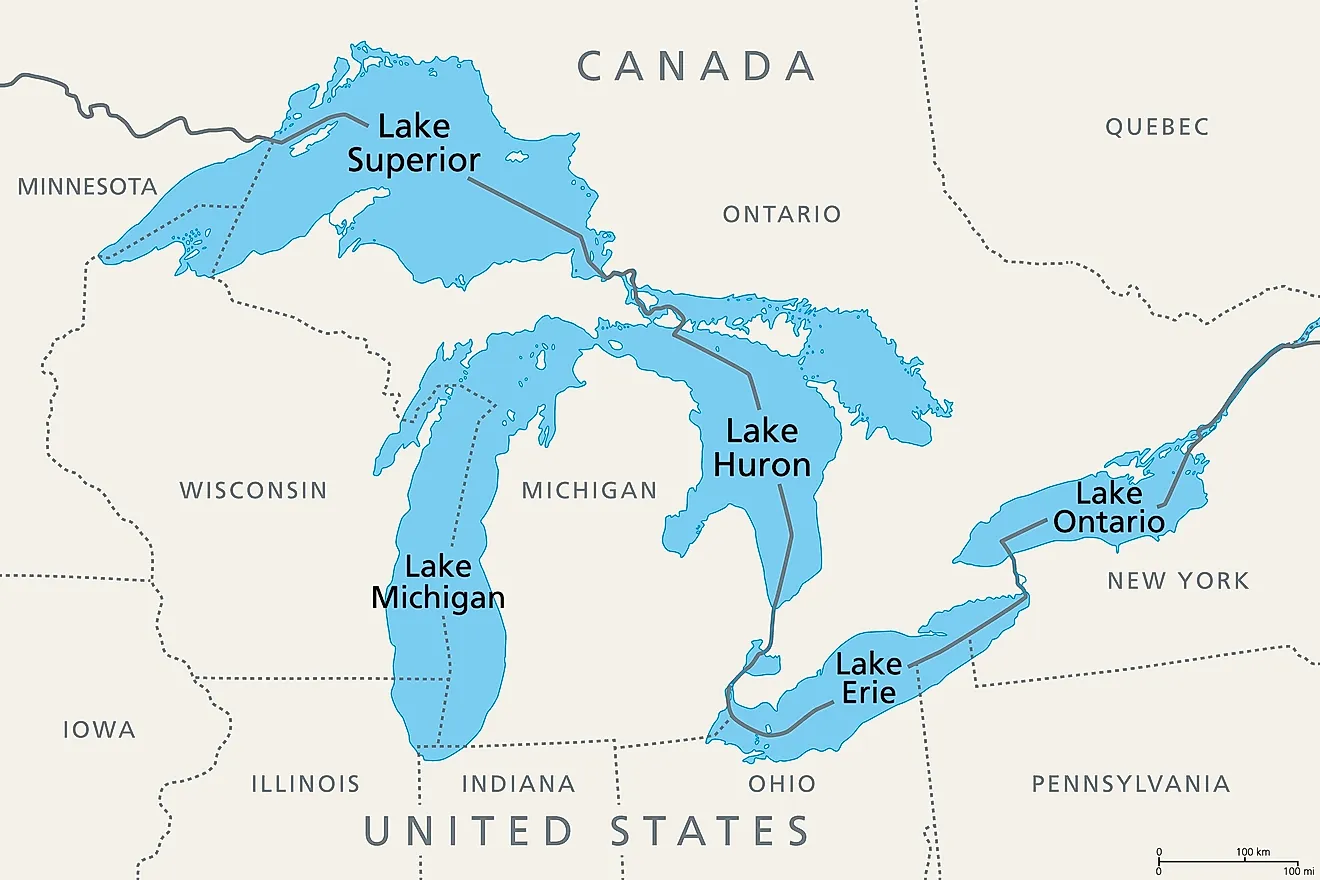
The kiyi is the standout aquatic endemic, while dwarf lake iris grows on old limestone shorelines, and Hungerford's crawling water beetle lives in a small number of cold northern streams. The lakes, glacial history, and specialized habitats restricted several species to ranges that barely extend beyond the shores of the Great Lakes.
Lake Huron Grasshopper

A patch of pale sand on the upper Great Lakes can hold an insect found nowhere beyond this shoreline system. The Lake Huron grasshopper, Trimerotropis huroniana, occurs only in dunes around Lakes Huron, Michigan, and Superior. Canada's proposed 2026 recovery strategy recognizes 14 extant subpopulations in Ontario, including nine on Manitoulin Island and two along the Lake Superior shore.
Adults are mottled silver-gray against open sand, and a dark band crosses each hind wing. Females place clusters of eggs in the dunes in late summer. Those eggs remain underground through winter before the next generation emerges as nymphs in spring.
The grasshopper needs open foredunes with sparse native vegetation. Wind, waves, ice, and shifting sand keep those bare patches available. Canadian recovery documents identify shoreline development, off-road vehicles, trampling, and invasive plants as important threats. Populations have already disappeared from Southampton and Wasaga Beach after major habitat changes.
Pitcher's Thistle

Pitcher's thistle, Cirsium pitcheri, belongs to the freshwater dune belt around Lakes Michigan, Huron, and Superior. The US Fish and Wildlife Service records native populations in Michigan, Wisconsin, Indiana, and Ontario, with most known sites around Lake Michigan. Illinois lost its original population, although conservation work later reintroduced the plant there. For much of its life, this thistle sits low in the sand as a fuzzy rosette. Mature plants eventually send up stalks carrying pale cream or pinkish flower heads. They occupy open beach ridges, dune slopes, and other sunny parts of active dune systems. Wind-blown sand periodically buries and exposes parts of these communities. Federal recovery documents identify shoreline development, trampling, invasive vegetation, and excessive dune stabilization as threats because each can reduce the open sandy ground the plant uses.
Dwarf Lake Iris

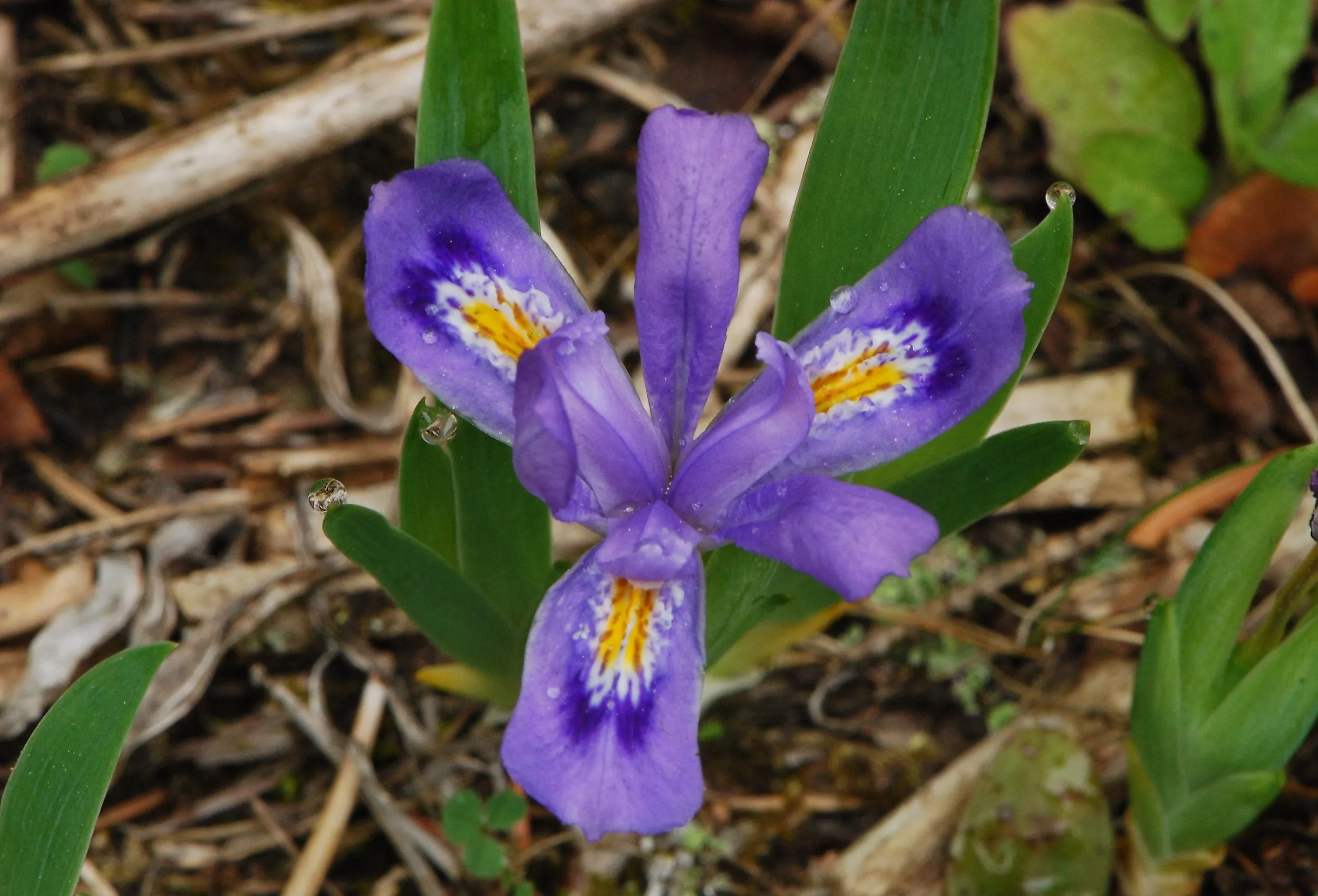
Dwarf lake iris, Iris lacustris, can squeeze into remarkably thin soil over limestone around northern Lakes Michigan and Huron. The US Fish and Wildlife Service's latest status review reports 165 extant occurrences, with 89 in Michigan, 36 in Wisconsin, and 40 in Ontario. Its range follows places such as Wisconsin's Door Peninsula, the Straits of Mackinac, and Ontario's Bruce Peninsula. The blue-violet flowers sit low to the ground among gravel, beach rubble, limestone cracks, and sparse vegetation.
Some colonies are nowhere near today's waterline. They grow on old beach ridges created when postglacial Great Lakes water levels stood in different positions. As lake levels changed, those former shorelines remained as strips of shallow, calcium-rich soil, and dwarf lake iris populations persisted on them. Botanist Thomas Nuttall collected the species on Mackinac Island in 1810. More than two centuries of botanical surveys later, its natural distribution is still confined to this northern Great Lakes belt.
Gillman's Goldenrod

Gillman's goldenrod, Solidago gillmanii, has a compact range along the dunes of Lakes Michigan and Huron. COSEWIC's 2019 assessment records it in Ontario, Michigan, Wisconsin, and Indiana. Wisconsin and Indiana occurrences are confined to the Lake Michigan shore, while many Michigan populations sit in active dune country along the state's western edge.
The name has shifted over time. Older botanical sources sometimes place the plant within Solidago simplex as a variety or subspecies, while COSEWIC recognizes S. gillmanii as a species. In the field, it favors open sandy dunes where plant cover remains sparse, and sunlight reaches the surface. Suitable patches can be surprisingly small within much larger beaches and dune fields. Repeated surveys have still found natural populations only around these two Great Lakes.
Houghton's Goldenrod

Houghton's goldenrod, Solidago houghtonii, occurs around northern Lakes Michigan and Huron in habitats rich in calcium. COSEWIC classifies it as a Great Lakes endemic and records major Canadian populations on Manitoulin Island and the Bruce Peninsula. US Fish and Wildlife Service records place much of the American population in northern Michigan, with a few inland occurrences.
The plant usually stands about 30 to 60 centimeters tall, with narrow leaves and clusters of yellow flower heads. Its favored ground includes limestone alvars, calcareous beach deposits, and interdunal wetlands. Soil depth, drainage, shade, and plant cover can change quickly across these sites, leaving usable habitat in scattered patches.
Genetic evidence supports a hybrid origin involving other goldenrods, followed by the establishment of a stable lineage recognized today as Houghton's goldenrod. On Manitoulin Island and the northern Michigan shore, a low limestone opening no bigger than part of a field can hold a meaningful share of the species' habitat.
Lakeside Daisy

Lakeside daisy, Tetraneuris herbacea, grows on limestone pavement that can look nearly bare for much of the year. In spring, compact plants produce bright yellow flower heads across the low rock surface. The US Fish and Wildlife Service describes the species as a Great Lakes endemic. Its largest natural populations occur in Ontario, while smaller natural populations survive in Ohio and Michigan, and restored populations remain in Illinois.
The favored habitat is alvar, where soil stays shallow over limestone bedrock and tree cover remains sparse. Bees and flies carry pollen among the flowers, and federal species accounts note that viable seed production requires pollen from genetically different individuals. The plants can also spread vegetatively by producing new rosettes. Development, invasive plants, shading, and vegetation succession can reduce occupied habitat. Even across extensive limestone country, the right mix of thin soil, moisture, and open exposure appears only in patches.
Hungerford's Crawling Water Beetle

Hungerford's crawling water beetle, Brychius hungerfordi, lives in cool streams within the Great Lakes region, mainly in northern Michigan and on Ontario's Bruce Peninsula. When the US Fish and Wildlife Service listed it in 1994, scientists knew of only three populations. The Service reported 13 known populations in 2021, while its 2025 survey protocol documents the beetle in 16 streams across Michigan and Ontario.
Adults occur in shallow pools and riffles where moving water stays cool and well oxygenated. Federal habitat accounts report temperatures around 15 to 25 degrees Celsius at occupied sites. Seasonal drops in stream level can expose damp sand along the banks, and that moist edge may be important during pupation.
Dredging, excess sediment, pollution, altered flow, logging, and some fish or beaver management activities have all been identified as potential threats. The beetle measures only a few millimeters, so finding it takes careful stream surveys rather than casual wildlife watching. Every known site remains within the northern Great Lakes region.
Michigan Monkeyflower

Michigan monkeyflower, Erythranthe michiganensis, is known only from six northern Michigan counties. Michigan monkeyflower is a distinct species endemic to northern Michigan and is one of several recognized plants native nowhere else. Recorded colonies occur in Benzie, Charlevoix, Cheboygan, Emmet, Leelanau, and Mackinac counties.
Cold, calcium-rich groundwater is a reliable clue to its habitat. The plant grows in springs, seeps, and streams, including sites near Great Lakes shorelines and below limestone bluffs. Low mats of rounded, toothed leaves carry yellow tubular flowers with red markings on the lower lip. Some colonies occupy narrow ribbons of wet ground where groundwater reaches the surface.
Michigan conservation guidance warns against changes in water flow, oxygenation, and turbidity at occupied sites. Many colonies also spread strongly through vegetative growth, so a thick patch of stems does not necessarily represent a large genetically varied population. Its entire accepted natural distribution remains in northern Michigan.
Isle Royale Ragwort

Isle Royale ragwort, Packera insulae-regalis, has one of the smallest documented ranges in the Great Lakes region. Botanists formally described the species in 2011 after studying plants near the summit of Mount Franklin on Isle Royale in Lake Superior. The original taxonomic paper reported a single population. Michigan Natural Features Inventory still lists one occurrence, most recently observed in 2024, and assigns the species a global rank of G1, meaning critically imperiled.
Researchers found the plant to be hexaploid, with six sets of chromosomes, while related Packera around the Great Lakes include plants with different chromosome numbers. The original description also reports vegetative rosettes growing from the roots and partial self-compatibility. Botanical surveys have not produced another accepted wild population elsewhere. For now, the species is known from that single high point on one island in Lake Superior.
Kiyi

The kiyi, Coregonus kiyi, is the strongest surviving example of a fish whose natural range lies entirely within the Great Lakes. Historically, it occupied Lakes Superior, Michigan, Huron, and Ontario. COSEWIC records the last accepted kiyi in Lake Ontario in 1964, Lake Huron in 1973, and Lake Michigan in 1974. Lake Superior now holds the surviving population.
A shoreline visitor has almost no chance of seeing one. Kiyi spend much of their time in very deep, cold water. Canadian assessments place most captures below 108 meters and report records near 200 meters. Their large eyes suit those dim depths, while long paired fins help researchers separate them from other ciscoes. The population is still producing young fish. In its 2025 Lake Superior survey, the US Geological Survey recorded age-1 kiyi at an average density of 1.15 fish per hectare. That recent survey confirms that young fish are still entering the population in Superior.
The biggest surprise is where these species actually live. The Great Lakes' most unique life is not concentrated in the middle of the lakes, but along dunes, limestone flats, cold streams, old shorelines, and isolated islands. That makes habitat loss especially important here: damage to one beach, seep, or dune system can affect a species with nowhere else to go. The Great Lakes are famous for their size, but some of their rarest species survive in remarkably small pieces of habitat.