How The Great Lakes Compare To The World's Largest Lakes
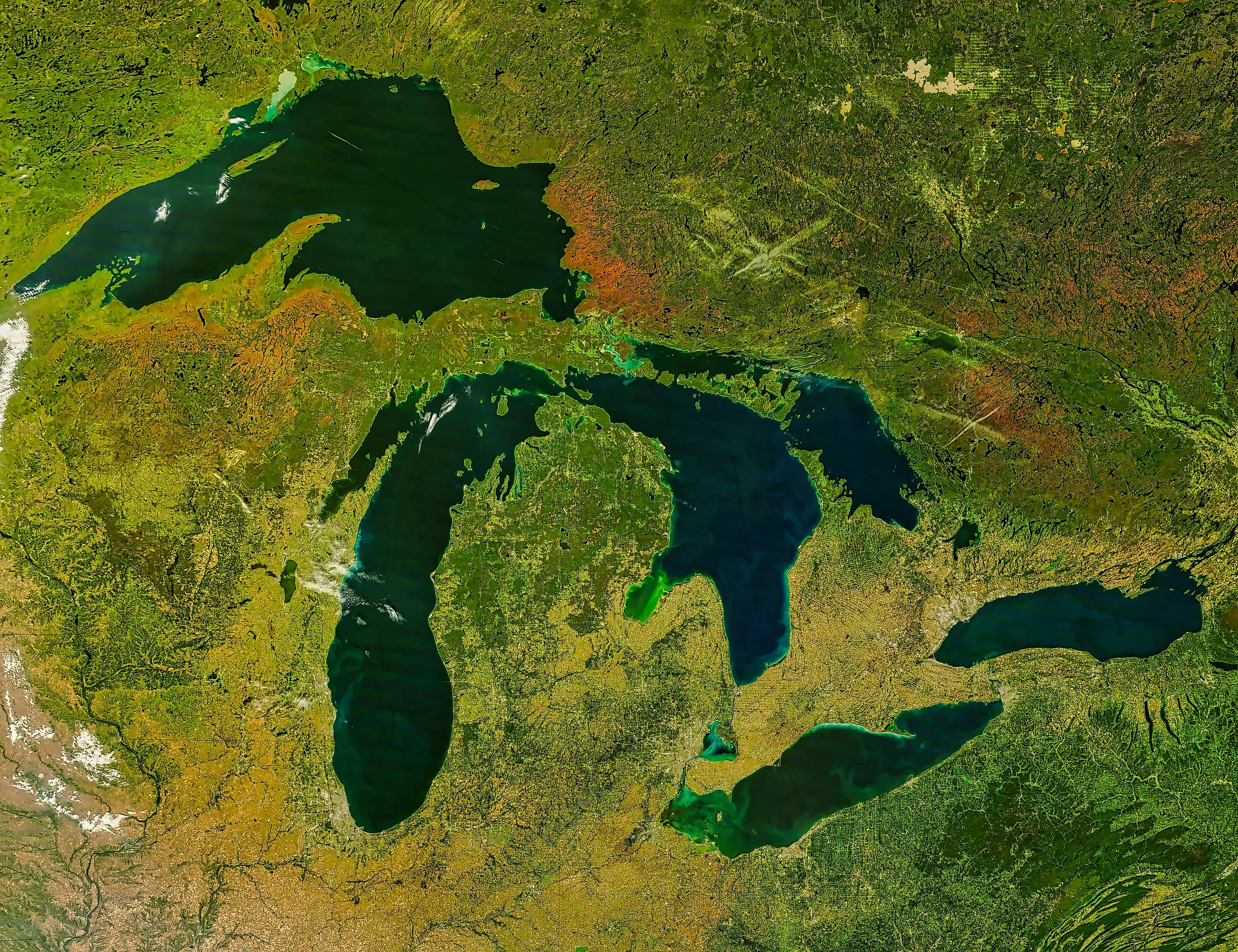
Of the millions of lakes on Earth, a select few stand apart for their immense size, with the biggest ones covering areas comparable to entire countries or US states. The Caspian Sea, which is a saltwater lake despite its name, ranks first in surface area by a significant margin. Lake Superior is the world's second largest lake and largest freshwater lake, and all five Great Lakes rank among the world's 13 biggest lakes by surface area. Yet, even if combined, the five Great Lakes are substantially smaller in area than the Caspian Sea alone, hammering home the point of just how unique the Caspian is among the world's lakes.
The World's Largest Lakes
| Rank | Lake | Location | Area (sq. mi.) | Area (sq. km.) |
|---|---|---|---|---|
| 1 | Caspian Sea | Azerbaijan, Iran, Kazakhstan, Russia, Turkmenistan | 149,200 | 386,400 |
| 2 | Lake Superior | United States, Canada | 31,700 | 82,100 |
| 3 | Lake Victoria | Tanzania, Uganda, Kenya | 26,800 | 69,484 |
| 4 | Lake Huron | United States, Canada | 23,000 | 59,570 |
| 5 | Lake Michigan | United States | 22,300 | 57,757 |
| 6 | Lake Tanganyika | Tanzania, Democratic Republic of the Congo, Burundi, Zambia | 12,700 | 32,900 |
| 7 | Lake Baikal | Russia | 12,200 | 31,500 |
| 8 | Great Bear Lake | Canada | 12,100 | 31,328 |
| 9 | Lake Malawi | Malawi, Mozambique, Tanzania | 11,400 | 29,604 |
| 10 | Great Slave Lake | Canada | 11,000 | 28,568 |
| 11 | Lake Erie | United States, Canada | 9,910 | 25,666 |
| 12 | Lake Winnipeg | Canada | 9,465 | 24,514 |
| 13 | Lake Ontario | United States, Canada | 7,340 | 19,010 |
Surface-area figures are approximate and can vary somewhat among sources because of differences in measurement methods and water levels. The ranking treats Lake Michigan and Lake Huron as separate lakes, as is conventional in most global lake rankings.
Caspian Sea
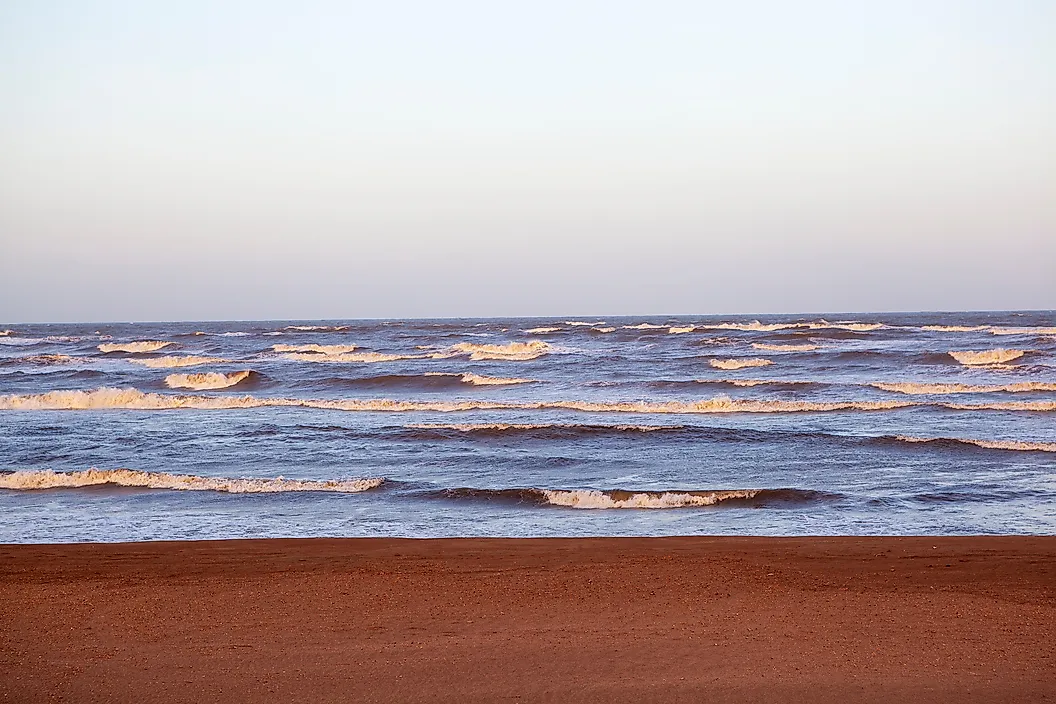
The Caspian Sea is by far the world's largest lake by surface area, covering a similar total area as the state of California. It is also a little more than one-and-a-half times larger than all five Great Lakes combined, which have a total surface area of about 94,250 square miles (244,100 square kilometers). Azerbaijan, Iran, Kazakhstan, Russia, and Turkmenistan have lakeshores on the Caspian, which has been an essential inland waterway for millennia. Despite its name and brackish water that varies in salinity, the Caspian Sea is technically a lake because it is completely enclosed by land and has no natural connection to the world's oceans.
The Caspian is also remarkably deep. Its southern basin reaches more than 3,300 feet (1,000 meters), while the northern portion is much shallower and can freeze during winter. The lake is a remnant of ancient seas that once connected with larger ocean systems. Because of its enormous size, the Caspian has characteristics more commonly associated with an inland sea, including large waves, strong currents, and extensive coastal ecosystems.
Lake Superior

Lake Superior is the world's second-largest lake by surface area and the largest freshwater lake, exceeding the next contender, Lake Victoria, by nearly 5,000 square miles. Covering approximately 31,700 square miles (82,100 square kilometers) along the United States-Canada border, Superior's shores extend through Minnesota, Wisconsin, Michigan, and Ontario. If it was a U.S. state it would rank ahead of 10 states in size, slotting in just barely behind South Carolina.
Lake Superior is also the deepest and largest by volume of the Great Lakes, reaching a maximum depth of about 1,333 feet (406 meters). Glaciers helped carve its modern basin during the last Ice Age, although the underlying geology is much older. More than 200 rivers flow into the lake, while the St. Marys River carries its water toward Lake Huron. The lake is also an important shipping route for iron ore, grain, and other bulk commodities.
Lake Huron

Lake Huron ranks fourth among the world's largest lakes, covering a slightly smaller area than West Virginia. It borders Michigan and Ontario and contains thousands of islands, including Manitoulin Island, the world's largest freshwater island. Georgian Bay and Saginaw Bay form major extensions of the lake, contributing to its irregular shoreline.
Lake Huron and Lake Michigan are connected by the deep Straits of Mackinac and are sometimes treated as a single hydrological lake called Michigan-Huron. Combined, they cover roughly 45,300 square miles (117,000 square kilometers). Under that classification, Michigan-Huron would rank second among the world's lakes by surface area, yet still measure more than 100,000 square miles smaller than the Caspian Sea.
Lake Michigan

Lake Michigan is the world's fifth-largest lake, falling short of its companion, Lake Huron, by less than 1,000 square miles. It is the only Great Lake located entirely within the United States, with shores in Michigan, Wisconsin, Illinois, and Indiana. Chicago and several other major cities sit along its shoreline, and the lake is a source of drinking water, shipping lanes, recreation, and wildlife habitat.
As mentioned above, Lake Michigan is directly connected to Lake Huron through the Straits of Mackinac, yet they are traditionally treated as two separate lakes. Lake Michigan's eastern shore is known for extensive freshwater sand dunes, while Green Bay and Grand Traverse Bay form two of the largest indentations along its shoreline. Like the other Great Lakes, its modern basin was heavily shaped by glaciers during the last Ice Age.
Lake Erie

Lake Erie ranks 11th among the world's largest lakes, covering an area a little smaller than Massachusetts and a bit larger than Vermont. It borders Michigan, Ohio, Pennsylvania, New York, and Ontario. While Lake Erie appears similar on the surface to the other Great Lakes, it is by far the shallowest of the five, averaging only about 62 feet (19 meters) deep and reaching a maximum depth of roughly 210 feet (64 meters).
Lake Erie's shallow water causes it to warm relatively quickly and support highly productive fisheries, and also to freeze over more readily than the other four lakes. The shallow water also contributes to environmental challenges, including nutrient pollution and harmful algae blooms. Most of Lake Erie's inflow comes from the Detroit River, while the Niagara River carries water toward Lake Ontario.
Lake Ontario

Lake Ontario is the 13th-largest lake in the world and the smallest of the five Great Lakes by surface area. It covers an area larger than Connecticut and smaller than New Jersey, and is bordered by Ontario and New York. Despite being more than 2,000 square miles smaller than Lake Erie, Lake Ontario is considerably deeper on average and at maximum, reaching about 802 feet (244 meters) at its deepest point.
Lake Ontario is the final link in the Great Lakes chain. Water from Lake Erie enters Lake Ontario through the Niagara River (including Niagara Falls) and exits it through the St. Lawrence River toward the Atlantic Ocean. The lake's shoreline includes one of North America's major population centers, Toronto, and its waters support shipping, recreation, fishing, and drinking-water supplies for millions.
Great Lakes Among the Greatest

Listing the world's largest lakes shows just how big the Great Lakes are and yet also how they are dwarfed by the Caspian Sea, which is larger than the five Great Lakes plus the next three lakes on the list combined. Lake Superior is the world's largest freshwater lake and the five Great Lakes, at a total of about 94,250 square miles (244,106 square kilometers), form the largest connected surface freshwater system in the world. While they cannot match the massive scale of the Caspian Sea, the Great Lakes stand out compared to any other chain of lakes on Earth.